Boost AI Agility: Usage Analytics + Low-Credit Slack/Discord Alerts
Track usage analytics and get low-credit Slack/Discord alerts to prevent surprises, reduce downtime, and keep teams moving. Learn how it works.
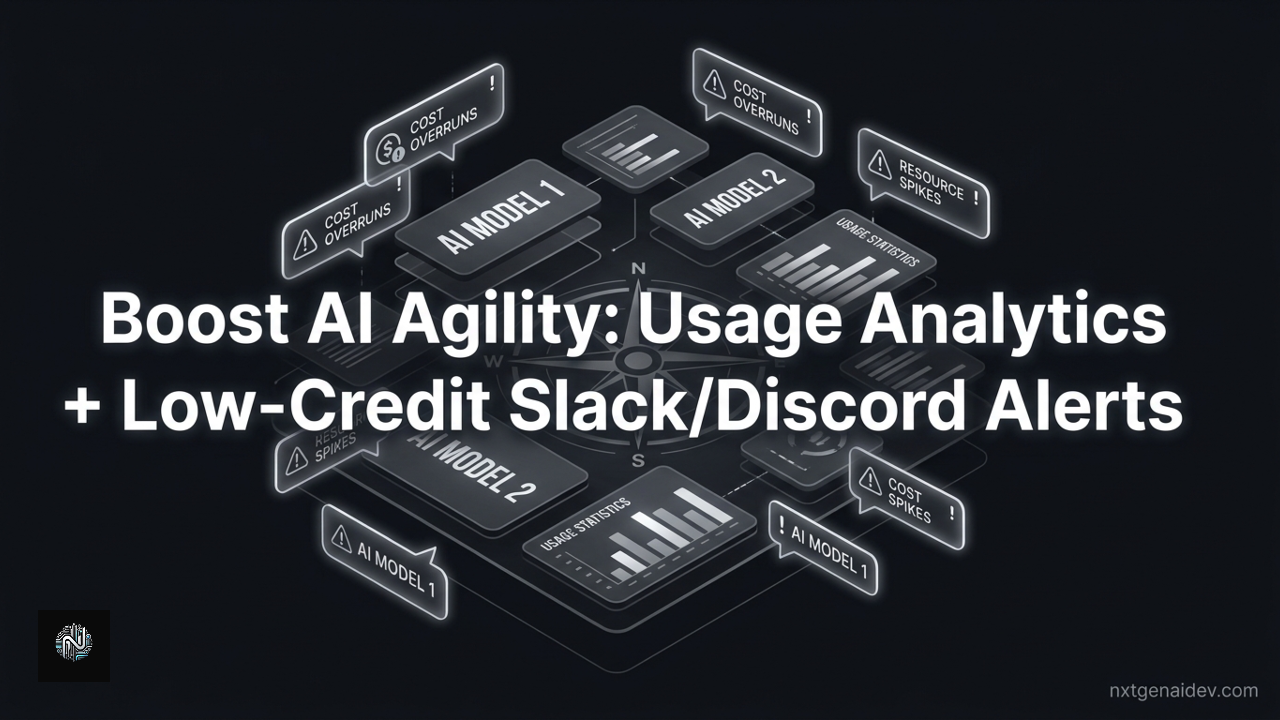
In the rapid currents of AI development, navigating fluctuating costs and usage across a myriad of models can feel like sailing without a compass. Agile engineering teams, constantly innovating and deploying, face the acute challenge of maintaining budget predictability and operational stability while leveraging the power of advanced AI. It's not just about using AI; it's about mastering its consumption without surprise expenses or sudden service interruptions.
NextGen AI DEV steps in as your essential navigation system, providing the immediate visibility and granular control necessary for high-velocity AI development. By integrating comprehensive usage analytics with real-time, configurable alerts, we empower teams to proactively manage their AI resources across a diverse ecosystem of 20+ AI models from 10+ providers, all unified through a single, powerful API. For agile teams, this proactive management isn't just a convenience—it's the cornerstone of sustained innovation and cost efficiency, ensuring that every AI call aligns with strategic goals and budgetary constraints.
Preventing Surprise AI Costs and Service Interruptions with NextGen AI DEV
Unforeseen spikes in AI usage or unnoticed credit depletion can derail projects, inflate budgets, and even halt critical services. NextGen AI DEV is engineered to eliminate these surprises, offering a robust framework for dynamic monitoring and precise financial control.
Dynamic Monitoring and Configurable Thresholds
NextGen AI DEV provides real-time monitoring of AI model consumption, offering a comprehensive view across all 20+ integrated models. This constant oversight ensures that every token, every API call, and every dollar spent is tracked and visible. Beyond mere tracking, NextGen AI DEV allows you to set highly customizable thresholds for usage, spend, or remaining credits. Imagine setting an alert for when a project's hourly spend exceeds a certain limit, or when the overall organization's credit balance dips below a critical level. These configurable thresholds act as an early warning system, preventing unexpected overages and enabling the swift detection of potential abuse or accidental spikes in consumption.
Crucially, these thresholds are designed to trigger immediate alerts, transforming potential service downtime into proactive adjustments. For CTOs, this means transforming reactive fire drills into strategic, informed decisions that prevent service interruptions before they impact users (How can CTOs use real-time AI usage alerts to prevent service interruptions?). Instead of discovering a depleted credit balance during peak hours, your team is notified well in advance, allowing for timely top-ups or resource reallocations.
Granular Visibility with Per-Org Credits
In larger organizations or those managing multiple AI projects, attributing AI costs accurately can be a complex labyrinth. NextGen AI DEV simplifies this significantly with its innovative per-org credit system. This system allows you to allocate specific AI budgets (in the form of credits) to different teams, departments, or individual projects within your organization. Each "org" operates with its own credit pool, fostering a clear sense of ownership and accountability.
This granular allocation dramatically improves financial visibility and accountability. Engineering managers and CTOs can precisely see how much AI budget each project or team is consuming, eliminating the ambiguity often associated with shared AI infrastructure (How do per-org credits improve visibility across multiple AI projects?). Teams can then track their specific credit consumption directly against their allocated budgets, providing a transparent view of their progress and helping them stay within financial guardrails, thereby reducing the dreaded "surprise AI costs" at the end of the billing cycle. It empowers teams to self-manage their AI expenditure, fostering greater fiscal responsibility and enabling more accurate project costing.
Tailoring Alerts for Timely Action: Slack/Discord Integration
Simply receiving an alert isn't enough; for an alert to be truly effective, it must be timely, relevant, and reach the right person through the right channel. NextGen AI DEV excels in this area, offering seamless integration with widely used communication platforms like Slack and Discord, ensuring that critical information is never missed and always actionable.
Event-Driven Triggers for Precise Notifications
NextGen AI DEV allows you to define exactly what specific AI usage events should trigger a Slack or Discord alert, ensuring that notifications are precise and meaningful rather than generic noise. This level of granularity is key to operational efficiency. For instance, you can configure alerts for:
Credit balance below X: A critical threshold warning that the overall organizational or a specific project's credit balance is running low.
Hourly spend exceeds Y: Notifying you if a project suddenly experiences a surge in AI API calls, potentially indicating an issue or an unexpected usage pattern.
Model usage spikes: Identifying unusual activity on a particular AI model (e.g., GPT-4-turbo, Claude 3 Opus) that might warrant investigation.
Daily or weekly usage approaching Z% of budget: Proactive alerts to help teams stay within their allocated per-org budgets.
Defining these triggers based on specific operational needs and billing thresholds ensures that your team is only alerted to situations that genuinely require attention (What should trigger a Slack or Discord alert for AI credit consumption?). This targeted approach prevents alert fatigue and ensures that every notification carries weight.
Intelligent Routing to the Right Channels
A critical low-credit alert should not go to a general company channel where it might be overlooked. NextGen AI DEV provides sophisticated routing capabilities, allowing you to direct different types of alerts to specific Slack channels, Discord servers, or even direct messages to key personnel. This intelligent routing is paramount for effective incident response and collaborative problem-solving.
Consider these concrete examples:
Critical low-credit alerts for the overall organization could be routed directly to the CTO and engineering leads in a dedicated
#ai-budget-criticalSlack channel.High usage warnings for a specific project might go to that project's development team in their
#project-x-devDiscord server, enabling them to investigate and adjust quickly.Billing threshold alerts could be sent to finance and procurement teams in a
#finance-alertschannel, allowing them to prepare for top-ups or budget reallocations.
This channel-specific workflow significantly enhances operational collaboration and speeds up response times (What is the best way to route AI usage notifications to the right team channel?). By ensuring the right people receive the right information at the right time, NextGen AI DEV transforms reactive problem-solving into proactive, coordinated action, maintaining the agility that defines modern development teams.
Mastering Alert Design: Preventing Fatigue and Ensuring Responsiveness
The goal of real-time alerts is to empower, not overwhelm. An influx of non-critical notifications can quickly lead to alert fatigue, causing genuinely important warnings to be ignored. NextGen AI DEV is designed with intelligent alert management features that allow engineering managers and CTOs to fine-tune their notification strategy, ensuring every alert is actionable and valuable.
Fine-Tuning Thresholds and Notification Frequency
NextGen AI DEV goes beyond static alert settings by allowing for dynamic thresholds. These can adapt to various factors such as project phases (e.g., higher thresholds during a critical launch, lower during maintenance) or historical usage patterns. For instance, you might set a higher spend threshold for a new generative AI feature in its initial rollout phase, then revert to a stricter limit once it stabilizes. This flexibility ensures that alerts remain relevant as your AI projects evolve.
Furthermore, you have granular control over notification frequency. Options range from immediate, real-time alerts for critical events, to hourly or daily summaries for less urgent trends, or even "only on significant change" to minimize noise. This ability to dial in the perfect frequency is crucial for preventing engineers from being overwhelmed with constant pings (How can alert thresholds be set without overwhelming engineers with noise?). By intelligently managing how often and under what circumstances alerts are sent, NextGen AI DEV ensures that when a notification does arrive, it commands attention.
Contextual Alerts for Actionable Insights
An alert that simply states "credits low" isn't particularly helpful. To enable quick and decisive action, alerts must be rich with context. NextGen AI DEV ensures that every notification sent through Slack or Discord includes all the essential information needed to understand the situation at a glance.
This rich context typically includes:
Which model is affected: Identifying if it's GPT-4-turbo, Claude 3 Haiku, or another specific model.
Which project or organization: Pinpointing the exact source of the usage or credit depletion.
Current credit balance: Providing the precise remaining balance.
Usage metrics: Detailing the specific usage leading to the alert (e.g., "hourly spend is $150, exceeding threshold of $100").
Link to dashboard: A direct link to the relevant section of the NextGen AI DEV dashboard for deeper investigation.
This comprehensive, contextual information empowers engineers to quickly understand the alert's implication, diagnose the potential cause, and take informed, decisive action without needing to hunt for additional data. Whether it's to investigate a code change, contact a team member, or simply approve a credit top-up, the necessary insights are immediately at their fingertips.
Comprehensive AI Governance and Financial Oversight
For engineering leaders and CTOs, the ability to maintain robust governance and financial oversight across a sprawling AI ecosystem is non-negotiable. NextGen AI DEV delivers this through a unified dashboard and sophisticated access controls, providing unparalleled transparency and accountability.
Unified Dashboard for Cross-Project Visibility
Imagine managing AI usage across multiple teams, diverse projects, and a growing array of models from 10+ different providers—all through disparate interfaces. It's a recipe for chaos and overlooked costs. NextGen AI DEV solves this with its centralized dashboard, offering a true single pane of glass for all AI usage. This intuitive interface consolidates data from 20+ models and a multitude of providers into a cohesive, easily digestible format.
This unified view enables CTOs and engineering managers to effortlessly monitor overall AI spend, track consumption trends over time, and ensure strict adherence to allocated budgets. From a high-level organizational overview to drilling down into specific project or model usage, the dashboard provides the insights needed for strategic decision-making, resource optimization, and effective cost management. It helps identify usage patterns, forecast future expenditures, and pinpoint areas for efficiency improvements, transforming complex data into clear, actionable intelligence.
Multi-Org RBAC and Audit Logs for Accountability
In large-scale AI operations, controlling who can access what data and configure which settings is paramount for security and compliance. NextGen AI DEV's multi-org Role-Based Access Control (RBAC) system provides this essential layer of security, allowing administrators to secure and scope access to usage data, alert configurations, and credit allocations based on specific roles and organizational structures. This ensures that only authorized personnel can view sensitive information or make critical changes, preventing unauthorized access and maintaining data integrity.
Beyond access control, NextGen AI DEV provides comprehensive audit logs. These logs meticulously track every significant action and change within the platform—who did what, when, and where. This feature is crucial for ensuring compliance with internal policies and external regulations, as it provides an immutable record of all operational activity. Unlike competitors who might offer rudimentary logging, NextGen AI DEV's audit logs are designed for enterprise-grade accountability, making it straightforward to investigate incidents, support governance frameworks, and demonstrate responsible AI management during audits. This level of transparency fosters trust and reinforces a culture of accountability across the entire organization.
Get Started with NextGen AI DEV for Proactive AI Management
The landscape of AI development is dynamic, demanding tools that can keep pace with rapid innovation while providing steadfast control. NextGen AI DEV's integrated usage analytics and real-time Slack/Discord alerts are purpose-built to meet this demand, offering an indispensable solution for modern engineering teams.
By delivering unparalleled visibility into AI consumption, enabling precise budget allocation with per-org credits, and facilitating instant, contextualized communication through your preferred channels, NextGen AI DEV empowers your agile teams to proactively manage AI resources effectively. It means optimizing budgets without compromising innovation, maintaining operational continuity regardless of usage spikes, and ensuring every AI-powered project runs smoothly and predictably. NextGen AI DEV seamlessly integrates into your existing workflows, offering straightforward setup and immediate value, allowing your organization to gain complete control over its AI infrastructure from day one.
Empower your agile teams with unparalleled visibility and control over AI resource consumption. Explore NextGen AI DEV's usage analytics and real-time Slack/Discord alerts today.