Unlocking the Potential of AI Agents in Business Operations
Discover how AI Agents can transform your business operations for better efficiency and smarter decision-making. Start enhancing your workflow today!
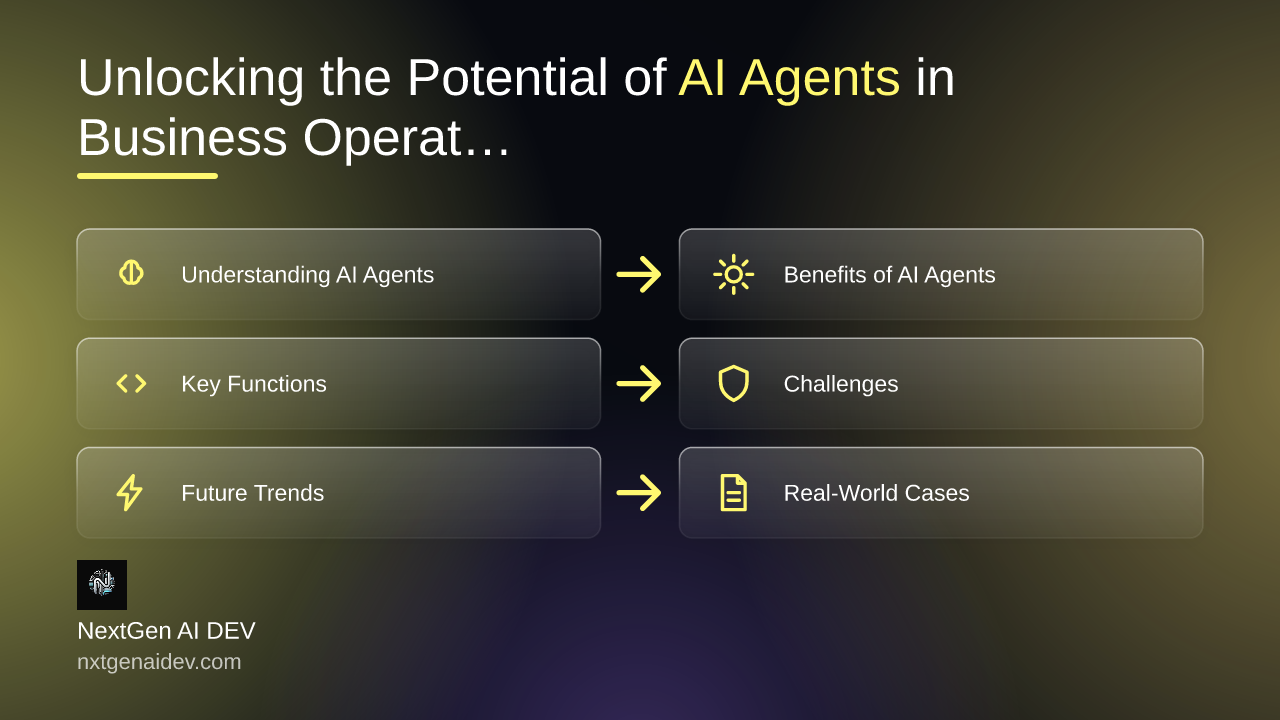
Unlocking the Potential of AI Agents in Business Operations
Understanding AI Agents in Business Operations
What are AI Agents?
AI agents are sophisticated software programs designed to autonomously perform tasks by learning from data, understanding their environment, and making decisions. In the realm of business, these agents play pivotal roles in automating processes, analyzing vast datasets, and enhancing customer interactions. Unlike traditional software, AI agents utilize machine learning and advanced algorithms to not just execute commands but also adapt and improve over time.
How Do AI Agents Work?
The technology behind AI agents is grounded in a combination of natural language processing (NLP), machine learning (ML), and robotics. AI agents gather data from various sources, process that information, and often work in real-time to provide insights or execute tasks. For instance, in an e-commerce setting, AI agents can monitor inventory levels, optimize pricing strategies based on competitor analysis, and even personalize marketing efforts—all without human intervention.
Real-world applications include customer service bots that can handle inquiries 24/7, AI systems that monitor network security, and even agents used for predictive maintenance in manufacturing. (source)
Benefits of Implementing AI Agents
Operational Efficiency
The introduction of AI agents into business operations can significantly streamline various processes. They possess the capability to automate repetitive tasks, allowing human employees to focus on strategic, value-added work. For example, AI agents can automatically schedule meetings, manage email responses, and handle simple inquiries, thus freeing up employees' time.
Cost Reductions
Cost savings is another compelling benefit derived from leveraging AI agents. By automating routine tasks, businesses can reduce labor costs while increasing overall productivity. A report by McKinsey indicates that automation can lead to cost reductions of up to 30% in some industries. Additionally, AI agents minimize errors associated with human handling, thereby avoiding costly corrections and improving efficiency in financial transactions.
Enhanced Customer Interaction
AI agents bring a new level of engagement to customer service. Companies that implement AI-driven chatbots have reported a 30% increase in customer satisfaction due to quicker response times and 24/7 availability. For instance, major airlines have deployed AI agents to assist passengers in real-time, providing updates about flight statuses, baggage claims, and answering frequently asked questions.
Key Functions and Capabilities of AI Agents
Task Management
AI agents excel at managing complex tasks autonomously, efficiently processing large volumes of data far beyond human capabilities. For example, AI can handle transaction monitoring in finance, flagging potentially fraudulent activities in real-time.
Data Analysis
The ability of AI agents to analyze business data is transformative. They can sift through troves of information, identifying trends and insights that are crucial for strategic decision-making. Implementing AI-driven analytics allows businesses to derive actionable insights, helping them to optimize inventory, fine-tune marketing strategies, and improve sales forecasting.
Predictive Analytics
Predictive analytics powered by AI provides organizations with foresight into future trends. For instance, in retail, AI agents can predict customer buying behaviors based on past transactions, helping companies better stock their shelves and tailor their promotional efforts. Systems that incorporate predictive analytics have been shown to increase sales by over 15% by aligning offerings with customer demand.
Comparing AI Agents with Chatbots and RPA
What Sets AI Agents Apart?
While AI agents, chatbots, and Robotic Process Automation (RPA) all aim to streamline business operations, they serve different purposes. Chatbots primarily focus on managing basic customer interactions, while RPA handles structured, repetitive tasks across different applications. In contrast, AI agents leverage broader datasets and machine learning capabilities to adapt over time and manage complex scenarios autonomously.
When to Use Each Solution
Choosing the right technology depends on the business need. For simple FAQs and customer inquiries, chatbots might suffice. RPA is ideal for automating repetitive financial processes. However, if you're looking to enhance operations through continuous learning, predictive modeling, and complex task management, AI agents are the ideal solution.
Challenges and Considerations for Deployment
Implementation Challenges
While the benefits can be substantial, deploying AI agents comes with its own set of challenges. Many organizations face technical hurdles related to integration with existing systems and insufficient data quality. Additionally, resistance to change among employees can delay or undermine implementation efforts.
Security and Privacy Concerns
Another critical aspect is the security and privacy of data. As AI agents gather and process sensitive information, they become prime targets for cyber threats. Businesses must prioritize establishing rigorous security protocols and ensuring compliance with data protection regulations to safeguard customer information.
Future Trends in AI Agents for Business Operations
Multi-Agent Coordination
One promising future trend is the development of multi-agent systems. These systems can collaborate to optimize workflows across departments, sharing insights and tasks to improve overall operational efficiency. For instance, in manufacturing, different AI agents could work together to adjust production schedules, manage supply chains, and enhance quality controls dynamically.
Industry-Specific Applications
Looking ahead, various industries stand to benefit significantly from AI agents. In finance, AI can be used for fraud detection and risk assessment; in healthcare, agents can help in patient management and diagnosis; while in customer service, they can personalize interactions based on previous engagements.
Real-World Case Studies of AI Agents in Action
Success Stories
Several companies have successfully implemented AI agents to drive operational excellence. For example, a major retail chain reported a 25% increase in sales after deploying an AI-driven inventory management system that anticipates stock shortages before they occur.
Lessons Learned
However, it’s essential to analyze these implementations critically. Companies that didn’t invest in proper training for their employees reported lower satisfaction and resistance to AI technologies, ultimately impacting the success of AI agent deployments.
What specific applications of AI agents have you encountered in your industry, and how have they impacted your operations?
💬 Join the conversation — share your take in the comments and tell us what you’d add.