Unlocking Efficiency: The Role of AI Coding Assistants in Software Development
Discover how AI Coding Assistants enhance productivity and creativity in software development. Explore their role and get started today!
Unlocking Efficiency: The Role of AI Coding Assistants in Software Development
Software development is evolving at a rapid pace, and the introduction of AI coding assistants is a game changer. These tools empower developers to streamline their workflows and enhance productivity, allowing them to focus on what truly matters—creating high-quality software.
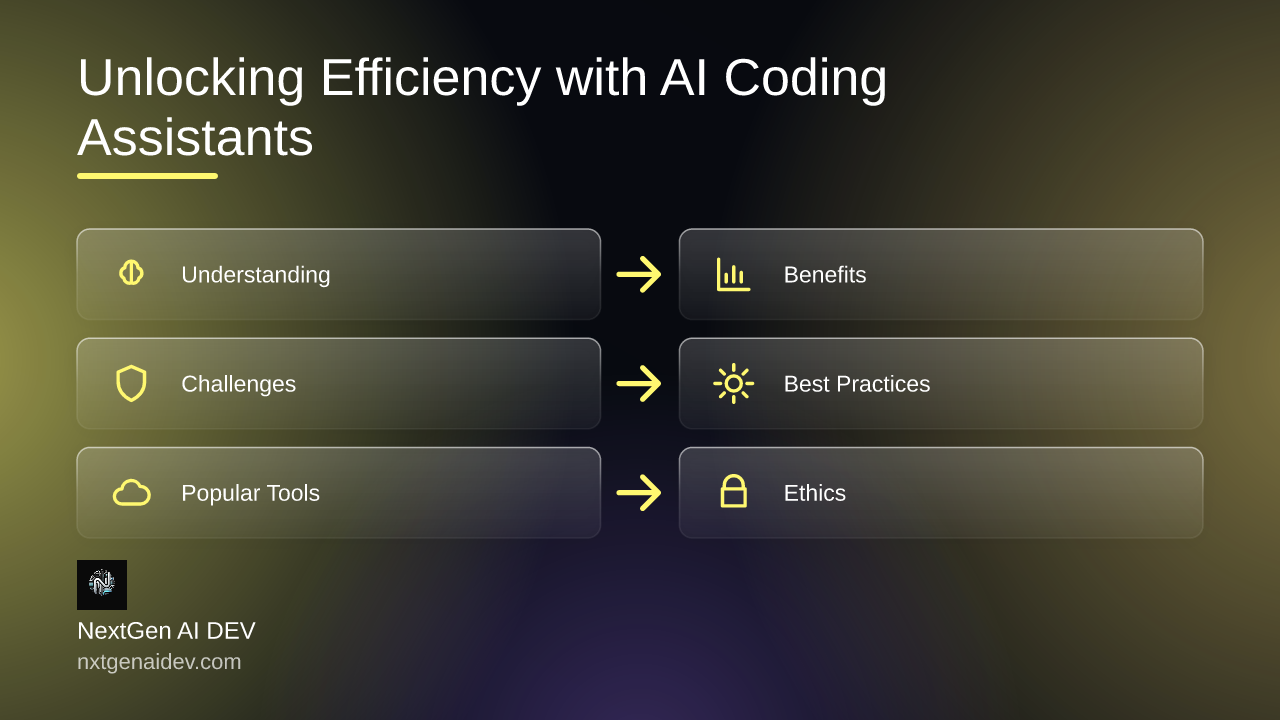
Understanding AI Coding Assistants
Definition and Key Features
AI coding assistants are innovative tools that leverage machine learning, particularly large language models (LLMs), to aid developers in writing code more efficiently. These sophisticated applications can generate code snippets, translate code between languages, and provide real-time suggestions for enhancements or corrections. Key features include:
Code Generation: Automatically producing code based on natural language prompts.
Code Translation: Converting code from one language to another seamlessly.
Real-time Suggestions: Offering instant recommendations to improve code quality or fixing bugs on the fly.
How AI Coding Assistants Work
At their core, AI coding assistants utilize natural language processing (NLP) capabilities to understand and respond to developer queries. By analyzing vast datasets of code and documentation, these tools can generate relevant code options and provide contextual suggestions. For instance, when a developer inputs a specific request like "create a function to calculate Fibonacci numbers," the assistant can offer a well-structured code snippet almost instantly.
Benefits of AI Coding Assistants in Development
Enhanced Developer Productivity
AI coding assistants significantly reduce the time developers spend on repetitive coding tasks. This allows them to reallocate their valuable time to more complex aspects of software development. According to studies, tools like GitHub Copilot have shown to reduce coding time by up to 30%, leading to a more efficient development cycle.
Speed and Accuracy
The accuracy of code generated by AI assistants is impressive. Studies indicate that AI-generated code maintains an accuracy rate of approximately 85%, minimizing errors that can lead to defects in the final product. A case study involving a large tech firm found that using an AI coding assistant resulted in a 20% reduction in bugs detected during testing phases.
Support for Learning and Development
AI coding assistants also play a crucial role in educational environments. They assist new developers in understanding best coding practices while offering suggestions that can enhance their learning process. This results not only in faster onboarding but also encourages existing developers to upskill as they interact with these advanced tools.
Challenges and Risks Associated with AI Coding Assistants
Cognitive Offloading
One concern surrounding the use of AI coding assistants is cognitive offloading, where developers may become overly reliant on these tools for problem-solving. This can inhibit critical thinking and diminish their ability to tackle complex coding issues independently.
Skill Degradation
Frequent use of AI tools may lead to skill degradation among developers. Over time, they may lose confidence in their coding abilities, as they become accustomed to relying on AI for solutions rather than applying their own knowledge and skills.
Security Risks
Additionally, incorporating AI-generated code into shared codebases raises security vulnerabilities. If the AI tool inadvertently generates flawed or insecure code, integrating this into production environments can expose organizations to significant risks.
Comparative Analysis: AI Coding Assistants vs. AI Coding Agents
Key Differences
While both AI coding assistants and coding agents serve to enhance the coding experience, they offer different functionalities. Coding assistants primarily provide support and suggestions, while coding agents often operate more autonomously, executing tasks based on defined criteria or workflows.
Use Cases for Each Tool
AI coding assistants are best used for tasks that require collaboration and iterative development, such as brainstorming and problem-solving suggestions. In contrast, coding agents can be leveraged for automated testing or deployment processes where minimal human intervention is expected.
Best Practices for Using AI Coding Assistants
Integrating AI Tools in Workflows
To effectively integrate AI coding assistants into existing workflows, teams should identify opportunities where these tools can add the most value. Training sessions can help teams adapt to the new technology, ensuring a smooth transition.
Maintaining Human Oversight
It's essential to maintain human oversight over AI-generated code. This ensures that potential pitfalls are caught before they can impact the project. By complementing AI suggestions with personal expertise, developers can enhance overall code quality.
Balancing Between AI and Manual Coding
Developers should strike a balance between using AI tools and traditional manual coding. While AI can speed up certain tasks, manual coding allows for deeper understanding and control over the code, which is crucial during critical phases of software development.
Popular AI Coding Assistants in the Market
Overview of Leading Tools
ChatGPT: Known for its conversational interactions, ChatGPT can assist in generating code snippets and debugging, making it a versatile tool.
GitHub Copilot: This tool is integrated into popular IDEs and offers suggestions as developers write code, learning from its extensive dataset to provide specific recommendations.
Emerging Players
Several emerging AI coding assistants are beginning to make their mark. Tools like Tabnine leverage community-generated code to enhance suggestions, while others focus on niche functionalities, catering to specific languages or frameworks, making the market increasingly diverse.
Ethical Considerations in AI-Driven Development
Legal Issues Around AI-Generated Code
As AI-generated code becomes ubiquitous, questions arise about ownership and responsibility. Who is accountable for bugs or vulnerabilities in AI-generated code remains a gray area that developers and companies must navigate.
Ethical Implications of Automation
The increasing automation brought on by AI tools raises ethical concerns, particularly regarding job displacement. As firms adopt these technologies to enhance efficiency and cut costs, developers must find ways to adapt to an evolving landscape.
AI coding assistants are not just tools; they're revolutionizing how software is developed, enabling developers to work smarter, not harder. As you dive deeper into AI technologies, consider how they can fit into your own coding practice.
What challenges or successes have you experienced with AI coding assistants in your development work? Share your story!
💬 Join the conversation — share your take in the comments and tell us what you’d add.