Understanding the Impact of Agentic AI on Business Operations
Discover how Agentic AI can streamline your business operations, enhancing efficiency and driving growth. Learn more today!
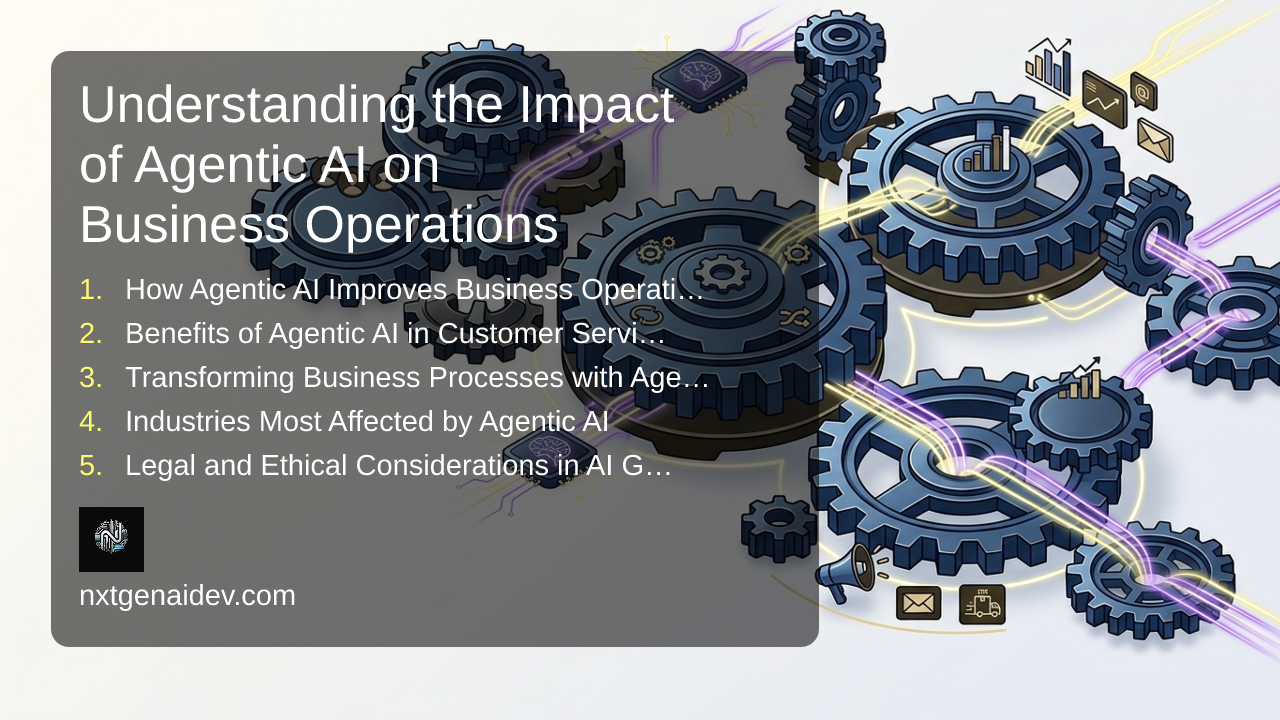
Understanding the Impact of Agentic AI on Business Operations
Imagine a world where your business operations are seamlessly orchestrated, decisions are made with pinpoint accuracy, and customer service feels tailor-made for each individual. This isn't a far-off dream—it's the reality brought by Agentic AI. This transformative technology is revolutionizing how organizations operate, streamlining processes, and redefining customer engagement.
How Agentic AI Improves Business Operations
Efficiency through Autonomous Workflow Orchestration
Agentic AI refers to systems that autonomously handle tasks and workflows, enabling organizations to focus on their core competencies. In a business context, it means delegating repetitive and mundane tasks to AI, resulting in improved efficiency and productivity.
For example, a major telecommunications company implemented an Agentic AI system to manage their workflow, reducing the time spent on administrative tasks by 40%. This shift not only enhanced operational speed but also allowed employees to shift their focus towards customer interactions and strategic initiatives. Case studies like this highlight the tangible improvements that can be achieved through AI-driven automation.
Enhancing Decision-Making with Predictive Intelligence Insights
The era of data-driven decisions has been advanced significantly by predictive intelligence insights afforded by Agentic AI. By analyzing vast amounts of data, these systems can forecast trends, customer behavior, and operational bottlenecks.
A retail giant deployed Agentic AI to analyze customer purchasing patterns, which led to a 25% increase in sales through targeted marketing campaigns. By integrating predictive analytics into their decision-making processes, companies can make informed choices that translate into real revenue growth.
Benefits of Agentic AI in Customer Service
AI-Powered Chatbots and Virtual Assistants
Enhancing customer service is one of the most visible impacts of Agentic AI technologies. AI-powered chatbots and virtual assistants now provide instant, 24/7 support, leading to improved customer satisfaction ratings. According to studies, businesses that adopted AI in their customer interactions saw a 30% increase in customer satisfaction.
An insurance company implemented a virtual assistant for claims processing. The result? Customers reported faster response times and improved clarity throughout the claims journey, driving higher retention rates.
Hyper-Personalization at Scale
Agentic AI allows businesses to deliver hyper-personalized experiences at scale, analyzing customer data to create tailored interactions. This level of personalization is pivotal in enhancing customer loyalty and boosting sales.
For instance, an e-commerce platform used Agentic AI to customize product recommendations for every user, leading to a remarkable 40% increase in conversion rates. By automating the personalization process, organizations can cater to consumer preferences dynamically and efficiently.
Transforming Business Processes with Agentic AI
Automation in Finance and Healthcare
Agentic AI is making waves in heavily regulated industries such as finance and healthcare. In finance, AI can automate tasks ranging from compliance checks to fraud detection, significantly reducing operational risks and enhancing accuracy.
A healthcare provider recently integrated an Agentic AI system aimed at patient scheduling and resource management. This not only streamlined operations but also improved patient satisfaction scores. By leveraging AI to automate these essential processes, organizations can serve their clients more effectively while minimizing administrative overhead.
Streamlining Supply Chains
Supply chain management benefits tremendously from Agentic AI, which helps organizations forecast demand, optimize inventory levels, and enhance logistics operations.
A global manufacturing company utilized Agentic AI for real-time analytics across its supply chain. This implementation reduced lead times by 15% and improved inventory turnover rates. The ability to adapt swiftly to market changes empowers organizations to stay ahead of the competition.
Industries Most Affected by Agentic AI
Finance and Banking Innovations
The finance sector is experiencing rapid growth in AI adoption, with many organizations leveraging Agentic AI for increased efficiency and innovation. Current trends suggest that the integration of advanced technologies is reshaping risk assessments and investment strategies.
For instance, a leading bank adopted an Agentic AI platform for personalized financial advice, resulting in enhanced customer engagement and satisfaction.
Healthcare Efficiency Improvements
Similarly, the healthcare industry stands on the brink of transformation as Agentic AI continues to carve its niche. Organizations are using this technology to streamline administrative tasks, improve diagnostics, and offer personalized treatment plans.
Case studies reveal that hospitals using Agentic AI for patient data processing achieved a 20% reduction in administrative errors, directly contributing to better patient outcomes.
Legal and Ethical Considerations in AI Governance
Importance of AI Governance and Security
As organizations turn to Agentic AI, the importance of robust governance frameworks becomes paramount. Implementing secure AI systems is critical for maintaining customer trust and regulatory compliance.
A multinational corporation faced backlash after failing to secure its AI algorithms, resulting in significant data breaches. This incident underscores the necessity of prioritizing cybersecurity and responsible AI use as organizations harness this powerful tool.
Cultural and Ethical Implications of AI Deployments
AI also raises important cultural and ethical considerations. Diverse stakeholders—including consumers, employees, and regulatory bodies—have varying perspectives on what ethical AI looks like.
A prominent example involved a tech company that deployed biased algorithms, leading to public outcry. They subsequently revamped their governance framework to incorporate broader stakeholder feedback, illustrating the need for ongoing ethical discussions.
Comparing Agentic AI with Traditional AI Models
Key Differences in Functionality
Agentic AI differentiates itself from traditional AI models through its capability to operate autonomously, learning from real-time data and adapting accordingly. While traditional AI typically requires human intervention, Agentic AI reduces this dependency and optimizes decision-making processes.
Scalability and Future-Proofing Business Models
The scalability of Agentic AI provides a substantial advantage over traditional models. As companies adopt this technology, they can future-proof their operations, ensuring their growth paths remain sustainable in a rapidly changing business landscape.
The return on investment from deploying Agentic AI is often more favorable due to its efficiency and ability to reduce costs over time. Companies that have embraced this transformation have seen up to a 200% ROI within just a couple of years.
As businesses increasingly adopt Agentic AI, the question arises: What specific experiences have you had with AI in your business operations, and how do you see Agentic AI shaping the future?
💬 Join the conversation — share your take in the comments and tell us what you’d add.