
Translating AI Research to Production: Your Engineering Playbook
AI Research made practical: turn breakthroughs into shipped products with a clear engineering playbook. Read now and build smarter.
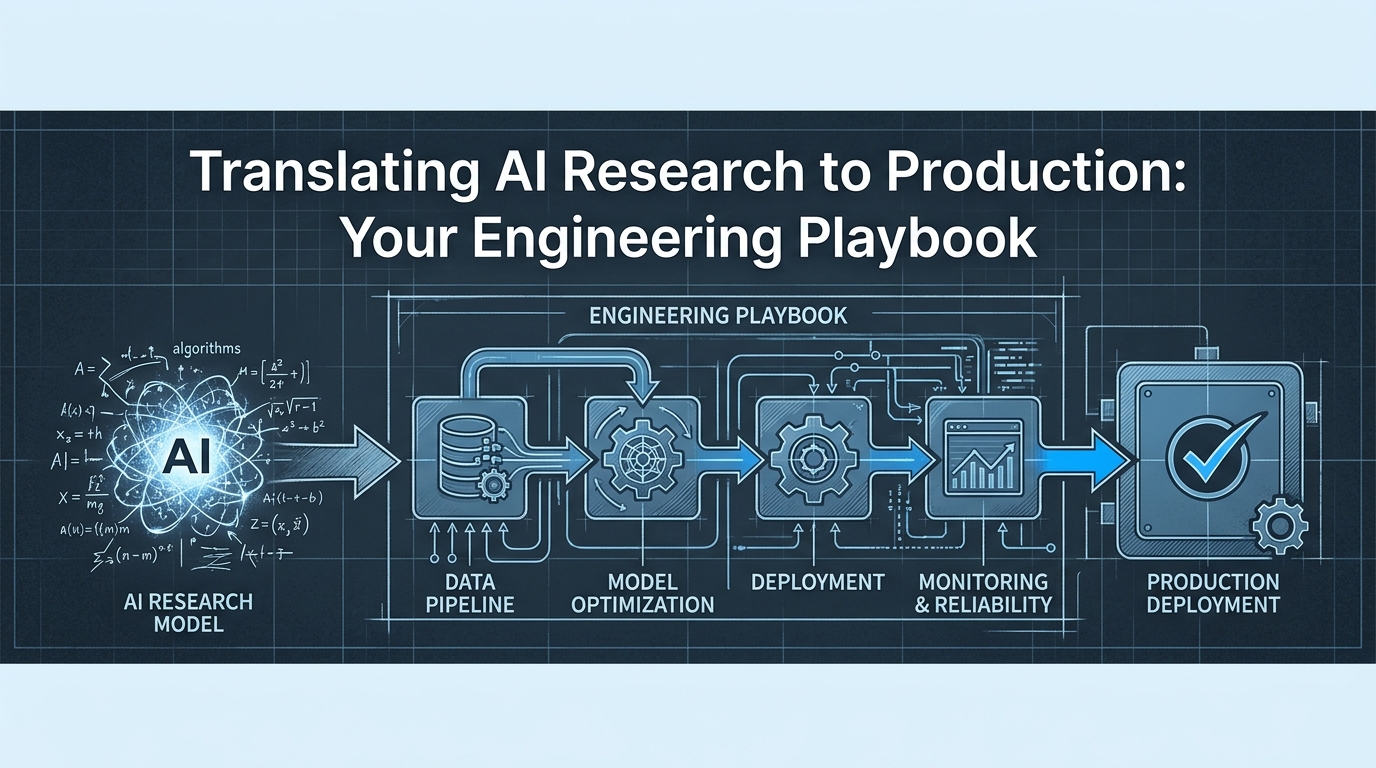
The spark of a groundbreaking AI idea often ignites in the research lab, fueled by novel algorithms and impressive theoretical performance. Yet, the journey from a promising research prototype to a robust, scalable, and reliable production system is fraught with challenges. It's a chasm that swallows countless innovative concepts, leaving them as compelling papers rather than transformative products. Translating AI research to production demands a dedicated engineering playbook that bridges this divide, transforming scientific breakthroughs into real-world impact.
This isn't merely about writing more code; it's about shifting mindsets, adopting specialized workflows, and fostering deep collaboration between scientists and engineers. This playbook will guide you through the critical phases, engineering considerations, and organizational strategies required to successfully deliver research-driven AI products to your users.
Bridging the Chasm: Why AI Research Often Stalls Before Production
The fundamental divergence between academic research and production systems is the root cause of many stalled AI projects. Research prioritizes novelty, theoretical bounds, and pushing the frontiers of what's possible. Success often means publishing a paper demonstrating a new state-of-the-art result on a benchmark dataset. Production systems, however, demand unwavering reliability, predictable efficiency, operational scalability, and cost-effectiveness under real-world constraints.
Common failure modes illuminate this gap:
"Model in a Notebook" Syndrome: A research scientist develops an incredibly accurate model within a Jupyter notebook, complete with custom data loading scripts and ad-hoc preprocessing. This isn't production-grade code; it lacks error handling, logging, testing, dependency management, and API readiness. It performs beautifully on clean test sets but crumbles under diverse, real-world inputs.
Unmet Latency/Throughput Requirements: A research model might take seconds or even minutes for inference, which is acceptable for offline analysis. But for a real-time recommendation engine or a conversational AI, sub-100ms latency might be non-negotiable, requiring significant re-engineering and optimization.
Unaddressed Edge Cases and Robustness: Research often focuses on average performance. Production systems must handle outliers, corrupted data, adversarial attacks, and unexpected inputs gracefully. A model that's 99% accurate on clean data but fails catastrophically on the 1% of edge cases can be a critical product flaw.
Lack of Production-Grade Infrastructure: The compute resources used for research (e.g., a single powerful GPU) are rarely sufficient or cost-effective for serving millions of inferences per day. Building scalable inference services, data pipelines, and monitoring systems is a non-trivial engineering task often overlooked in the research phase.
To turn AI research into a production product, organizations need to cultivate a "translational AI" role or mindset. This involves individuals or teams specifically tasked with understanding both research innovation and engineering rigor, acting as the crucial nexus between the two worlds. They translate research insights into engineering requirements and production constraints back into research considerations, ensuring alignment from the outset.
The Translational AI Workflow: From Experiment to Enterprise System
Successfully moving research to production requires a structured, phased approach that acknowledges the iterative nature of AI development. It's not a single handoff but a continuous collaboration.
Here's an outline of a typical workflow for taking a machine learning model from research to production:
Ideation & Feasibility:
Goal: Define the problem, explore potential AI solutions, and assess technical and business feasibility.
Research Focus: Literature review, preliminary data exploration, basic proof-of-concept.
Engineering Focus: High-level architectural discussion, data availability assessment, initial performance targets (latency, throughput).
Artifacts: Problem definition document, high-level feasibility report.
Research Prototyping:
Goal: Develop a functional prototype demonstrating the core AI capability and its potential performance.
Research Focus: Model selection, training, initial evaluation on benchmark datasets. Focus on maximizing theoretical performance.
Engineering Focus: Early collaboration on data pipeline requirements, understanding model complexity, discussing potential deployment strategies.
Artifacts: Research report (detailing methodology, results, limitations), prototype code (often in notebooks), trained model artifacts.
Production-Readiness Evaluation:
Goal: Rigorously test the prototype against production criteria beyond just accuracy, determining its readiness for operationalization.
Research Focus: Explainability analysis, robustness testing, identifying failure modes.
Engineering Focus: Deep dive into production metrics (latency, cost, memory), building evaluation harnesses, optimizing the model for inference.
Artifacts: Comprehensive evaluation report (performance, cost, robustness), optimized model candidates, clear production requirements.
Operationalization:
Goal: Integrate the optimized model into existing infrastructure, build robust MLOps pipelines, and deploy it to users.
Research Focus: Providing expertise on model behavior, helping debug real-world performance issues.
Engineering Focus: Building inference services, setting up monitoring, creating CI/CD pipelines, establishing incident response.
Artifacts: Production inference service, monitoring dashboards, MLOps pipeline definitions.
Continuous Improvement:
Goal: Monitor live performance, detect drift, retrain models, and iterate based on user feedback and new data.
Research Focus: Analyzing performance degradation, identifying new research directions, experimenting with model updates.
Engineering Focus: Maintaining infrastructure, automating retraining, managing model versions, A/B testing new versions.
Artifacts: Retrained models, A/B test results, performance reports, updated documentation.
Crucially, this is an iterative process. Feedback loops are essential, with production insights informing new research directions and evaluation data feeding back into model improvements.
Phase 1: Rigorous Evaluation & Production-Readiness Gating
Before any novel AI model sees the light of day in a production environment, it must pass a stringent evaluation phase that goes far beyond the typical accuracy metrics seen in research papers. This is the critical gateway to production.
Beyond Accuracy: Defining Production Metrics
While research often celebrates high F1-scores, AUC, or BLEU scores, production success hinges on a broader, more practical set of metrics. These include:
Latency: How quickly does the model return an inference? (e.g., median inference time, 95th percentile latency).
Throughput: How many inferences can the model serve per second? (e.g., requests per second under load).
Cost-per-Inference: What are the computational (CPU/GPU) and memory costs associated with each prediction?
Robustness: How well does the model perform when faced with noisy, incomplete, or slightly adversarial data? Does it maintain performance across diverse real-world distributions?
Fairness: Does the model exhibit bias across different demographic groups or sensitive attributes? Are decisions equitable?
Memory Footprint: How much RAM or VRAM does the model consume during inference? This is crucial for edge devices or cost-sensitive deployments.
Stability: Does the model's performance degrade over time with live data? Is it susceptible to concept drift or data drift?
For instance, a research team might achieve 95% accuracy on an image classification task. In production, however, if that model takes 500ms to process an image for a real-time recommendation system, it's likely unusable. The engineering team might require sub-100ms latency at 90% accuracy, accepting a slight dip in accuracy for a significant boost in user experience.
Building Robust Evaluation Harnesses
To effectively evaluate an emerging AI model before deploying it, you need to create comprehensive evaluation harnesses that simulate real-world conditions. This involves:
Diverse Data Distributions: Don't just test on a single hold-out set. Use data that reflects the full spectrum of inputs the model will encounter in production, including historical data, edge cases, rare events, and known failure modes.
Offline-to-Online Parity: Ensure that your offline evaluation pipelines closely mirror your online data processing. This means using the exact same feature engineering, preprocessing steps, and data transformations. Discrepancies here are a common source of "works on my machine" issues.
# Example: Ensuring data pipeline consistency
def preprocess_data_research(raw_input):
    # Research-specific preprocessing (might be ad-hoc)
    pass

def preprocess_data_production(raw_input):
    # Production-grade preprocessing (standardized, tested)
    pass

# Ensure preprocess_data_research is refactored into preprocess_data_production
# for production evaluation and deployment.
Stress Testing and Load Simulation: Evaluate model performance under various load conditions to understand its limits regarding throughput and latency.
Bias and Fairness Testing: Implement specific tests to identify and quantify potential biases against protected groups or attributes. Use metrics like statistical parity difference, equalized odds, or demographic parity.
Robustness Testing: Introduce noise, missing values, or even adversarial examples to see how the model behaves. Tools like adversarial attack libraries can be invaluable.
Automated Reporting: Build systems that automatically generate detailed reports on all defined production metrics, visualizing trade-offs and highlighting areas for improvement.
Specific thresholds for "production-ready" might look like:
Median inference latency:
< 50ms99th percentile inference latency:
< 150msThroughput:
> 1000 requests/secondper inference nodeCPU/GPU utilization:
< 80%under target loadAccuracy:
> 90%on representative live data distributionBias metric (e.g., statistical parity difference):
< 0.05across identified sensitive groups
This rigorous gating process ensures that only models truly capable of withstanding the rigors of a live environment move forward.
Phase 2: Engineering for Inference Efficiency & Cost Control
Once a model demonstrates production readiness in terms of its core capabilities, the next phase focuses on optimizing it for efficient and cost-effective inference. This is where MLOps practices that optimize resource utilization and performance for research-driven AI products become paramount.
Model Optimization Techniques
Meeting strict latency and throughput budgets often requires transforming the research model into an inference-optimized version.
Quantization: This technique reduces the precision of model weights and activations, typically from 32-bit floating point (FP32) to 16-bit floating point (FP16) or even 8-bit integers (INT8). This significantly shrinks model size and speeds up computation, often with minimal impact on accuracy.
Example: TensorFlow Lite or PyTorch's
torch.quantizationmodule allows post-training or quantization-aware training.
Model Pruning: Removes redundant connections or neurons from a neural network. This can reduce model size and computational load without significant accuracy loss, especially in overparameterized models.
Knowledge Distillation: A smaller, "student" model is trained to mimic the behavior of a larger, more complex "teacher" model. The student model is faster and more resource-efficient, inheriting the teacher's knowledge.
Neural Architecture Search (NAS): Automates the design of neural network architectures, often discovering smaller, more efficient models that perform comparably to hand-designed ones.
Graph Optimization/Compilation: Frameworks like ONNX Runtime, TensorRT, or OpenVINO optimize computation graphs for specific hardware, applying fusions, kernel optimizations, and memory layout adjustments.
When optimizing, it's crucial to understand the trade-offs. A highly optimized INT8 quantized model might be incredibly fast but could experience a slight drop in accuracy or struggle with specific edge cases. Balancing model complexity, accuracy, and inference cost (compute, memory) is an art that requires close collaboration between research and engineering.
Hardware and Infrastructure Considerations
The choice of hardware and infrastructure profoundly impacts inference efficiency and cost.
Specialized Hardware:
GPUs: Excellent for highly parallelizable deep learning models, providing high throughput.
TPUs (Tensor Processing Units): Google's custom ASICs optimized specifically for neural network workloads, offering high performance for certain model types.
Custom ASICs (e.g., AWS Inferentia, NVIDIA Jetson for edge): Tailored solutions for specific inference tasks, often offering the best performance-per-watt or cost-per-inference.
Deployment Modalities:
Serverless Inference (e.g., AWS Lambda, Google Cloud Run): Good for sporadic, low-volume requests; scales automatically but can have cold start latencies.
Dedicated Inference Services (e.g., Kubernetes deployments, SageMaker Endpoints): Provides consistent latency and throughput for high-volume, real-time applications, offering fine-grained control.
Edge Deployment: Running models directly on devices (mobile, IoT) reduces latency, enhances privacy, and allows offline functionality. Requires extremely efficient models.
Batch vs. Real-time: Differentiate between models that can process large datasets asynchronously (batch) and those requiring immediate responses (real-time). Batch processing allows for higher utilization and potentially lower cost per inference.
The MLOps practices that matter most for research-driven AI products revolve around model versioning, reproducible environments, automated testing of performance benchmarks, and flexible deployment strategies. You need to be able to quickly iterate on model optimizations, test their impact, and deploy them safely.
Phase 3: Operationalizing & Monitoring Novel AI Systems
Once optimized, the next step is to safely integrate and deploy these novel AI systems into production, followed by robust monitoring to ensure their continued health and performance.
Deployment Strategies for Experimental Models
Deploying experimental or novel models requires caution to mitigate risks.
Canary Releases: Introduce the new model to a small subset of users (e.g., 1-5%) first. Monitor key performance indicators (KPIs) and error rates. If stable, gradually increase the traffic. This limits the blast radius of potential issues.
A/B Testing: Deploy two versions of a model (A and B) simultaneously, routing user traffic evenly between them. This allows for direct comparison of performance (e.g., click-through rates, conversion, user engagement) in a live environment.
Shadow Mode (Dark Launch): Deploy the new model in parallel with the existing production model, but don't use its predictions to influence user experience. Log its predictions and compare them to the old model's predictions and actual outcomes. This allows for real-world validation without risk.
Feature Flags/Kill Switches: Implement mechanisms to quickly toggle between model versions or disable the new model entirely if critical issues arise.
Robust MLOps pipelines are essential here, providing capabilities for:
Versioning: Every model iteration, data snapshot, and code change should be versioned for reproducibility and traceability.
Continuous Integration (CI): Automate testing of model code, preprocessing logic, and basic inference tests whenever changes are committed.
Continuous Delivery (CD): Automate the deployment process, from building inference images to deploying to staging and then production environments, often triggered by successful CI checks.
Comprehensive Monitoring & Incident Response
Scaling a prototype AI system into production safely depends heavily on comprehensive monitoring and a well-defined incident response plan. You need to know what to monitor and what to do when things go wrong.
Key monitoring metrics include:
Model Performance:
Online Accuracy/Recall/Precision: If ground truth is available (e.g., user feedback, downstream system outcomes), directly measure model performance on live data.
Proxy Metrics: For tasks without immediate ground truth, monitor metrics that correlate with desired outcomes (e.g., for a fraud detection model, monitor the number of successful fraud attempts caught vs. false positives).
Data Drift: Is the distribution of incoming inference data changing compared to the training data? This indicates a potential need for retraining.
Concept Drift: Is the underlying relationship between input features and target variable changing? This signifies that the model's "understanding" of the world is becoming outdated.
Inference Latency & Throughput: Monitor the speed and volume of predictions.
Error Rates: Track API errors, model prediction errors, or unusual output patterns.
Resource Utilization: CPU, GPU, memory, and network usage of inference services. Spikes or drops can indicate problems.
Anomaly Detection: Use statistical methods to detect unusual patterns in model inputs, outputs, or internal states.
An effective incident response plan for AI systems includes:
Alerting: Automated alerts triggered by predefined thresholds (e.g., drop in online accuracy, spike in latency, significant data drift).
Investigation: Tools and dashboards to quickly diagnose the root cause (e.g., data pipeline issues, model bug, infrastructure problem).
Rollback Strategies: Mechanisms to instantly revert to a previous, stable model version or deployment configuration. This is a non-negotiable safety net.
Root Cause Analysis: A structured process to understand why the incident occurred, prevent recurrence, and update monitoring/alerting.
The Human Element: Cultivating Research-Product Collaboration
Technology alone cannot bridge the gap between AI research and engineering. The most effective way to bridge this gap lies in fostering a collaborative culture and structuring teams and processes to facilitate constant communication and shared understanding.
Structuring Cross-Functional Teams
Organizational models that actively promote interaction between research scientists and production engineers are critical:
Embedded Engineers in Research Teams: A production-focused engineer (e.g., an ML Engineer) is embedded directly within a research team. They provide immediate feedback on the production implications of research choices, help structure experimental code, and often take on the initial productionization efforts.
Dedicated Translational AI Teams: A specialized team acts as the conduit, receiving promising research prototypes and owning their journey to production. These teams are experts in both ML research and robust software engineering.
Joint Ownership: For specific projects, create truly cross-functional teams where research scientists and engineers share ownership from ideation to deployment and maintenance.
Each model has its pros and cons, but the common thread is minimizing silos and maximizing shared context.
Clear Communication & Handoff Protocols
Ambiguity is the enemy of successful AI product development. Establishing clear communication and handoff protocols is vital:
Shared Roadmaps: Develop a unified roadmap that integrates research milestones with engineering development cycles. This ensures everyone understands project timelines and dependencies.
Regular Syncs: Schedule recurring meetings where researchers present progress and challenges, and engineers discuss production constraints and requirements. This isn't just a status update; it's a forum for joint problem-solving.
Documentation Standards: Mandate comprehensive documentation throughout the lifecycle. This includes:
Model Cards: Document model details (purpose, performance, intended use, ethical considerations, training data, limitations).
Data Sheets for Datasets: Document dataset characteristics (collection process, composition, known biases, limitations).
API Specifications: Clearly define how the model will be integrated via APIs.
Runbooks/Playbooks: Operational guides for maintaining and troubleshooting the deployed model.
Joint Problem-Solving Sessions: When a research model encounters production issues (e.g., accuracy drop in live traffic), researchers and engineers should debug together. This builds empathy and shared expertise.
The goal is to move from "throwing models over the wall" to a continuous, collaborative effort where research and engineering are two sides of the same coin.
Governance & Responsible AI: Ship with Confidence
As AI systems become more powerful and pervasive, particularly those stemming from novel research, the ethical, safety, and governance considerations are paramount. Shipping with confidence means building responsibility into every stage.
Risk Assessment & Safety Reviews
Novel AI systems carry inherent risks that must be formally assessed and mitigated. This requires a multi-faceted review process:
Technical Risks: Model brittleness, failure modes on edge cases, data vulnerabilities, interpretability challenges.
Ethical Risks: Potential for bias, fairness issues, privacy violations, misuse, opacity in decision-making.
Business Risks: Reputational damage, regulatory non-compliance, financial loss due to erroneous predictions.
A formal safety review process might include:
Bias Detection & Fairness Checks: Proactive analysis using tools (e.g., AI Fairness 360) to identify and quantify biases across demographic groups and ensure equitable outcomes.
Interpretability Assessments: For high-stakes applications, understanding why a model makes a prediction is crucial. Techniques like SHAP, LIME, or attention mechanisms help elucidate model behavior.
Data Privacy Considerations: Ensure that training data is collected and used ethically and in compliance with regulations (e.g., GDPR, CCPA). Implement differential privacy or federated learning where appropriate.
Ethical AI Principles in Practice
Operationalizing ethical AI principles requires concrete tools and processes:
Model Cards: Inspired by "nutrition labels," model cards provide a structured framework for documenting a model's characteristics, intended uses, performance on various subgroups, and known limitations. This promotes transparency and accountability.
Example Section in a Model Card:
Model Name: Fraud Detection v2.1
Developers: [Research Team A], [ML Engineering Team B]
Version: 2.1.0
Purpose: To identify fraudulent financial transactions in real-time.
Intended Use Cases: Transaction screening for online banking.
Training Data: Anonymized transaction logs from 2020-2023. Contains ~1% synthetic fraud.
Limitations: May exhibit lower performance on novel fraud patterns not present in training data. Potential for bias against new user profiles due to limited historical data.
Performance Metrics (on production validation set):
  - Precision@K: 0.85
  - Recall: 0.72
  - False Positive Rate: 0.01%
  - Latency (99th percentile): 80ms
Fairness Assessment: Reviewed for demographic parity across age groups (25-35, 36-50, 50+); observed minor deviation in false positive rates for 50+ group (0.012% vs 0.009%).
Datasheets for Datasets: Similar to model cards, datasheets document the provenance, composition, collection methodology, and known biases of datasets used for training. This is crucial for understanding potential model biases.
Compliance Checkpoints: Integrate regulatory requirements (e.g., for finance, healthcare) into the deployment pipeline. Ensure audit trails, explainability hooks, and data governance policies are in place.
By embedding governance and responsible AI practices throughout the translational workflow, organizations can ship novel AI systems with greater confidence and mitigate adverse societal or business impacts.
Knowing When to Ship: The Final Checkpoints for AI Research
The journey from a research concept to a production-ready AI system is long and complex. Determining when an AI research idea is truly ready for production deployment is a critical decision, and it's rarely a binary "yes" or "no." It’s often about managing risk and understanding the current state of a continuously evolving system.
Here are the key criteria and a checklist of critical questions to ask before a full production launch:
Reliable Performance Under Load: Has the model consistently met or exceeded all defined production performance metrics (latency, throughput, accuracy, cost-per-inference) during rigorous testing and shadow deployments?
Robustness Across Data Distributions: Has the model been tested against diverse real-world data, edge cases, and potential adversarial inputs, demonstrating stable and predictable behavior?
Clear Operational Playbook: Is there a comprehensive MLOps pipeline for deployment, monitoring, and incident response, including clear rollback strategies?
Established Feedback Loop: Are mechanisms in place to collect live performance data, detect drift, and feed insights back to both engineering for operational improvements and research for future model iterations?
Risk Mitigation: Have all identified technical, ethical, and business risks been assessed, documented, and mitigated to an acceptable level? Have responsible AI principles (fairness, transparency, privacy) been addressed?
Cost-Effectiveness: Is the cost of running the model in production sustainable and justified by the business value it delivers?
Remember, "done" in AI is often "ready for its next iteration." A production launch is not the finish line but rather the beginning of continuous learning, monitoring, and improvement. The goal is to deploy an AI system that is stable, performant, and safe enough to deliver value, with the understanding that it will evolve.
Critical Questions Before Full Production Launch:
Have we exhaustively tested the model with real-world data, not just benchmark datasets?
Can we reliably roll back to a previous model version or disable the AI system immediately if something goes wrong?
Are our monitoring systems effectively tracking all critical production metrics, including data and concept drift?
Does the model meet the defined latency, throughput, and cost-per-inference requirements?
Have we identified and addressed potential biases or fairness issues, and is this documented in a model card?
Is the team prepared for incident response, with clear roles and communication protocols?
Do we have a plan for ongoing model maintenance, retraining, and version management?
Is the business value delivered by the model outweighing its operational costs and risks?
What's the biggest challenge you've faced when trying to translate cutting-edge AI research into a stable, production-ready system, and what strategies did your team find most effective in overcoming it?
💬 Join the conversation — share your take in the comments and tell us what you’d add.