
Beyond LLMs: When Traditional Machine Learning Still Outperforms GenAI
Machine Learning still wins on speed, cost, and reliability for the right tasks. See where it outperforms generative AI and choose smarter.
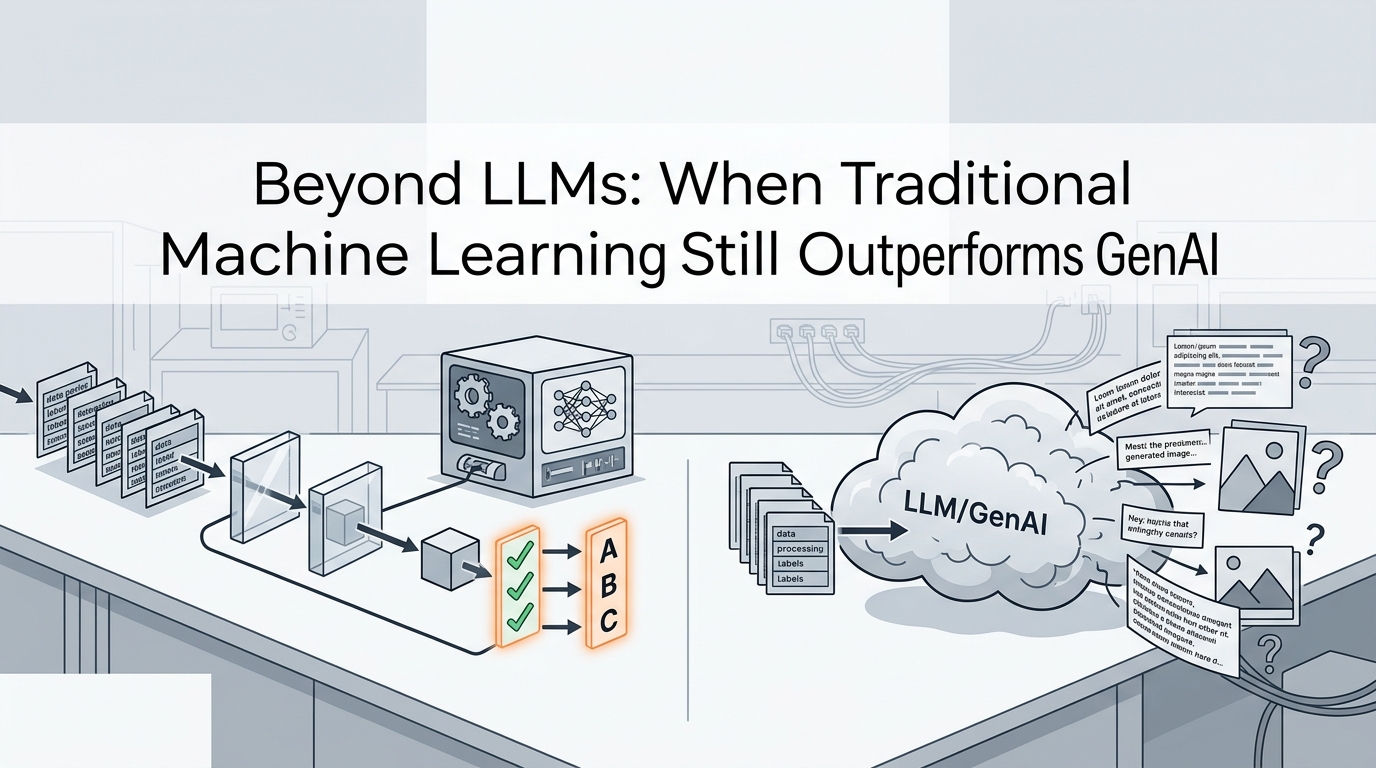
The buzz around Generative AI (GenAI), particularly large language models (LLMs), has been deafening, capturing imaginations with its ability to create, converse, and innovate. Yet, beneath the surface of this transformative wave, a foundational truth persists: traditional machine learning techniques, honed over decades, remain not just relevant but often superior for a host of critical business tasks. This isn't a zero-sum game of "ML vs. GenAI," but rather an intelligent application of "which tool for which task" in the increasingly sophisticated AI landscape.
While GenAI excels at novel content creation and open-ended problem-solving, traditional ML continues to deliver unparalleled precision, speed, and reliability where prediction, classification, and clear decision-making are paramount. Understanding these distinctions is key to building robust, efficient, and strategically sound AI solutions that drive real-world value.
Decoding the Difference: Machine Learning vs. Generative AI
To effectively navigate the modern AI toolkit, it’s crucial to understand the fundamental architectural and functional differences between traditional Machine Learning and Generative AI.
Traditional Machine Learning primarily encompasses models designed for discriminative tasks. These models learn patterns from existing data to make predictions, classify inputs, or estimate numerical values. Their goal is to identify boundaries, relationships, and probabilities within data.
Examples of traditional ML tasks:
Predicting sales figures: Using historical sales data, promotional calendars, and economic indicators to forecast future demand.
Classifying images: Identifying objects within an image, like distinguishing between cats and dogs, or detecting manufacturing defects.
Identifying spam emails: Analyzing email content, sender information, and headers to classify messages as legitimate or spam.
Recommending products: Suggesting items to users based on their past purchases, browsing history, and similar users' behavior.
Generative AI, on the other hand, focuses on creation. These models learn the underlying distribution of data and then generate new, original content that resembles the training data but isn't identical to it. They are designed to produce outputs rather than merely predict or classify.
Examples of GenAI tasks:
Writing articles or marketing copy: Generating human-like text based on a given prompt or topic.
Generating images from text prompts: Creating novel visual art or photorealistic scenes from descriptive input.
Synthesizing speech: Producing natural-sounding audio from written text.
Developing code: Generating programming code snippets or entire functions based on a functional description.
The core distinction lies in their purpose: traditional (discriminative) ML models learn to distinguish or predict, while generative models learn to produce. This fundamental difference dictates their respective strengths and optimal applications.
Specific Tasks Where Traditional Machine Learning Still Shines
Despite the allure of GenAI's creative capabilities, several critical business functions demand the precision, efficiency, and robustness that traditional Machine Learning models inherently provide.
Low-Latency Scoring and Real-time Ranking
In applications where decisions must be made in milliseconds, traditional ML models are often the only viable choice. Consider scenarios like programmatic advertising, personalized website experiences, or real-time fraud detection. These systems require near-instantaneous scoring of user profiles, bid prices, or transaction legitimacy.
Traditional models such as logistic regression, decision trees, or gradient-boosting machines (GBMs) like XGBoost or LightGBM excel here. Their relatively simpler architectures mean they can be incredibly fast at inference. A linear model merely performs a weighted sum, while tree-based models traverse a limited number of nodes.
For example, in online advertising, an ad exchange needs to decide which ad to show to a user within tens of milliseconds. A highly optimized logistic regression model can take user features (location, browsing history, time of day) and ad features (bid price, past performance) to predict click-through probability in microseconds. Deploying a large language model for this task would be computationally prohibitive due to its vast parameter count and sequential processing nature, leading to unacceptable latency.
Accurate Forecasting and Time Series Analysis
When it comes to predicting numerical values over time, whether it's stock prices, energy consumption, or retail demand, traditional time series models often deliver superior accuracy and reliability. Models like ARIMA (AutoRegressive Integrated Moving Average), Exponential Smoothing (ETS), and specialized recurrent neural networks (RNNs) or LSTMs are explicitly designed to capture temporal dependencies, seasonality, trends, and autocorrelation within sequential data.
GenAI models, particularly LLMs, can generate sequences of text that look like forecasts, but they lack the inherent mathematical grounding and statistical rigor to make precise numerical predictions based on historical patterns. Their strength lies in language generation, not precise numerical extrapolation of time-dependent variables.
Consider demand forecasting for a retail supply chain. A well-tuned Prophet model (developed by Meta) can accurately predict future sales for thousands of SKUs by decomposing historical data into trend, seasonality, and holiday effects, often outperforming more general-purpose deep learning models for specific forecasting challenges. These models provide not just a point estimate but often also prediction intervals, crucial for operational planning.
Anomaly Detection and Fraud Prevention
Identifying rare, critical deviations from normal behavior is a specialized task where traditional unsupervised and semi-supervised ML techniques shine. In fraud detection, cybersecurity, or industrial fault detection, the goal is to pinpoint anomalous instances without generating plausible but fake "normal" data.
Algorithms like Isolation Forests, One-Class SVMs, Local Outlier Factor (LOF), and Autoencoders are specifically designed for this purpose. They learn the characteristics of 'normal' data and flag anything that deviates significantly. Their effectiveness comes from their ability to work with imbalanced datasets (where anomalies are very rare) and to highlight what makes an observation anomalous.
For instance, in credit card fraud detection, an Isolation Forest can quickly identify transactions that are "isolated" or "different" from the vast majority of legitimate transactions by building trees that recursively partition data. This is more effective than trying to use a generative model to "create" fraudulent transactions, as the goal is to find existing unusual patterns, not synthesize them. The interpretability of feature importance in these models can also directly point to the suspicious elements of a transaction, aiding human investigators.
Calibrated Risk Scoring and Regulated Environments
In sectors like finance, healthcare, and insurance, precise, interpretable, and auditable risk scores are non-negotiable. Traditional ML models, particularly logistic regression and generalized linear models (GLMs), are preferred because they provide well-calibrated probabilistic outputs and transparent decision rules.
For example, in credit risk assessment, a bank needs to assign a probability of default to a loan applicant. A logistic regression model outputs a score that can be directly interpreted as a probability. Crucially, the coefficients of the model reveal the exact impact of each input feature (e.g., credit score, income, debt-to-income ratio) on the risk. This level of transparency is essential for regulatory compliance (e.g., Basel accords, fair lending laws) and for explaining decisions to customers.
Generative AI models, while capable of sophisticated pattern recognition, struggle to provide the kind of precise, calibrated probabilities and the granular, feature-level explanations required in these highly regulated, high-stakes environments. Their outputs are often less deterministic and harder to trace back to specific inputs, making them unsuitable where strict audit trails and explainability are mandated.
Tactical Advantages: Why Traditional ML Wins on Metrics That Matter
Beyond specific tasks, traditional Machine Learning offers tactical advantages that translate directly into business value, especially in production environments where performance, cost, and accountability are paramount.
Interpretability and Explainability (XAI)
In many real-world applications, knowing why a model made a particular decision is as crucial as the decision itself. Traditional ML models inherently offer greater interpretability. For instance, in a linear regression model, the coefficients directly quantify the impact of each input feature. For tree-based models, feature importance scores can be easily derived. Tools like SHAP (SHapley Additive exPlanations) and LIME (Local Interpretable Model-agnostic Explanations) can provide feature-level explanations even for more complex traditional models like Gradient Boosting Machines, explaining individual predictions.
Consider a medical diagnosis support system. A traditional ML model predicting disease risk might highlight specific symptoms or lab results that led to its conclusion. This allows clinicians to validate the model's reasoning, build trust, and potentially uncover new insights. GenAI, often referred to as a "black box," typically cannot offer such granular, attributable explanations, making its adoption problematic in scenarios requiring high levels of human oversight and understanding.
Auditability and Regulatory Compliance
Regulated industries demand robust audit trails for every automated decision. Traditional ML models, with their structured inputs, predictable outputs, and simpler, more transparent logic, facilitate the creation and maintenance of these audit trails. It's often straightforward to trace a prediction back to its specific input features and the model parameters that influenced it.
Financial institutions, for example, must demonstrate that their credit scoring models are fair, non-discriminatory, and comply with various consumer protection laws. The ability to inspect model coefficients, decision paths, and the impact of individual features makes traditional ML models much easier to validate and certify for regulatory bodies. Attempting to audit a GenAI model that generates free-form text or complex images poses significant, often insurmountable, challenges in terms of compliance and accountability.
Compute Cost and Inference Speed at Scale
Deploying and running AI models in production at scale comes with significant operational costs. Traditional ML models generally have vastly lower computational demands compared to resource-intensive GenAI models. Their smaller footprint, fewer parameters, and less complex architectures lead to:
Lower training costs: Less GPU time, often trainable on CPUs.
Faster inference times: Critical for real-time applications as discussed earlier. A simple logistic regression model can make predictions on millions of records per second on commodity hardware.
Reduced infrastructure needs: Less memory, storage, and processing power required for deployment.
For businesses running thousands of predictions per second, such as recommendation engines or fraud detection systems, the difference in compute cost between a traditional ML model and a GenAI model can be astronomical, directly impacting profitability. A traditional model might cost cents per million inferences, while a GenAI model could cost dollars or even tens of dollars for the same volume, making the latter impractical for high-throughput, low-margin operations.
Data Efficiency and Specificity
Traditional ML models can often achieve superior performance with smaller, high-quality, domain-specific datasets. They are particularly effective when the underlying relationships in the data are well-understood or when specific features carry significant predictive power. While GenAI models often require vast, diverse datasets for pre-training and then extensive fine-tuning for specialized tasks, traditional models can be highly effective with curated, focused datasets.
Consider building a predictive model for equipment failure in a specific manufacturing plant. The dataset might be limited to sensor readings, maintenance logs, and environmental factors from that single plant. A traditional ML model like an SVM or a Random Forest, carefully engineered with features relevant to the machinery, can learn to identify precursor signs of failure with high accuracy. A GenAI model would struggle with such a constrained dataset, requiring much broader data or extensive pre-training on general machinery data, which may or may not translate effectively to the specific nuances of a given plant. Traditional ML models leverage the specificity of the data directly, leading to more precise and robust outcomes in specialized applications.
Building Bridges: The Power of Hybrid ML + Generative AI Architectures
The most forward-thinking approach isn't to choose one paradigm over the other, but to strategically combine their strengths. Hybrid architectures unlock new possibilities, leveraging GenAI for its creative and conversational capabilities while relying on traditional ML for precision, speed, and analytical rigor.
Here are a few ways these paradigms can complement each other:
GenAI for Natural Language Interfaces, Traditional ML for Core Logic: Imagine a customer support chatbot (GenAI) that understands complex queries and responds conversationally. When a query involves product recommendations or account issue resolution, the GenAI can hand off to a traditional ML model that performs a precise lookup or prediction based on customer data. The traditional ML model delivers the accurate answer, which the GenAI then rephrases into a human-friendly response.
Example: A user asks, "What's the best mortgage rate for me?" An LLM parses the intent, extracts key user data (income, credit score), and passes it to a traditional logistic regression model which predicts eligibility and scores different mortgage products. The LLM then presents the top recommendations and explanations in natural language.
GenAI for Data Augmentation and Synthetic Data Generation: Training robust traditional ML models often requires large amounts of data. In scenarios where real-world data is scarce or sensitive, GenAI can be used to generate synthetic data that mimics the characteristics of the original. This augmented dataset can then be used to train or fine-tune traditional ML models more effectively.
Example: For a rare disease diagnosis model, a Variational Autoencoder (VAE) (a type of generative model) could generate synthetic patient records, including symptoms and lab results, helping a Random Forest classifier learn to identify patterns with greater accuracy without violating patient privacy.
Traditional ML for Core Analysis, GenAI for Personalized Output/Explanation: Traditional ML can perform complex data analysis, prediction, or anomaly detection, and then GenAI can be used to contextualize, summarize, or personalize the findings for an end-user.
Example: An Isolation Forest detects anomalous transactions in a financial system. Instead of merely alerting an analyst with raw scores, an LLM could generate a concise summary of why the transaction was flagged, highlighting the specific unusual features (e.g., "Transaction initiated from an unusual geographic location, involving a higher-than-average amount for this customer, and occurring outside typical spending hours").
By creating these synergistic workflows, organizations can tap into the best of both worlds, achieving solutions that are both powerful and practical.
Making the Right Choice: A Practical Decision Framework
Choosing between traditional ML, Generative AI, or a hybrid approach requires a structured decision-making process rooted in your project's specific requirements and constraints. Here’s a practical framework to guide your choice:
What is the Primary Goal? Prediction/Classification vs. Content Generation:
Prediction/Classification (e.g., "Is X true?", "What is the value of Y?"): Leans towards traditional ML. These are discriminative tasks with clear, measurable outcomes.
Content Generation (e.g., "Create X", "Summarize Y", "Draft Z"): Leans towards Generative AI. These involve producing novel outputs.
How Critical Are Interpretability, Auditability, and Regulatory Compliance?
High Importance (e.g., finance, healthcare, legal): Strong preference for traditional ML due to its inherent transparency and ease of auditing.
Lower Importance (e.g., creative content, internal tools): GenAI can be a strong contender.
What are the Latency, Compute Cost, and Deployment Constraints?
Low Latency, Low Cost, High Throughput (e.g., real-time bidding, simple recommendations): Traditional ML is typically more efficient and cost-effective.
Higher Latency Tolerated, Higher Compute Budget (e.g., complex content creation, advanced research): GenAI may be feasible, but be mindful of resource consumption.
What is the Nature and Volume of Available Data?
Structured, Semi-structured, Specific, High-Quality, Limited Volume: Traditional ML can often excel with well-engineered features from smaller, domain-specific datasets.
Unstructured, Diverse, Very Large Volume, General Purpose: GenAI thrives on vast amounts of data for pre-training and may require significant fine-tuning for specificity.
How Important is Precision and Reproducibility?
High Precision, Reproducible Results (e.g., numerical forecasting, strict classification): Traditional ML typically offers more deterministic and precise outcomes.
Creative, Plausible, Diverse Outputs (e.g., brainstorming, artistic generation): GenAI is designed for this, embracing variability.
By systematically addressing these questions, you can identify the most appropriate AI paradigm for your unique business problem, ensuring that you select the tool best suited to deliver optimal results.
Conclusion: The Strategic Imperative of Balanced AI Adoption
The advent of Generative AI has undoubtedly expanded the horizons of what's possible with artificial intelligence, inspiring awe with its creative prowess and ability to interact with the world in novel ways. However, it’s a critical strategic error to view this innovation as an obsolescence signal for traditional Machine Learning. Instead, GenAI enriches the overall AI ecosystem, providing powerful new capabilities that complement, rather than entirely replace, established techniques.
For tasks demanding high precision, rapid inference, robust interpretability, and strict regulatory compliance—from real-time fraud detection and accurate financial forecasting to critical risk assessment—traditional Machine Learning models continue to hold an undeniable edge. Their efficiency, transparency, and proven reliability make them indispensable workhorses in the modern data-driven enterprise.
The truly intelligent path forward involves a nuanced understanding of each paradigm's strengths and limitations. By embracing a balanced approach, where both traditional ML and Generative AI are strategically deployed—often in hybrid architectures—organizations can unlock the full potential of AI, building solutions that are not only innovative but also robust, efficient, and aligned with core business objectives.
Considering the specific needs of your projects, where do you find traditional Machine Learning still indispensable, and in what ways are you exploring hybrid architectures with Generative AI?
💬 Join the conversation — share your take in the comments and tell us what you’d add.