The Impact of AI Innovation on Modern Business Strategies
Discover how AI innovation can elevate your business strategies for competitive advantage. Explore insights and strategies today!
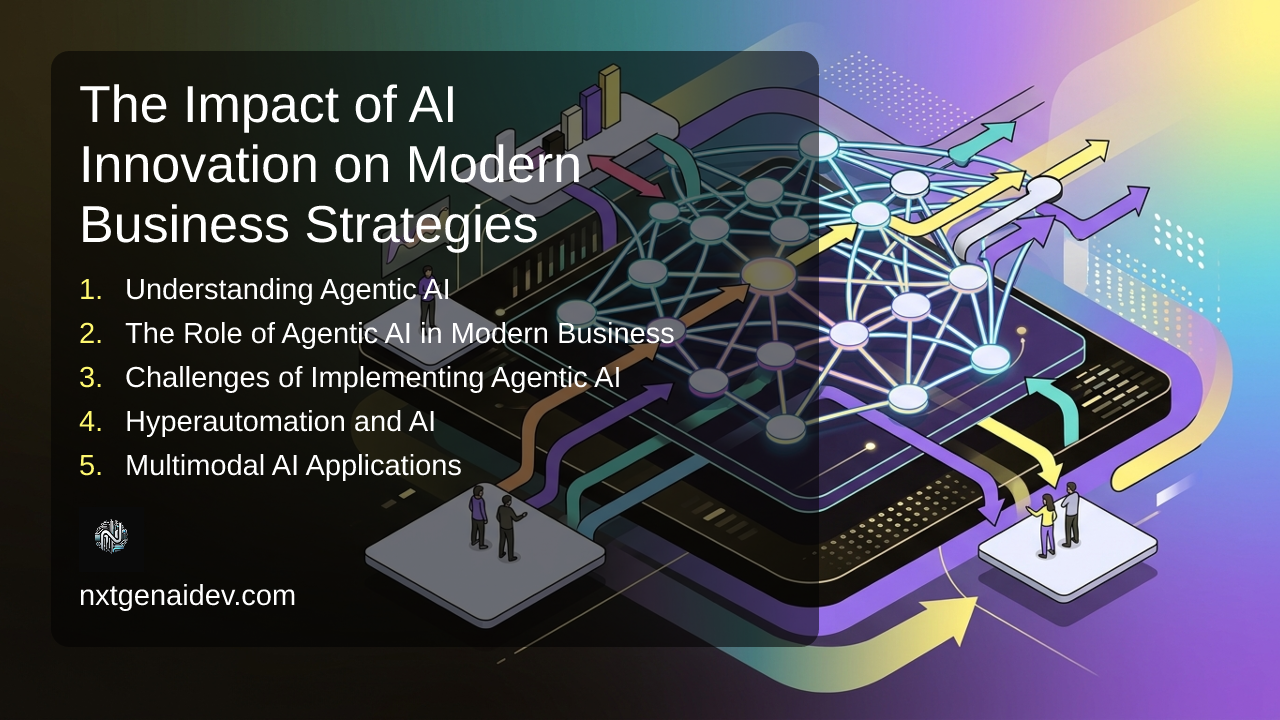
The Impact of AI Innovation on Modern Business Strategies
As businesses navigate the complexities of the digital landscape, AI innovation stands out as a transformative force. Central to this evolution is agentic AI, a revolutionary technology reshaping decision-making processes and operational strategies across industries.
Understanding Agentic AI
Defining Agentic AI
Agentic AI refers to sophisticated systems capable of autonomous decision-making based on vast datasets. These systems possess the ability to analyze patterns, draw conclusions, and act without needing significant human input. For instance, companies like Google utilize agentic AI to optimize their advertising models, adjusting in real time based on user behavior.
Differences from Traditional AI
Unlike traditional AI, which often relies on human intervention for decision-making, agentic AI excels in self-learning and real-time adaptability. Traditional AI models require ongoing manual updates and input, whereas agentic AI continuously improves by learning from new data. This distinction is crucial in today's fast-paced business environment, as the need for rapid responses and accurate insights becomes increasingly paramount.
The Role of Agentic AI in Modern Business
Impact on Decision-Making
Agentic AI significantly enhances business decision-making efficiency. By automating complex processes, organizations can improve speed and accuracy, leading to better outcomes. For instance, companies like JPMorgan Chase leverage agentic AI to analyze financial data in seconds, allowing for instantaneous investment decisions that were previously unthinkable.
The predictive capabilities of this technology enable companies to make more informed choices based on data-driven insights, transforming previously reactive models into proactive strategies.
Enhancing Customer Experience
Enhancing customer experiences is another area where agentic AI excels. With the ability to predict customer preferences and behaviors, businesses that integrate agentic AI can optimize interactions with clients. For example, Netflix employs agentic AI to recommend shows based on viewing patterns, creating a more personalized user experience that boosts engagement and retention.
Real-world applications, like chatbots powered by agentic AI, showcase the technology's effectiveness in customer service. These tools can analyze inquiries and resolve issues in real-time, significantly improving customer satisfaction and operational efficiency.
Challenges of Implementing Agentic AI
Regulatory and Ethical Considerations
Navigating the regulatory and ethical landscape surrounding AI is a significant challenge for modern businesses. As governments worldwide begin to implement regulations on AI, organizations must ensure compliance while fostering innovation. This evolving legal landscape can create uncertainties, compelling companies to remain vigilant and adaptive.
Moreover, ethical concerns regarding data privacy and decision transparency are paramount. Businesses must prioritize transparency in AI-driven decisions, ensuring users understand how their data is used and protected.
Integration Challenges
Integrating agentic AI within existing technological frameworks can present hurdles too. Legacy systems may not seamlessly accept the advanced functionalities of agentic AI, leading to inefficiencies or bottlenecks.
To overcome these challenges, businesses should consider adopting modular technology solutions that allow for incremental integration. For instance, using APIs (Application Programming Interfaces) can enable a smoother transition by allowing legacy systems to communicate effectively with new agentic AI modules.
Hyperautomation and AI
Hyperautomation represents an evolution in process management, leveraging AI to automate extensive workflows. This trend creates unparalleled efficiency and adaptability in business operations. Companies such as Siemens have seen profound benefits by adopting hyperautomation strategies, where agentic AI streamlines manufacturing processes.
Successful Case Studies
Case studies, such as those from Unilever, demonstrate how hyperautomation using agentic AI can redefine workflow management. By integrating AI across supply chains, Unilever improved operational efficiency and responsiveness to market changes. This approach not only reduced costs but also enhanced product delivery timelines.
Multimodal AI Applications
What is Multimodal AI?
Multimodal AI refers to systems that utilize various types of data inputs—like text, audio, and visual data—to make more informed decisions. This integrative approach allows businesses to glean insights that might be missed when relying on a single data source.
Applications Across Industries
Industries from healthcare to finance are tapping into the advantages of multimodal AI. In healthcare, for instance, systems can combine patient data with imaging results to enhance diagnostic accuracy and streamline treatment plans.
In finance, firms are employing multimodal AI to analyze market trends, improve risk assessments, and enhance customer interactions. By integrating diverse data types, organizations can develop more comprehensive insights, ensuring they remain competitive in an ever-evolving market.
Scaling Agentic AI Solutions
Small Businesses vs. Large Enterprises
Scaling agentic AI solutions varies significantly between small enterprises and large corporations. Small businesses can harness agentic AI to level the playing field against larger competitors by integrating affordable AI tools tailored to their needs, such as automated marketing platforms.
On the other hand, large enterprises must address complexities related to compliance, data governance, and resource allocation. Establishing AI centers of excellence within these organizations can facilitate smoother adoption and integration across departments.
Exploring Vertical AI
Vertical AI focuses on solutions tailored to specific industries, offering enterprises a significant competitive edge. For example, AI models tailored for the manufacturing sector can optimize production processes, reduce waste, and enhance quality control.
Small businesses looking to adopt agentic AI can start by identifying niche markets where industry-specific solutions can make an immediate impact. This approach ensures that they maximize the technology’s potential without overwhelming their resources.
Future Trends in AI Innovation
Emerging Technologies
The future of AI innovation appears bright, with emerging technologies like edge computing and 5G connectivity poised to further transform AI capabilities. These advancements will allow businesses to process data more efficiently, reduce latency, and enhance real-time decision-making, heralding a new era for agentic AI applications.
Predicting the Future of Business Strategies
As AI innovation continues to evolve, businesses will increasingly rely on these technologies to drive growth. The ability to adapt to changing market conditions through predictive insights gained from AI will become essential. Companies that embrace this shift will likely lead their industries by leveraging cutting-edge capabilities to optimize strategies and maintain relevance.
How has your business adapted to the integration of AI technologies, and what challenges have you faced? Your insights could contribute to a richer understanding of AI's role in shaping modern business strategies!
💬 Join the conversation — share your take in the comments and tell us what you’d add.