The Future of AI Agents: Innovations and Current Solutions Compared
Discover how AI Agents are revolutionizing industries. Learn about current solutions and future innovations to stay ahead in technology.
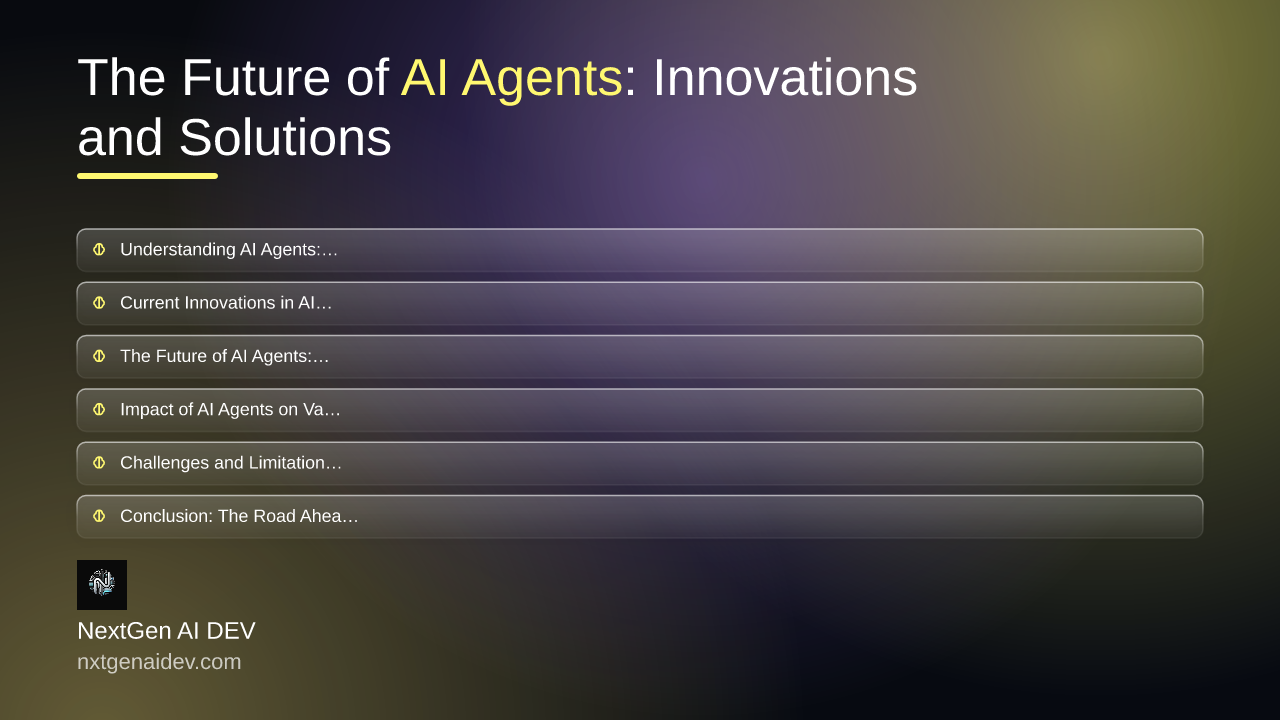
Understanding AI Agents: Definition and Functionality
Artificial Intelligence (AI) agents are rapidly reshaping our technological landscape, acting as powerful tools that can automate tasks, analyze vast amounts of data, and learn from their interactions. But what exactly are AI agents, and how do they operate? Let’s dive deeper into their definition, functionality, and some current examples.
What are AI Agents?
AI agents are software entities that utilize algorithms and data to perform tasks autonomously. They can be characterized by their ability to perceive their environment, reason about it, and act upon it, often mimicking human decision-making processes. Key characteristics include:
Autonomy: They operate independently to make decisions without human intervention.
Adaptability: AI agents learn from their experiences and improve over time using techniques like machine learning.
Interactivity: They can interact with users, other agents, and data sources to enhance their functionality.
How AI Agents Operate
AI agents rely on sophisticated algorithms and data sets to function efficiently. They process information through a framework that includes:
Perception: Utilizing sensors or data inputs to gather information about their environment.
Reasoning: Applying algorithms to analyze data and make informed decisions.
Execution: Taking actions based on the conclusions drawn from the analyzed data.
For instance, AI agents such as chatbots in customer service are revolutionizing the industry by providing instant responses and solutions to customer inquiries. Other examples include virtual personal assistants like Siri and smart home devices that create efficient environments based on user preferences.
Current Innovations in AI Agents
The landscape of AI agents is constantly evolving, with several innovations emerging that make them more autonomous and versatile. Here are some of the most exciting advancements.
Autonomous Self-Learning Capabilities
Self-learning AI agents utilize advanced machine learning techniques to adapt to new information independently. This capability reduces the need for explicit programming and allows agents to improve their performance over time. For voting prediction models, for example, self-learning algorithms can continuously analyze new data—from demographics to historical voting trends—boosting accuracy and reliability.
Integrating Multimodal Technologies
Today’s AI agents are increasingly leveraging multimodal capabilities, which include processing and integrating data from various sources, such as text, audio, and visual inputs. This integration enhances their capability to provide comprehensive responses. For instance, an AI agent equipped with both visual recognition and natural language processing can analyze customer queries alongside visual product data, creating a richer customer experience.
Open-Source Platforms for AI Development
Open-source AI platforms like TensorFlow and PyTorch have significantly democratized AI development, allowing developers across the globe to collaborate and innovate. With these tools, companies can rapidly prototype and deploy AI agents while minimizing costs. Open-source initiatives not only foster creativity but also lead to the creation of more robust and versatile AI solutions.
The Future of AI Agents: Trends and Predictions
As we look toward the future, several trends are likely to shape the evolution of AI agents, particularly in enterprise applications, ethical governance, and integration challenges.
Enterprise Applications of AI Agents
AI agents are poised to make substantial inroads into enterprise environments, where they can streamline operations and improve efficiency. Consider the following potential use cases:
Customer Support: AI agents will take on more complex queries, learning from each interaction to provide better, faster solutions.
Supply Chain Optimization: Autonomous agents could analyze inventory data, predict shortages, and suggest procurement strategies without human input.
Employee Training: AI agents can facilitate personalized training programs, adapting content based on individual learning styles and progress.
Ethical Governance and Integration Challenges
As AI agents become more prevalent in our lives, crucial ethical considerations must be addressed. The development of governance frameworks is essential to ensure that AI is used responsibly, particularly regarding:
Transparency: Users should understand how and why decisions are made by AI agents.
Accountability: Clear guidelines are necessary to assess responsibility when AI agents operate independently.
Furthermore, enterprises face integration challenges as they work to embed AI agents into existing systems. The complexity of aligning AI technology with established processes may lead to reluctance among users resistant to change, making effective change management strategies essential.
Impact of AI Agents on Various Industries
AI agents are transforming industries by enhancing efficiency and offering unique solutions that were previously unimaginable. Let’s explore two critical sectors: healthcare and finance.
Healthcare Transformation
The integration of AI agents in healthcare is revolutionizing patient care. AI applications range from diagnosing diseases using medical imaging data to providing personalized treatment plans. Key benefits include:
Predictive Analytics: AI agents can analyze patient data to foresee health issues before they arise.
Telemedicine: Virtual health assistants can facilitate remote consultations, making healthcare more accessible.
Successful case studies, such as IBM Watson Health, demonstrate how AI agents can assist healthcare providers in making informed decisions based on vast datasets.
Finance and Risk Management Applications
In finance, AI agents are enhancing risk management through more accurate predictive models. They analyze market data, extract actionable insights, and even automate trading actions based on predefined algorithms. Case studies from institutions leveraging AI for fraud detection highlight this potential, where AI agents successfully identify unusual patterns in transaction data, significantly minimizing losses.
Challenges and Limitations of AI Agents
Despite their promise, AI agents face several challenges that hinder their widespread adoption. Understanding these limitations is crucial for effective development and implementation.
Technological Hurdles
The development and deployment of AI agents encounter various technological barriers, such as:
Data Integrity: Agents depend heavily on quality data to perform efficiently. Inaccurate or biased data can lead to erroneous outcomes.
Processing Power: Advanced AI models require significant computational resources, which can be a barrier to smaller enterprises.
Addressing these challenges requires ongoing research and investment in infrastructure.
User Acceptance and Market Readiness
Another significant obstacle is user acceptance. The successful integration of AI agents hinges on the willingness of users to adopt new technologies. Factors contributing to market readiness include:
Training: Users must understand how to effectively work alongside AI agents.
Trust: Establishing reliability in AI agents is essential for wider acceptance.
Understanding these dynamics can help in designing more user-friendly AI solutions that encourage adoption.
Conclusion: The Road Ahead for AI Agents
The landscape of AI agents is teeming with potential opportunities and challenges that will define the future of technology. Key trends, such as enhanced self-learning architectures and multimodal capabilities, are expected to shape developments in this space.
Future Developments to Watch
As AI agents evolve, several areas warrant close attention, including their expanding applications in healthcare and finance, as well as ongoing advancements in ethical governance frameworks.
Your Role in the AI Agent Evolution
With the rapid transformation of AI agents, we invite you to consider your role in this evolution. Your insights and experiences matter. How do you see AI agents impacting your industry, and what ethical considerations do you think are most critical as they become integrated into our daily lives?
What are your thoughts on the ethical implications of deploying AI agents in your industry?
💬 Join the conversation — share your take in the comments and tell us what you’d add.