
Strategic Technical Debt Management for Product Engineering Growth
Discover how effective product engineering and strategic debt management can drive sustainable growth. Start optimizing your processes today!
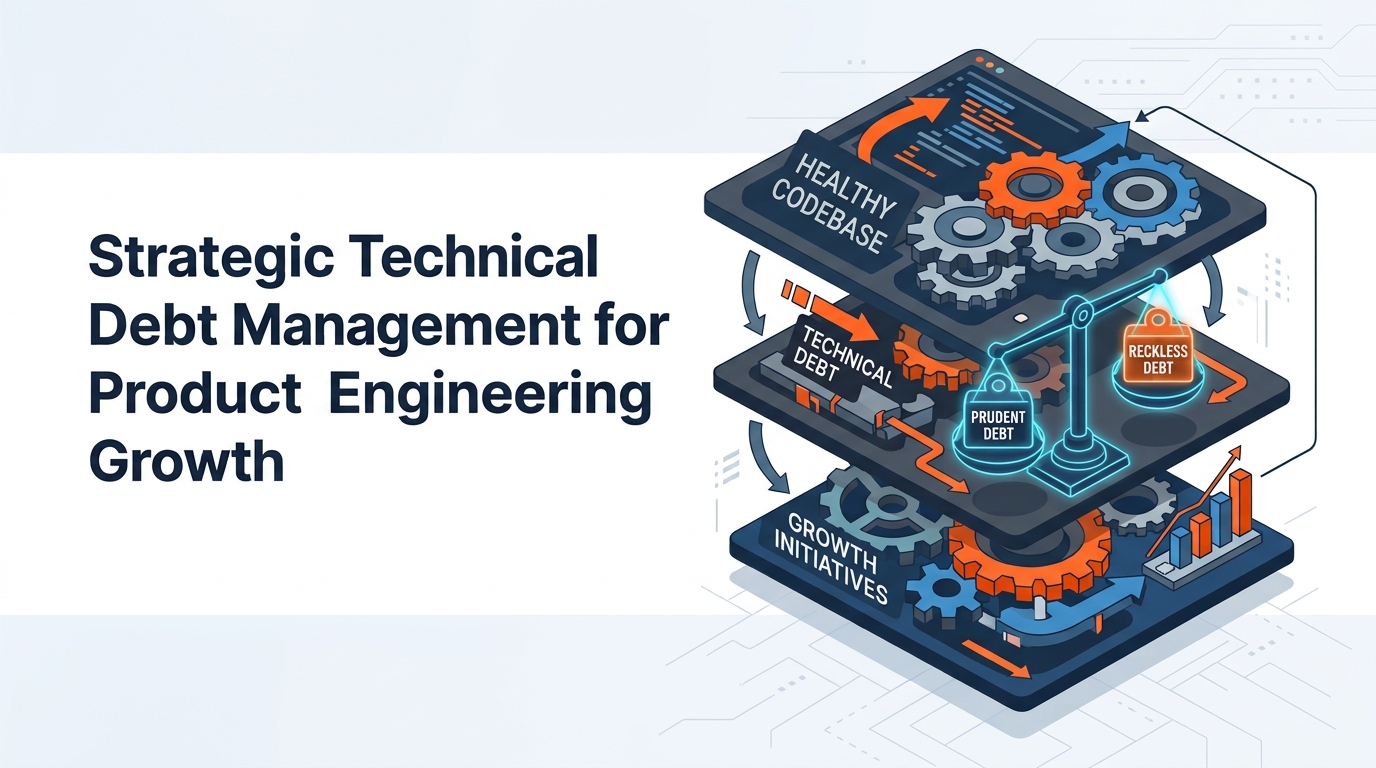
Building a thriving product requires more than just innovative ideas; it demands a relentless commitment to maintain the health and agility of your codebase. Many product engineering teams find themselves grappling with the insidious creep of technical debt, but a well-defined approach to strategic technical debt management can transform this challenge into a powerful driver for sustainable growth. This isn't about mere clean-up; it's about making intentional choices that propel your product forward, ensuring long-term velocity and innovation.
What is Strategic Technical Debt Management in Product Engineering?
Strategic technical debt management is a deliberate, proactive framework for identifying, assessing, prioritizing, and systematically addressing the accumulated technical deficiencies within a product's codebase and architecture. Unlike reactive, ad-hoc fixes or endless "technical chores," this approach integrates debt reduction into the core product development lifecycle, aligning it with business objectives. It acknowledges that technical debt, when managed correctly, isn't always a negative force, but a lever for speed and innovation.
The Nuance: Prudent vs. Reckless Technical Debt
To truly understand strategic technical debt management, it's essential to distinguish between its two primary forms: prudent and reckless. Martin Fowler's Technical Debt Quadrant provides a valuable framework for this understanding:
Prudent (Intentional) Technical Debt: This arises when a team consciously decides to take a shortcut to deliver value quickly, knowing there's a future cost. For example, building a Minimum Viable Product (MVP) with known architectural compromises to validate market fit. The key is that the debt is intentional, its consequences are known, and there's a plan for future repayment. This debt is often a calculated business decision.
Reckless (Unintentional) Technical Debt: This is the more insidious form, accumulated due to poor design decisions, lack of understanding, tight deadlines leading to haphazard code, or simply neglecting best practices. The consequences are often unknown or poorly understood until they manifest as bugs, performance issues, or a crippling inability to evolve the product. This type of debt is rarely strategic and almost always detrimental.
Strategic technical debt management focuses on minimizing reckless debt while making informed, prudent choices where necessary, always with a clear repayment plan.
Why Product Engineering Teams Can't Ignore It
Ignoring technical debt is akin to building a skyscraper without maintaining its foundation. Initially, the progress might seem rapid, but cracks will inevitably appear, leading to slower construction, safety hazards, and eventually, a halt in development. For product engineering teams, unmanaged technical debt translates directly into:
Hindered Innovation: Every new feature takes longer to build and integrate due to a brittle or complex codebase. Engineers spend more time understanding existing systems than creating new ones.
Reduced Market Responsiveness: The ability to pivot quickly, respond to competitor moves, or capitalize on emerging market opportunities is severely hampered when the underlying technology is rigid and resistant to change.
Increased Development Costs: Bugs become more frequent, requiring more QA cycles and developer time for fixes. Deployment pipelines become fragile, and maintenance consumes a disproportionate amount of resources.
Lower Team Morale: Engineers become frustrated working with legacy code, duplicated logic, and constant firefighting, leading to burnout and high attrition rates.
Compromised Product Quality: The cumulative effect of shortcuts can manifest as performance degradation, security vulnerabilities, and an inconsistent user experience, ultimately damaging the product's reputation and user trust.
Ultimately, unmanaged technical debt directly impacts a product's ability to evolve, compete, and sustain long-term growth. It transforms innovation from an exciting endeavor into a daunting, resource-draining struggle.
Unpacking the Real Cost: Technical Debt's Impact on Product Engineering Growth
Technical debt isn't just an abstract concept; it has tangible, often devastating, impacts on an organization's bottom line, its ability to innovate, and the well-being of its engineering teams. Understanding these costs is the first step toward building a compelling case for strategic remediation.
Quantifying the Drag on Innovation and Delivery
The most direct and measurable impact of technical debt is the drag it places on development velocity. New feature development slows to a crawl as engineers navigate increasingly complex and interdependent systems. Consider these scenarios:
Increased Time-to-Market: A simple feature that should take two weeks now takes six because developers must untangle legacy code, fix unexpected side effects, and refactor existing components just to make space for the new functionality.
Rampant Bugs and Rework: A poorly architected module might introduce a cascade of bugs whenever a seemingly minor change is made. Teams spend more time identifying and fixing defects than writing new code, leading to frustrating rework cycles.
Maintenance Overheads: A significant portion of engineering resources is diverted from innovation to mere maintenance – keeping the lights on, patching vulnerabilities, and nursing fragile systems. This directly cannibalizes resources that could be creating new value.
Example Metrics for Assessment: To quantify this drag, organizations can track:
Defect Escape Rate: The number of bugs found in production per release. High rates indicate quality issues stemming from debt.
Mean Time To Recovery (MTTR): How long it takes to restore service after an incident. High MTTR often points to complex, brittle systems.
Code Complexity Metrics: Tools can analyze cyclomatic complexity, coupling, and cohesion to identify debt-ridden areas.
Deployment Frequency: How often code is deployed to production. Lower frequency can indicate fear of breaking things due to debt.
The Hidden Toll on Team Morale and Velocity
Beyond the measurable delays, technical debt extracts a significant human cost. Engineers are problem solvers by nature, but constantly battling the same intractable issues, dealing with unmaintainable code, or being forced to implement "ugly" solutions can severely erode morale.
Developer Frustration and Burnout: Imagine trying to innovate in a codebase where every change feels like wading through treacle. This leads to profound frustration, reduced job satisfaction, and ultimately, burnout.
Reduced Productivity: When developers are demotivated and constantly fighting the system, their overall productivity drops. They spend more time context-switching, debugging, and expressing their dissatisfaction than actively building.
High Employee Turnover: Talented engineers seek environments where they can build, learn, and grow, not perpetually fix and maintain. High technical debt is a major driver of attrition, forcing organizations to incur significant costs in recruiting and onboarding new talent.
Unpredictable Roadmaps: The presence of significant technical debt makes it nearly impossible to accurately estimate effort or predict delivery timelines. Scope creep due to unforeseen complexities becomes the norm, leading to missed deadlines and eroding trust between engineering and business stakeholders.
By understanding these multifaceted costs, product engineering leaders can make a stronger case for prioritizing strategic technical debt management, not just as an engineering concern, but as a critical business imperative.
Prioritizing Technical Debt: Balancing Innovation with Remediation
The challenge isn't just identifying technical debt, but deciding which debt to tackle and when. With limited resources, product engineering teams must strike a delicate balance between pushing new features and investing in remediation. Strategic prioritization ensures that debt repayment efforts yield the maximum business value.
Applying the Technical Debt Quadrant for Prioritization
Building on Martin Fowler's quadrant, a practical framework for prioritization considers both the business impact of the debt and the effort to fix it. You can overlay this with the intentionality (prudent vs. reckless) to guide decisions:
High Business Impact, Low Effort to Fix (Quick Wins): These are critical issues that are relatively easy to resolve. Prioritize them immediately. Examples: Fixing a critical performance bottleneck in a high-traffic area, simplifying a heavily used but overly complex API endpoint. These are often "reckless accidental" debt that is simple to fix, or "prudent intentional" debt that is now due for repayment.
High Business Impact, High Effort to Fix (Strategic Initiatives): These represent significant architectural or foundational issues that severely impede product growth. Plan these as major initiatives, potentially across multiple sprints or quarters. Examples: Re-platforming a monolithic service, addressing critical security vulnerabilities, modernizing a core legacy module. These are often "reckless systemic" debt.
Low Business Impact, Low Effort to Fix (Backlog Items): Small irritants or minor code smells. Tackle these when bandwidth allows, perhaps during dedicated "bug smashing" days or as part of ongoing refactoring. Don't let them accumulate, but don't stop critical work for them.
Low Business Impact, High Effort to Fix (Deprioritize or Defer): Debt in rarely used parts of the system or components slated for deprecation. These might not need immediate attention, or ever, unless their business impact changes.
Example Prioritization Criteria: When evaluating, ask:
Cost of Delay: How much revenue/users/opportunity are we losing by not fixing this?
Frequency of Interaction: How often do developers (or users) interact with this problematic code?
Risk Mitigation: Does fixing this reduce security risks, data loss, or system outages?
Developer Friction: How much is this slowing down the team or impacting morale?
Future Impact: Will this debt prevent us from building crucial future features?
Integrating Debt Management into Agile Workflows
The most effective way to manage technical debt strategically is to embed its reduction directly into existing agile processes. It shouldn't be a separate, "engineering-only" project that competes for resources; it's an ongoing part of product development.
Allocate a Percentage of Sprint Capacity: A common and effective strategy is to dedicate a fixed percentage (e.g., 10-20%) of each sprint's capacity specifically to technical debt stories. This ensures continuous, incremental progress. For example:
Sprint Backlog:
Feature A (5 story points)
Feature B (3 story points)
Tech Debt: Refactor User Auth Module (2 story points)
Tech Debt: Optimize Database Query X (1 story point)
Dedicated "Debt Sprints" or "Hardening Sprints": Occasionally, for larger, more impactful debt items, a dedicated sprint can be planned. This allows the team to focus entirely on deep refactoring, architectural improvements, or system-wide cleanups without the pressure of new feature delivery. These are particularly useful after major releases or before significant new initiatives.
"Bug Smashing" Days/Weeks: Regular, short-duration events where the entire engineering team (or parts of it) focuses on clearing out minor bugs, small pieces of debt, and improving code quality. This builds camaraderie and quickly clears low-hanging fruit.
Definition of Done (DoD) Inclusion: Integrate quality metrics and debt prevention into your DoD. For example, "No new P1 bugs introduced," "Test coverage maintained/improved," "Code review passed with no critical issues," or "Relevant documentation updated."
Technical Debt Stories/Epics: Treat technical debt items as first-class citizens in your product backlog. Write clear, concise stories or epics that articulate the business value of the debt repayment (e.g., "As a developer, I want the user registration module refactored so that new user onboarding features can be delivered 50% faster").
Measuring Success: Define clear metrics for debt reduction initiatives. Beyond simple "debt items closed," track improvements in:
Velocity Stability: Does the team's capacity become more predictable?
Defect Rates: Are fewer bugs escaping to production?
Deployment Frequency: Can we deploy more often with confidence?
New Feature Time-to-Market: Are new features delivered faster post-remediation?
By weaving debt management directly into agile workflows, product teams ensure that continuous improvement isn't an afterthought, but an integral part of their delivery engine.
Fostering a Debt-Aware Culture Across Product Engineering
Technical debt isn't solely an engineering problem; its roots and consequences often span across product management, design, and even business strategy. For strategic technical debt management to truly succeed, an organization must cultivate a culture where everyone understands, acknowledges, and takes shared responsibility for its impact.
Educating the Team and Stakeholders on Debt Management
The first step in fostering a debt-aware culture is education. It's crucial to bridge the communication gap between technical and non-technical stakeholders.
Translating Technical Jargon to Business Impact: Engineers often speak in terms of "tight coupling" or "technical debt." Product managers and business stakeholders need to hear how this translates to "slower time-to-market," "increased operational costs," or "inability to respond to competitor features."
Regular, Transparent Communication:
"Tech Debt Showcases": Engineers can regularly present the work they've done to reduce debt, illustrating the "before and after" impact on development speed, stability, or cost.
Roadmap Discussions: During product roadmap planning, actively discuss the current state of technical debt and how it impacts future delivery capabilities. For example, "We can build Feature X, but it will take twice as long if we don't first address the debt in Module Y."
Workshops and Cross-Functional Training: Organize informal workshops where engineers explain core architectural components and their current health, while product managers explain the business context and user needs. This builds empathy and shared understanding.
Visualizing Debt: Use dashboards or simple visual aids to track technical debt metrics (e.g., number of critical code smells, areas with high defect rates, modules with significant architectural debt). Make these visible to all stakeholders, linking them to business outcomes where possible.
Establishing Clear Ownership and Accountability
While technical debt is a shared concern, specific ownership and accountability are vital for effective management.
Shared Responsibility, Individual Accountability:
Engineers: Are empowered and expected to identify and flag potential technical debt during design and development. They are responsible for adhering to coding standards and participating in code reviews to prevent new debt.
Team Leads/Architects: Responsible for guiding architectural decisions, identifying larger architectural debt, and ensuring that debt reduction is integrated into sprint planning.
Product Managers: Responsible for understanding the business implications of technical debt and collaborating with engineering to prioritize debt stories alongside new features based on business value. They champion debt reduction as critical to product health.
Leadership: Provides the necessary resources and strategic backing for debt management initiatives, recognizing it as an investment in future growth.
Proactive Debt Flagging: Implement processes where engineers can easily flag potential debt items during design reviews, code reviews, or even daily stand-ups. This could be a simple tagging system in your issue tracker (e.g.,
tech-debtlabel,refactor-needed).Architectural Decision Records (ADRs): Document significant architectural decisions, including any known technical debt incurred, the rationale, and the plan for repayment. This fosters transparency and ensures institutional knowledge is captured.
Debt Backlogs and Owners: Maintain a dedicated, visible backlog for technical debt. Assign clear owners (teams or individuals) to specific categories of debt or particular problematic modules. This clarifies who is responsible for championing its remediation.
By making technical debt a transparent, shared responsibility across product, design, and engineering, organizations can move from a reactive, blame-centric approach to a proactive, collaborative culture that sees debt management as a cornerstone of product excellence.
Proactive Debt Management and Future Trends in Product Engineering
The landscape of product engineering is constantly evolving, bringing new tools and strategies to the forefront of technical debt management. Moving beyond reactive fixes, proactive debt management involves strategic choices and leveraging emerging technologies to prevent debt accumulation and systematically address existing challenges.
Modernization as a Debt Payoff Engine
One of the most powerful strategies for tackling long-standing, systemic technical debt is through modernization initiatives. These are not merely upgrades but strategic shifts that inherently resolve accumulated issues.
Migrating to Microservices: Breaking down a monolithic application into smaller, independently deployable services can reduce the complexity of individual components, making them easier to manage, scale, and refactor. This often addresses "architectural debt" and "code ownership debt" by compartmentalizing functionality.
Cloud Adoption and Serverless Architectures: Moving to cloud-native platforms can eliminate infrastructure debt (e.g., maintaining on-premise servers) and encourage the adoption of more resilient, scalable patterns. Serverless functions, for instance, naturally encourage smaller, focused codebases, reducing complexity.
Re-platforming: This involves rebuilding a core component or even the entire system on a new technological stack or architecture. While a significant undertaking, it's often the most effective way to eliminate decades of accumulated technical debt and unlock new capabilities.
These initiatives are strategic investments that provide a unique opportunity to build healthier, more maintainable systems from the ground up, effectively paying off a large chunk of debt in one go.
Leveraging AI for Technical Debt Identification and Remediation
Artificial Intelligence and Machine Learning are beginning to play an increasingly significant role in automating and improving technical debt management.
Automated Code Smell Detection: AI-powered static analysis tools can go beyond traditional linters, identifying subtle code smells, patterns of complexity, and potential future issues that human reviewers might miss. They can learn from historical codebases and defect rates to predict problematic areas.
Predictive Maintenance: By analyzing code changes, commit history, and defect logs, AI can predict which modules are likely to become maintenance headaches in the future, allowing teams to proactively refactor before debt accumulates.
Intelligent Refactoring Suggestions: Some advanced tools can suggest specific refactoring opportunities, recommend architectural improvements, or even semi-automate repetitive refactoring tasks, significantly reducing the manual effort involved.
Natural Language Processing for Documentation Debt: AI can help identify gaps in documentation, suggest content for auto-generation, or even translate complex technical comments into more digestible explanations.
While still evolving, AI promises to make technical debt identification and remediation more efficient and proactive, freeing up engineers for higher-value work.
Addressing Architectural Debt Systematically
Architectural debt is often the most impactful and challenging form of technical debt. It lies at the system's core, affecting scalability, performance, and overall maintainability.
Strategic Re-platforming & Modularization: As mentioned, this is a heavy lift but often necessary. For instance, breaking a monolithic database into domain-specific data stores or splitting a large service into modular components (e.g., using Domain-Driven Design principles) to reduce interdependencies.
Introducing Anti-Corruption Layers: When integrating with legacy systems, an anti-corruption layer can act as a buffer, preventing the "bad patterns" of the old system from contaminating new, clean code. This allows for incremental modernization without a full rewrite.
Continuous Refactoring and Clean Code Practices: This is the daily hygiene that prevents new debt. Encouraging and enforcing clean code principles, regular code reviews, and small, continuous refactoring efforts as part of every development task ensures that the codebase remains healthy over time.
'Organizational Debt' and its Influence: Beyond code, "organizational debt" (e.g., unclear roles, slow decision-making, poor communication structures) often directly contributes to technical debt accumulation. Addressing this requires improving team autonomy, streamlining processes, and fostering better cross-functional collaboration. For example, if product and engineering can't agree on priorities, engineers might push code with known issues to meet deadlines, creating technical debt. Solutions include clearer decision matrices and robust stakeholder alignment processes.
By combining strategic modernization efforts with cutting-edge AI tools and a commitment to architectural health, product engineering teams can move towards a truly proactive debt management strategy, ensuring long-term product viability and innovation.
Measuring the ROI of Technical Debt Remediation
Investing in technical debt remediation, like any other business investment, must demonstrate a clear return. Product engineering leaders need to articulate this value in terms that resonate with leadership and stakeholders, proving that time spent on code health directly contributes to business growth.
Key Metrics for Tracking Progress and Impact
Quantifying the impact of technical debt reduction requires tracking a combination of direct and indirect metrics. These KPIs should illustrate improvements in efficiency, quality, and team health.
Direct Efficiency Metrics:
Deployment Frequency: An increase in how often code is deployed to production, indicating higher confidence and less risk.
Lead Time for Changes: The time it takes for a commit to get to production. Reduction signifies improved development workflow.
Build Times: Faster build and CI/CD pipeline times mean less waiting for developers.
Mean Time To Recovery (MTTR): A decrease indicates more resilient systems and faster incident resolution.
Quality Metrics:
Defect Escape Rate: Reduction in bugs found in production after a release.
Bug Density: Lower number of open bugs per feature or module.
Code Complexity Scores: Improvement in metrics like cyclomatic complexity or coupling for refactored modules.
Team & Business Metrics:
Team Velocity Stability/Predictability: More consistent sprint velocity post-remediation due to fewer unforeseen blockers.
Developer Satisfaction (via surveys): Improved morale and reduced frustration.
Reduced Operational Costs: Less time spent on firefighting, fewer system outages, lower cloud resource consumption due to optimization.
Faster Feature Delivery: Track the time from concept to delivery for new features that interact with previously debt-ridden areas.
Communicating Value to Leadership and Stakeholders
Translating engineering metrics into business value is crucial for securing continued investment in technical debt remediation.
Link Debt Reduction to Business Outcomes:
"Refactoring the checkout module reduced P1 bugs by 70%, directly improving conversion rates by 2% and saving an estimated $X per month in lost revenue."
"Modernizing our API gateway allowed us to integrate with Partner Y 3X faster, unlocking a new market segment with projected annual revenue of $Z."
"Reducing legacy technical debt in our deployment pipeline decreased our MTTR by 50%, saving X hours of engineering time during incidents and preventing Y hours of downtime for customers."
Focus on ROI Narratives: Instead of saying "We refactored Module X," say "Our investment in refactoring Module X is expected to reduce maintenance costs by 15% and accelerate future feature development by 20%, yielding an ROI of Z% over the next year."
Visual Dashboards and Reports: Create clear, easy-to-understand dashboards that visualize progress on key metrics. Use charts and graphs to show trends (e.g., decreasing bug count, increasing deployment frequency).
Regular Updates: Include technical debt updates in regular business reviews or leadership meetings, not as a standalone engineering report, but as an integral part of product health and strategy.
Tell the Story: Use qualitative data alongside quantitative. Share anecdotes from engineers about how much easier their work has become, or from product managers about faster delivery of user-requested features.
Establishing a continuous feedback loop—where debt management strategies are refined based on observed outcomes—ensures that remediation efforts remain impactful and aligned with overarching product and business goals. This data-driven approach transforms technical debt from a hidden cost into a visible investment with measurable returns.
What specific metric or cultural practice has had the most significant impact on managing technical debt within your product engineering team, and why?
💬 Join the conversation — share your take in the comments and tell us what you’d add.