
Startup Technology Stack for AI-First Companies: A Strategic Guide
Startup Technology strategies to build a lean, scalable AI-first stack. Learn what to use, what to skip, and move faster with confidence.
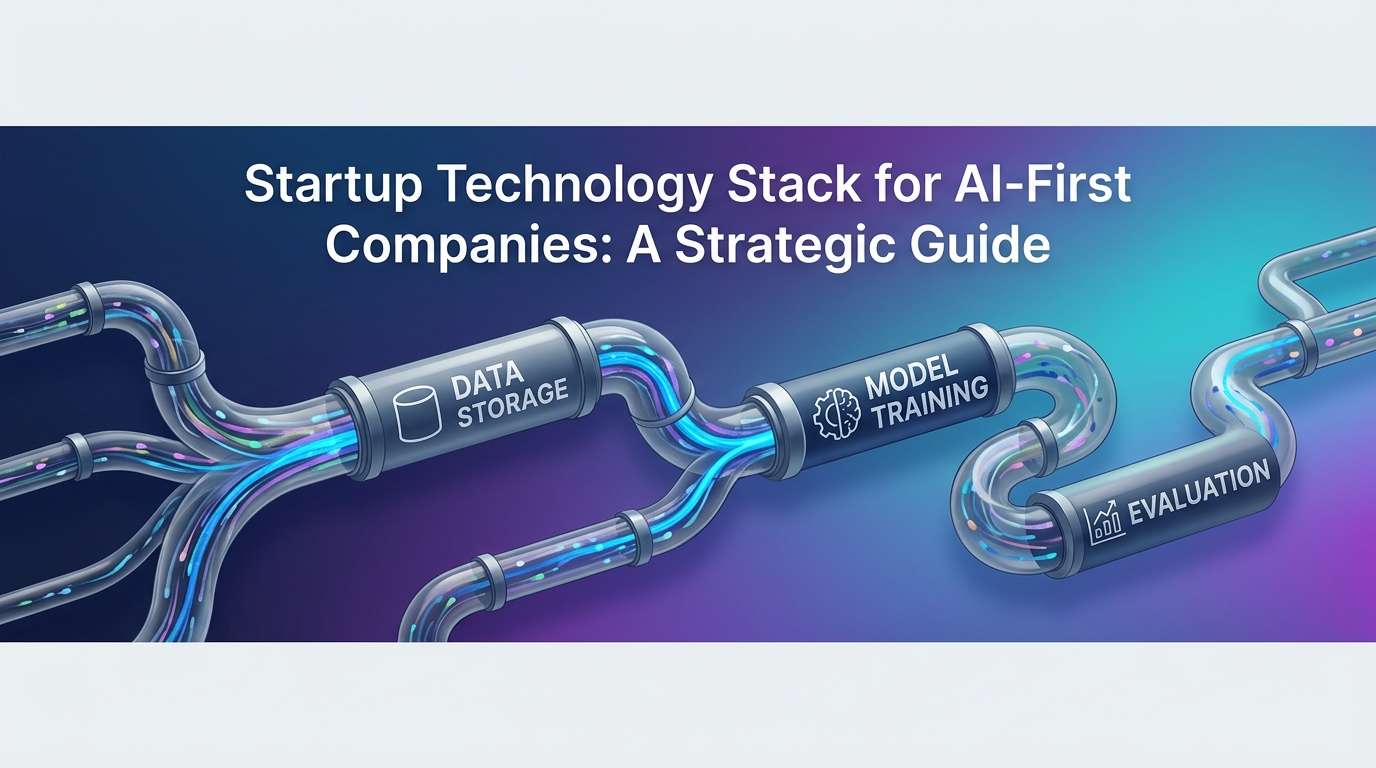
Launching an AI-first startup isn't just about groundbreaking algorithms; it's fundamentally about architecting a robust, scalable, and intelligent startup technology stack. Unlike traditional software ventures, building an AI-first product demands a unique set of considerations from day one, prioritizing data, models, and continuous learning above all else. This strategic guide will walk you through the core components and critical decisions necessary to build a resilient foundation for your AI innovation.
The AI-First Difference: Beyond Traditional Startup Technology
Forget the standard LAMP or MEAN stack. An AI-first company operates on fundamentally different principles, requiring a technology stack that is agile, data-centric, and designed for constant evolution. The core paradigm shifts from static logic to dynamic, probabilistic outcomes.
What Differentiates an AI-First Stack?
At its heart, an AI-first stack prioritizes data pipelines, model inference, and continuous evaluation loops over the more static concerns of traditional web application delivery. Your product is the intelligence, and that intelligence is only as good as the data it's trained on and the models that process it. This means:
Dynamic and Probabilistic Nature: Unlike deterministic software where
input Aalways yieldsoutput B, AI components often produce probabilistic or evolving results. The stack must be built to handle this uncertainty gracefully, providing fallback mechanisms, confidence scores, and pathways for human oversight.Inherent Need for MLOps and Observability: From the outset, robust observability, monitoring, and MLOps practices are non-negotiable. You need to know what your models are doing in production, how they're performing, and why they might be failing or deviating. This isn't an afterthought; it's part of the core product delivery.
Responsible AI from Inception: Ethical considerations, data governance, security, and responsible AI principles are core tenets from inception. Bias mitigation, fairness, explainability, and privacy aren't features to add later; they are design constraints that shape your data, models, and user interactions from the very beginning.
Key Challenges for AI-First Startups
The unique nature of AI brings its own set of formidable challenges that directly influence technology choices:
Data Bias and Quality: Ensuring high-quality, unbiased, and representative data is a continuous battle. Your stack needs tools for data cleaning, labeling, augmentation, and bias detection.
Model Drift: Models degrade over time as real-world data changes. The stack must support continuous retraining, monitoring for performance decay, and robust deployment pipelines for new model versions.
Cost Control for Inference: Running large language models (LLMs) or complex deep learning models can be astronomically expensive. Optimizing inference costs through efficient serving, batching, caching, and model quantization is crucial.
Managing Diverse Model Endpoints: As your product evolves, you might incorporate multiple models—some proprietary, some third-party APIs, some fine-tuned open-source. Managing these diverse endpoints, their APIs, latency, and dependencies requires careful architectural planning.
The Foundational Layer: Core Startup Technology Choices for AI
The bedrock of any AI-first startup technology stack begins with fundamental programming languages, frameworks, and backend services. These choices set the tone for development velocity, performance, and future scalability.
Programming Language: Python as the AI Lingua Franca
When it comes to AI and machine learning, Python is the undisputed champion. Its dominance stems from several key factors:
Extensive AI/ML Libraries: Python boasts an unparalleled ecosystem of libraries tailored for AI and ML, including:
Numerical Computation: NumPy, SciPy
Deep Learning Frameworks: PyTorch, TensorFlow, Keras
Traditional ML: Scikit-learn
Data Manipulation: Pandas
LLM Orchestration: LangChain, LlamaIndex
Vast Developer Ecosystem: The sheer number of developers, online resources, tutorials, and community support for Python is immense, making it easier to hire talent and find solutions to complex problems.
Readability and Rapid Prototyping: Python's clean syntax allows for quick iteration and prototyping, which is critical in the fast-paced environment of an AI startup.
While languages like Julia (for high-performance numerical computing) or R (for statistical analysis) have their niches, Python offers the most comprehensive and integrated experience for building an entire AI product.
Frontend Frameworks: Delivering AI Experiences with Speed
For delivering dynamic, AI-powered user interfaces with speed and an excellent developer experience, Next.js stands out as a strong contender.
Server-Side Rendering (SSR) & Static Site Generation (SSG): Next.js's ability to pre-render pages on the server or at build time significantly improves initial load times and SEO, crucial for user acquisition. For AI, this means that initial UI components can be rendered before an AI model's inference completes, providing a faster perceived experience.
Developer Experience (DX) and Fast Iteration: Built on React, Next.js offers a familiar and productive environment for frontend developers. Its file-system based routing, API routes, and built-in optimizations accelerate development cycles.
Seamless AI Integration: With API routes (built-in serverless functions), Next.js makes it straightforward to call your backend AI inference services or even directly integrate with third-party LLM APIs from the server, keeping API keys secure and potentially reducing client-side latency.
Other frameworks like Vue.js with Nuxt.js or even SvelteKit offer similar benefits, but Next.js holds a strong market share and community backing.
Backend Services: FastAPI vs. Node.js for AI Workloads
The choice of backend framework often comes down to team expertise and specific requirements. For AI workloads, two strong contenders are FastAPI and Node.js.
FastAPI: The Pythonic Choice for Performance
Strengths: FastAPI is a modern, fast (on par with Node.js and Go for API performance), Python-native web framework built for building APIs. Its key advantages for AI:
Direct Integration with AI Models: Since your AI models are likely in Python, FastAPI allows for seamless, high-performance integration. You can load models directly into your FastAPI application, avoiding inter-process communication overhead.
Asynchronous Support: Built on ASGI, FastAPI natively supports
async/await, enabling efficient handling of concurrent requests, crucial for serving multiple model inferences simultaneously.Automatic Documentation: Pydantic for data validation and OpenAPI for API documentation are built-in, saving development time and improving API usability.
from fastapi import FastAPI
from pydantic import BaseModel

app = FastAPI()

class PredictionRequest(BaseModel):
    text: str

class PredictionResponse(BaseModel):
    prediction: str
    confidence: float

# Assume your model is loaded here
# from your_ml_model import MyModel
# model = MyModel()

@app.post("/predict", response_model=PredictionResponse)
async def predict_text(request: PredictionRequest):
    # Placeholder for actual model inference
    # result = model.infer(request.text)
    # return PredictionResponse(prediction=result.prediction, confidence=result.confidence)
    return PredictionResponse(prediction=f"Processed: {request.text}", confidence=0.95)
Node.js: Broader Web Service Development and Real-time
Strengths: Node.js (with frameworks like Express.js or NestJS) is excellent for broader web service development, real-time features (websockets), and full-stack JavaScript teams.
Unified Language: If your frontend team is already proficient in JavaScript, a Node.js backend can streamline development and allow for full-stack developers.
Event-Driven, Non-Blocking I/O: Ideal for applications requiring high concurrency and real-time interaction, though less critical for pure model inference tasks compared to FastAPI.
Guidance:
Choose FastAPI if your primary backend logic revolves around serving Python-based AI models, and you prioritize raw inference performance and tight integration with your ML stack.
Choose Node.js if you have an existing JavaScript-heavy team, require extensive real-time web features beyond just model serving, or are building a broader application where AI is one component among many. Many startups even run both, with FastAPI serving ML endpoints and Node.js handling user management and general API.
The Data & Intelligence Layer: Models, Databases, and Vectors
This layer is where the "AI" truly resides. It encompasses your models, the data that fuels them, and the specialized databases required to manage embeddings and knowledge.
Choosing Your Foundation Model Provider: Managed vs. Open-Source
A critical early decision for any AI-first startup is how to acquire and manage foundation models (FMs).
Criteria for Selection:
Cost: API call costs, inference costs, fine-tuning costs.
Performance & Latency: Speed of response, crucial for user experience.
Fine-tuning Capabilities: Ability to adapt the model to your specific domain or data.
Data Privacy & Compliance: How is your data used? Is it retained? GDPR, HIPAA, CCPA compliance.
Model Size & Capabilities: The range of tasks the model can perform and its intelligence level.
When to Leverage Managed API Services (e.g., OpenAI, Anthropic, Google Gemini):
Rapid Prototyping: Get started immediately without infrastructure headaches.
Initial Deployment: Often sufficient for early-stage products to validate market fit.
Access to State-of-the-Art Models: Instantly use cutting-edge models without training them yourself.
Reduced Operational Overhead: No need to manage GPUs, scaling, or model serving infrastructure.
Example: Using OpenAI's GPT-4 API for a conversational agent or content generation.
import openai

openai.api_key = "YOUR_API_KEY"

response = openai.chat.completions.create(
    model="gpt-4",
    messages=[
        {"role": "system", "content": "You are a helpful assistant."},
        {"role": "user", "content": "Tell me a fun fact about AI."}
    ]
)
print(response.choices[0].message.content)
When to Consider Self-Hosting Open-Source Models (e.g., Llama 3, Mistral, Gemma):
Cost Control at Scale: As usage grows, self-hosting can become significantly cheaper than API calls, especially for high-volume inference.
Deep Customization & Fine-tuning: Full control over the model architecture and the ability to fine-tune with highly proprietary data.
Specific Privacy Needs: For sensitive data, self-hosting ensures data never leaves your infrastructure.
Edge Deployments: Deploying models on local devices or within specific network environments.
Decision Points: Start with managed services for speed and agility. As you scale, understand your cost curves, evaluate privacy requirements, and assess the benefits of customization. If cost, control, or unique fine-tuning become paramount, explore self-source options with infrastructure like NVIDIA's TensorRT-LLM or vLLM.
Vector Databases: Starting with pgvector, Evolving to Dedicated Solutions
For AI applications, especially those leveraging Large Language Models (LLMs) and Retrieval Augmented Generation (RAG), vector similarity search is fundamental.
pgvector: Early-Stage SimplicityUtility:
pgvectoris an extension for PostgreSQL that allows you to store and query vector embeddings directly within your existing relational database. For early-stage startups, it's incredibly useful as it leverages familiar infrastructure and avoids adding another database to manage.Use Case: Ideal for simple RAG implementations, small-to-medium datasets, and when you already use PostgreSQL. It allows you to store your text, its vector embedding, and any metadata in one place.
CREATE EXTENSION vector;
CREATE TABLE documents (
    id uuid PRIMARY KEY,
    content TEXT,
    embedding vector(1536) -- For OpenAI Ada-002, or adjust for your model
);
Dedicated Vector Databases: Scaling for Complexity
Trigger Points:
Scale: Tens of millions or billions of vectors.
Advanced Features: Complex filtering, multi-tenancy, real-time updates, hybrid search (combining keyword and vector).
Performance: Lower latency for very high QPS (queries per second).
Managed Service: Offloading operational overhead.
Solutions: Pinecone, Weaviate, Qdrant, Milvus. These are purpose-built for vector search, offering superior performance, scalability, and advanced features.
Recommendation: Begin with pgvector if you're already on PostgreSQL. It's easy to get started and sufficient for many early-stage needs. Plan for migration to a dedicated vector database as your data volume, complexity, and performance requirements grow.
Data Storage: Relational, NoSQL, and Object Storage
A comprehensive AI stack utilizes different data storage solutions for their specific strengths:
Relational Databases (e.g., PostgreSQL, MySQL):
Role: Storing structured data like user profiles, application metadata, transaction logs, and anything requiring strong consistency, complex queries, and ACID compliance.
pgvectorextends its utility for AI here.
NoSQL Databases (e.g., MongoDB, DynamoDB, Cassandra):
Role: Handling semi-structured or unstructured data, high-velocity data streams, and use cases requiring flexible schemas or massive horizontal scalability. Examples include user activity logs, feature flags, or caching inference results.
Object Storage (e.g., AWS S3, Google Cloud Storage, Azure Blob Storage):
Role: The workhorse for storing large binary objects like raw datasets (training, validation, test), model checkpoints, generated artifacts, images, videos, and audio files. It's cost-effective, highly scalable, and durable. This is often the primary storage for your AI factory.
The Operational Layer: Observability, MLOps, and Infrastructure
The intelligence in your AI product is only effective if it's reliable and performant in production. This layer focuses on bringing your models to life and keeping them healthy.
Essential Observability for AI Systems
Observability for AI goes beyond traditional application monitoring. You need deep insights into your models' behavior:
Model Performance Monitoring:
Accuracy/F1 Score: Track over time, especially after new deployments.
Drift Detection: Monitor for concept drift (relationship between input and output changes) and data drift (input data distribution changes).
Inference Latency: Ensure models respond within acceptable timeframes.
Error Rates: Identify model failures or unreliable predictions.
Resource & Cost Monitoring: Track GPU utilization, CPU, memory, and critically, API token usage and associated costs for managed foundation models.
User Feedback & Ground Truth: Integrate mechanisms to collect user feedback and compare model outputs to human-labeled ground truth for continuous improvement.
Recommended Tools:
For LLM Applications: Langfuse offers end-to-end observability, tracking traces, spans, inputs, outputs, costs, and latency for LLM calls.
For Experiment Tracking & Model Monitoring: Weights & Biases (W&B) or MLflow provide comprehensive platforms for logging experiments, tracking model metrics, versioning datasets, and monitoring model performance in production.
Traditional APM: Tools like Datadog, New Relic, or Prometheus/Grafana should still be used for infrastructure and application-level metrics.
MLOps & Deployment: From Experiment to Production
Getting a model from a Jupyter notebook to a production-ready, scalable service requires robust MLOps practices.
CI/CD Pipelines for App Code and ML Models:
Application Code: Standard CI/CD (GitHub Actions, GitLab CI, Jenkins) for building, testing, and deploying your API and frontend.
ML Models: Specialized pipelines for:
Data Validation: Ensuring incoming data meets quality standards.
Model Training: Automating the training process, logging metrics, and versioning artifacts.
Model Evaluation: Running comprehensive tests against new models.
Model Deployment: Canary deployments, A/B testing, and rollback strategies.
Containerization (Docker) and Orchestration (Kubernetes, AWS ECS/EKS, Google Kubernetes Engine):
Docker: Package your AI models and their dependencies into portable containers, ensuring consistent environments from development to production.
Kubernetes: For orchestrating containers at scale. It provides capabilities for automatic scaling, load balancing, and self-healing. Managed Kubernetes services (EKS, GKE, AKS) abstract away much of the complexity. For simpler deployments, AWS ECS or Google Cloud Run offer managed container execution without the full Kubernetes overhead.
Leveraging Cloud Providers (AWS, GCP, Azure):
Scalable Compute: Access to powerful CPUs and, crucially, GPUs for training and inference.
Managed Services: Cloud providers offer a plethora of managed services (e.g., AWS SageMaker, GCP Vertex AI) that simplify data processing, model training, and deployment.
Global Reach: Deploy your services closer to your users for lower latency.
Choosing a cloud provider often comes down to existing expertise, cost models, and specific managed services that align best with your startup's needs.
Strategic Considerations for Scaling Your Startup Technology
Building the initial stack is one thing; scaling it effectively while managing costs and risks is another. These strategic considerations are vital for long-term success.
Cost Management and Optimization Strategies
AI workloads, especially those involving large models and GPUs, can quickly become expensive. Proactive cost management is crucial.
Foundation Model APIs:
Intelligent Caching: Cache common LLM responses where appropriate to avoid redundant API calls.
Model Selection: Use smaller, cheaper models for simpler tasks or initial filtering, reserving larger models for complex scenarios.
Prompt Engineering: Optimize prompts to get desired results with fewer tokens.
Rate Limiting & Usage Quotas: Implement controls to prevent runaway costs from unexpected usage spikes.
GPU Compute:
Spot Instances: Utilize cheaper, interruptible spot instances for non-critical or batch training jobs.
On-Demand Scaling: Scale GPU resources up and down dynamically based on demand.
Model Quantization & Pruning: Optimize model size and complexity to reduce inference compute requirements.
Serverless Inference: Explore services like AWS Lambda with GPU support or specialized inference endpoints that scale to zero.
Data Storage:
Lifecycle Policies: Automatically move old data to cheaper archival storage tiers (e.g., S3 Glacier).
Data Deduplication: Avoid storing redundant copies of data.
Security, Governance, and Responsible AI Principles
These are not optional add-ons but fundamental aspects that must be designed into your stack from day one.
Robust Security Measures:
Authentication & Authorization: Implement strong access controls for all APIs and data.
Rate Limiting: Protect your endpoints from abuse and DDoS attacks.
Data Encryption: Encrypt data at rest and in transit.
Audit Logs: Maintain comprehensive logs for all critical system actions.
Vulnerability Scanning: Regularly scan your code and dependencies for security flaws.
Data Privacy & Governance:
Compliance: Adhere to regulations like GDPR, CCPA, HIPAA from the outset.
Data Anonymization/Pseudonymization: Implement techniques to protect sensitive user data.
Consent Management: Ensure proper consent for data collection and usage.
Responsible AI Principles:
Bias Mitigation: Actively work to detect and reduce bias in your training data and models.
Model Explainability: Where possible, provide insights into how your models make decisions, especially in sensitive applications.
Human-in-the-Loop: Design systems where human oversight or intervention is possible when AI outputs are critical or uncertain.
Build vs. Buy, Open-Source vs. Proprietary Decisions
Every component in your stack presents this fundamental dilemma. There's no single right answer, but a strategic framework can help.
Build In-House:
Pros: Full control, maximum customization, potential competitive advantage.
Cons: High development cost, ongoing maintenance burden, slower time to market.
When: For your core differentiating IP, where off-the-shelf solutions don't meet unique requirements.
Leverage Managed Services (Buy):
Pros: Faster time to market, reduced operational overhead, access to expert-managed solutions, scalability.
Cons: Vendor lock-in, recurring costs, less control over underlying infrastructure, potential feature limitations.
When: For non-differentiating infrastructure (databases, message queues, cloud compute) or highly complex components (foundation models) where you don't have core expertise.
Adopt Open-Source Solutions:
Pros: Cost savings (no licensing fees), community support, transparency, flexibility to customize.
Cons: Requires in-house expertise to implement and maintain, potential for fragmentation or lack of commercial support.
When: For mature, widely adopted components (e.g., Python libraries, Docker, Kubernetes) or when specific privacy/customization needs outweigh the benefits of managed services.
Trade-offs: Constantly evaluate the balance between development time, maintenance burden, vendor lock-in, and the strategic importance of each component. For a startup, lean towards "buy" or open-source solutions to accelerate time to market, reserving "build" for your core competitive advantage.
What's the one non-obvious technology choice that has significantly impacted your AI startup's trajectory, either positively or negatively? Share your experience below!
💬 Join the conversation — share your take in the comments and tell us what you’d add.