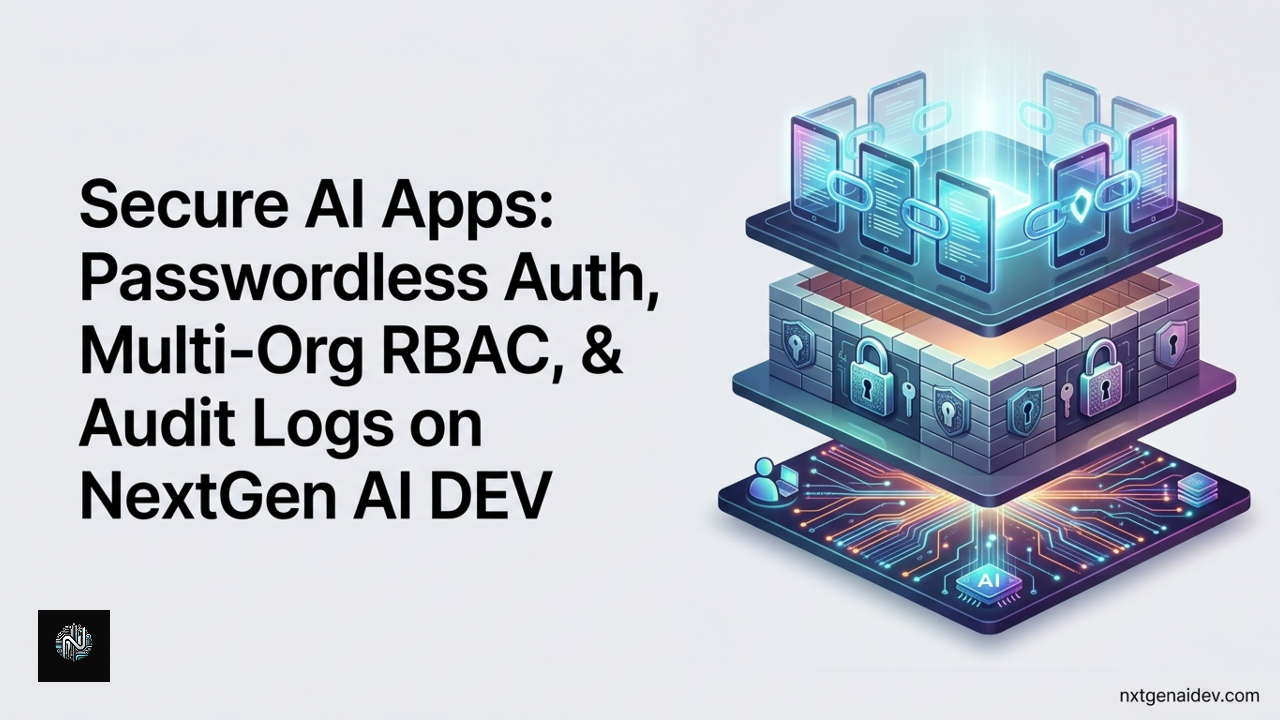
Secure AI Apps: Passwordless Auth, Multi-Org RBAC, & Audit Logs on NextGen AI DEV
Secure AI apps faster with passwordless auth, multi-org RBAC, and audit logs—simplify access control and boost visibility. Read more.
Developing cutting-edge AI applications brings unprecedented innovation, but it also ushers in a new era of complex security challenges. From safeguarding sensitive data processed by models to ensuring accountable actions by autonomous agents, the stakes for secure AI apps have never been higher, especially in dynamic, multi-tenant environments. Traditional security paradigms often fall short when confronted with the unique demands of AI, introducing vulnerabilities around data privacy, intricate access control to models and datasets, and maintaining transparent accountability.
This is precisely where NextGen AI DEV steps in. Our unified platform is engineered from the ground up to address these critical issues, providing an integrated suite of security features—including robust passwordless authentication, multi-organization role-based access control (RBAC), and comprehensive audit logs—all designed to empower developers to build and deploy secure, scalable AI applications with confidence.
The Imperative of Secure AI Application Development
The rapid evolution of AI technology, particularly in generative AI and autonomous agents, has amplified the need for a security-first approach to development. As AI applications move from isolated experiments to core enterprise operations and multi-tenant platforms, they inherit the complexities of securing not just user data, but also model intellectual property, sensitive prompts, and the outputs of AI inferences. Protecting these unique assets across diverse users, organizations, and AI models requires a sophisticated, integrated security architecture that most generic solutions simply cannot provide.
Consider a multi-tenant AI platform where numerous organizations leverage shared AI infrastructure. Each tenant has distinct data, models, and compliance requirements, demanding strict isolation and granular access controls. The rise of AI agents introduces further complexity, requiring mechanisms to track their actions, delegate authority, and ensure their decisions are auditable. Without purpose-built security, these environments become fertile ground for data breaches, unauthorized access, and compliance failures. NextGen AI DEV mitigates these risks by offering a unified platform where security is not an afterthought but an intrinsic part of the development lifecycle, providing integrated features that tackle these challenges head-on.
Streamlined Access with Passwordless Authentication for AI Platforms
The gateway to any application is authentication, and for AI platforms, traditional methods like passwords or static API keys pose significant security risks and user friction.
Why Passwordless is Essential for AI
Passwords are a common attack vector, prone to phishing, brute-force attacks, and credential stuffing. In a fast-paced AI development environment, managing a myriad of passwords for different tools and platforms is not only cumbersome for developers but also expands the attack surface. Similarly, static API keys, while convenient, lack dynamic control and can become a significant vulnerability if compromised, offering persistent access to critical AI resources without further verification. This outdated approach increases the likelihood of account takeover and complicates compliance with modern security standards.
The benefits of passwordless authentication are clear: enhanced security, a superior user experience, and simplified compliance. By eliminating the need for passwords, you remove the weakest link in the security chain, drastically reducing the risk of credential-related breaches. Users benefit from quicker, more intuitive login experiences, while organizations gain stronger assurances of identity and easier adherence to stringent security regulations.
NextGen AI DEV's Passwordless Implementation
NextGen AI DEV natively integrates robust passwordless options, making secure access seamless and efficient. Our platform supports single sign-on (SSO) for enterprise users, one-time passcodes (OTP) for versatile authentication, and modern passkeys for a frictionless, cryptographically secure login experience directly into your AI development environment. This comprehensive approach ensures that identity verification is strong without burdening users with complex passwords (How do I design passwordless authentication for a multi-tenant AI developer platform without increasing account takeover risk?).
Beyond just login, NextGen AI DEV ties passwordless identity directly to crucial operational aspects. This means user access is not merely granted but also intrinsically linked to their specific organization's credits, usage limits, and billing structures. For instance, a user authenticated via SSO will automatically be associated with their organization's allocated resources and billing profile, ensuring that access decisions for AI models and platform features depend on their verified identity and organizational membership, rather than static, easily compromised API keys (How can passwordless auth (OTP, social login, passkeys) be integrated with RBAC so that access decisions for AI models depend on roles and org membership rather than static API keys?). This integration creates a secure, accountable, and operationally efficient environment for all AI workloads.
Achieving Granular Control with Multi-Org RBAC for AI Workloads
In multi-tenant AI platforms, managing access for diverse users across various organizations and roles is a labyrinthine task, often leading to over-privileged access or operational bottlenecks.
Challenges of Multi-Tenant AI Authorization
Imagine an AI platform serving multiple enterprises, each with its own set of developers, data scientists, and project managers. Each organization requires strict isolation of its data, models, and configurations. Furthermore, within each organization, different roles need varying levels of access—a data scientist might need full access to specific datasets and model training environments, while a project manager only needs to view reports and deployment statuses. The complexity intensifies when considering not just human users, but also AI agents and automated tools that need programmatic access to models and datasets. Without a robust, granular RBAC system, ensuring strict tenant isolation and enforcing the principle of least privilege becomes incredibly challenging, increasing the risk of unauthorized data access or model manipulation (What is the best way to implement multi-org RBAC for AI models, agents, and datasets so that each tenant’s data and logs remain isolated?).
Moreover, granting sufficient flexibility for developers and data scientists to experiment with AI models and agents while maintaining strict security controls is a delicate balance. Overly restrictive policies stifle innovation, while overly permissive ones open doors to vulnerabilities. The ideal solution must enable fine-grained control over access to specific models, datasets, and configurations for both human users and AI agents, ensuring that every entity has precisely the permissions required for its function—no more, no less (How do I enforce least-privilege access for AI agents and tools while still giving developers and data scientists enough flexibility to experiment?).
NextGen AI DEV's Multi-Org RBAC in Action
NextGen AI DEV delivers governance-grade RBAC capabilities specifically tailored for the intricate demands of multi-tenant AI environments. Our platform allows you to define custom, organization-level roles that precisely map to the responsibilities within your team. For example, you can create roles like "Engineer," "Product Manager," "Auditor," or "Admin," and then map these roles to specific capabilities within NextGen AI DEV. An "Engineer" might have permissions to change model configurations and deploy new AI agents, while a "Product Manager" can view traces and performance metrics, and an "Auditor" can only access audit logs without any modification rights (How do I design org-level roles (e.g., engineer, PM, auditor, admin) for AI platforms and map them to capabilities like viewing traces, changing configs, and accessing audit logs?).
This level of granularity extends to every resource within the platform, including access to specific AI models (e.g., Anthropic, Together), datasets, and even specific API endpoints. NextGen AI DEV inherently ensures strict tenant isolation, guaranteeing that each organization's data and resources remain securely siloed. However, for use cases requiring collaboration, our RBAC system can also enable secure cross-org collaboration, allowing controlled sharing of specific resources while maintaining overall security and isolation boundaries. This flexibility ensures that security never becomes a barrier to innovation or necessary teamwork.
Comprehensive Visibility with Unified Audit Logs for AI Events
Understanding "who did what, when, and why" is fundamental to security and compliance. In the realm of AI, this visibility extends beyond traditional user actions to encompass the decisions and operations of AI models and agents.
The Unique Demands of AI Audit Trails
Traditional application logs typically focus on user interactions with defined APIs and databases. However, AI agent audit logs present a distinct set of requirements. They must capture not only the human user's intent but also the AI agent's identity, the delegation chains if the agent acts on behalf of another entity, and crucially, the model decisions, tool calls, and data accesses made during an agent's execution. Without this context, it's impossible to trace back an anomalous AI behavior or verify compliance with a specific policy. Simply put, AI agent logs need to answer "who did what, on whose authority, using which model, and with what outcome?" (Why AI agent audit logs are different from application logs?How should audit logs represent both human users and AI agents, including delegation chains and on-behalf-of token exchanges, so that we can later answer who did what, on whose authority?).
NextGen AI DEV's Integrated Logging Solution
NextGen AI DEV's integrated logging solution is purpose-built to meet these unique demands. Our platform automatically captures a comprehensive array of critical events, including: every inference request made to a model, every tool call executed by an AI agent, every data access operation, and every configuration change. Each log entry is enriched with essential context: the identity of the user or agent, the organization it belongs to, the specific AI model used, the prompt, the outcome, any policy decisions applied, and precise timestamps (Which events should be captured in audit logs for AI applications and agents to satisfy enterprise security and compliance requirements (e.g., NIST AI RMF, EU AI Act)?What are the minimum fields an AI platform needs to log for each model inference or agent tool call (user, org, model, prompt, tool, outcome, policy decision, timestamps)?). This detailed logging ensures that you have a complete, contextual audit trail for every action within your AI applications, vital for debugging, security analysis, and compliance with emerging standards like NIST AI RMF and the EU AI Act.
Recognizing the sensitive nature of AI prompts and outputs, NextGen AI DEV employs a sophisticated approach to privacy-preserving logging. This includes PII redaction to remove personally identifiable information, hashing of sensitive prompts or outputs to maintain data integrity without exposing raw content, and intelligent data classification. Furthermore, we implement robust role-scoped access to log details, ensuring that only certain privileged roles (e.g., "Auditor" or "Admin") can see full prompt/output bodies and other sensitive AI log data, while others can only view metadata or redacted versions, adhering to strict privacy and compliance mandates (How can an AI platform log prompts and outputs for debugging and compliance while preserving user privacy and sensitive data (e.g., hashing, redacting, classification)?What safeguards should be in place so that only certain privileged roles can see full prompt/output bodies and other sensitive AI log data, while others see metadata only?).
To further bolster security and compliance, NextGen AI DEV provides tamper-evident, append-only audit trails. This means once a log entry is created, it cannot be altered or deleted, ensuring the integrity of your audit history. Our platform offers configurable retention policies, allowing you to define how long logs are stored, and supports various exportable formats for easy integration with your existing security information and event management (SIEM) systems. This ensures that AI-specific context like model version, prompt, and agent identity are preserved when logs are exported, providing a seamless flow of intelligence into your broader security operations (How should we secure audit logs themselves in a multi-tenant AI platform, including role-based access to logs, tamper-evidence, and long-term retention policies?How can audit logs for AI workloads be exported and integrated into existing SIEM systems without losing AI-specific context like model version, prompt, and agent identity?).
Building a Robust Foundation with NextGen AI DEV's Unified Platform
Securing individual components of an AI application in isolation can lead to fragmented security postures and overlooked vulnerabilities. A holistic, integrated approach is paramount.
The AI Gateway Advantage
NextGen AI DEV distinguishes itself as a central AI gateway, fundamentally simplifying the complexity of AI security and management. This gateway unifies critical functions such as authentication, authorization, rate limiting, and audit logging across an expansive ecosystem of AI models and providers. With NextGen AI DEV, you can interact with 20+ models from 10+ providers—including leading services like Anthropic and Together—all through a single, consistent API. This eliminates the need to integrate and secure each model provider individually, drastically reducing development overhead and potential security gaps (What patterns exist for building a single AI gateway that centralizes authentication, RBAC, usage limits, and audit logging across multiple model providers and tools?). Our platform not only centralizes these critical security features but also integrates per-organization credits and robust usage analytics with low-credit alerts via Slack/Discord, ensuring complete financial and operational transparency.
End-to-End Security Architecture
The true power of NextGen AI DEV lies in its holistic, integrated security approach. Instead of piecemeal solutions—one for auth, another for RBAC, and yet another for logging—our platform provides an end-to-end security architecture that is designed to work seamlessly together. This unified approach eliminates compatibility issues, simplifies deployment, and ensures that security policies are consistently applied across all AI workloads and interactions. For developers, this means less time spent on infrastructure and more time on innovation, confident that the underlying security is robust and well-managed.
Furthermore, NextGen AI DEV is built to help organizations navigate the evolving landscape of AI governance frameworks and standards. By leveraging our integrated features for access control, data isolation, and comprehensive logging, developers can ensure that their AI applications are compliant with emerging regulations and best practices, such as NIST AI RMF and the EU AI Act. For enterprises with specific infrastructure requirements or strict data residency policies, NextGen AI DEV also offers self-hosted deployment options, providing maximum control and flexibility over your AI security environment.
Practical Steps to Secure Your AI Projects with NextGen AI DEV
Integrating NextGen AI DEV into your existing workflow is designed to be straightforward, enabling AI developers, CTOs, and product managers to quickly enhance the security posture of their AI applications.
Integrating NextGen AI DEV into Your Workflow
To begin, developers can start by routing their AI model calls through the NextGen AI DEV gateway. This immediately centralizes authentication and enables the enforcement of RBAC policies. CTOs and product managers can then leverage the intuitive dashboard to define organizational roles, set granular access permissions for models and data, and configure passwordless authentication methods. The platform's comprehensive audit logs will automatically begin capturing all AI-related events, providing immediate visibility and a foundation for compliance. Our robust API and comprehensive documentation ensure a smooth integration process, allowing teams to quickly leverage these powerful security features.
Example Use Cases for Enhanced Security
Consider a multi-tenant generative AI application that allows users to create content. With NextGen AI DEV, you can:
Secure Multi-Tenant Generative AI: Implement passwordless authentication for users logging into the content creation platform. Utilize multi-org RBAC to ensure that users from one organization cannot access or even view the generated content or prompts of another, while still allowing different roles within an organization (e.g., "Creator," "Editor") distinct permissions on their own content and associated models.
Fine-Grained Access for Data Science Teams: A data science team collaborating on sensitive models can use NextGen AI DEV's RBAC to grant specific team members access to particular model versions or experimental datasets, while restricting others to only view results or use stable models. Audit logs track every model inference, parameter change, and data access, ensuring accountability for sensitive AI development.
Compliance for Agent-Based Workflows: For AI agents performing automated tasks, NextGen AI DEV's audit logs capture every tool call and decision, including the agent's identity and the human user who initiated the agent's action. This provides an irrefutable trail for compliance, demonstrating adherence to policies even in complex, delegated agent workflows.
By leveraging NextGen AI DEV, teams can streamline complex security challenges, transforming them from daunting obstacles into manageable configurations. This allows your team to focus on what truly matters: innovating and delivering powerful, responsible AI solutions, knowing that your applications are built on a secure, compliant, and transparent foundation.
Ready to build secure, scalable AI applications? Explore NextGen AI DEV's unified platform today and revolutionize how you secure your AI workloads.