
Scalable AI SaaS Development: Key Architectural Patterns
SaaS Development insights for building scalable AI products with stronger architecture, better performance, and fewer costly mistakes. Read more.
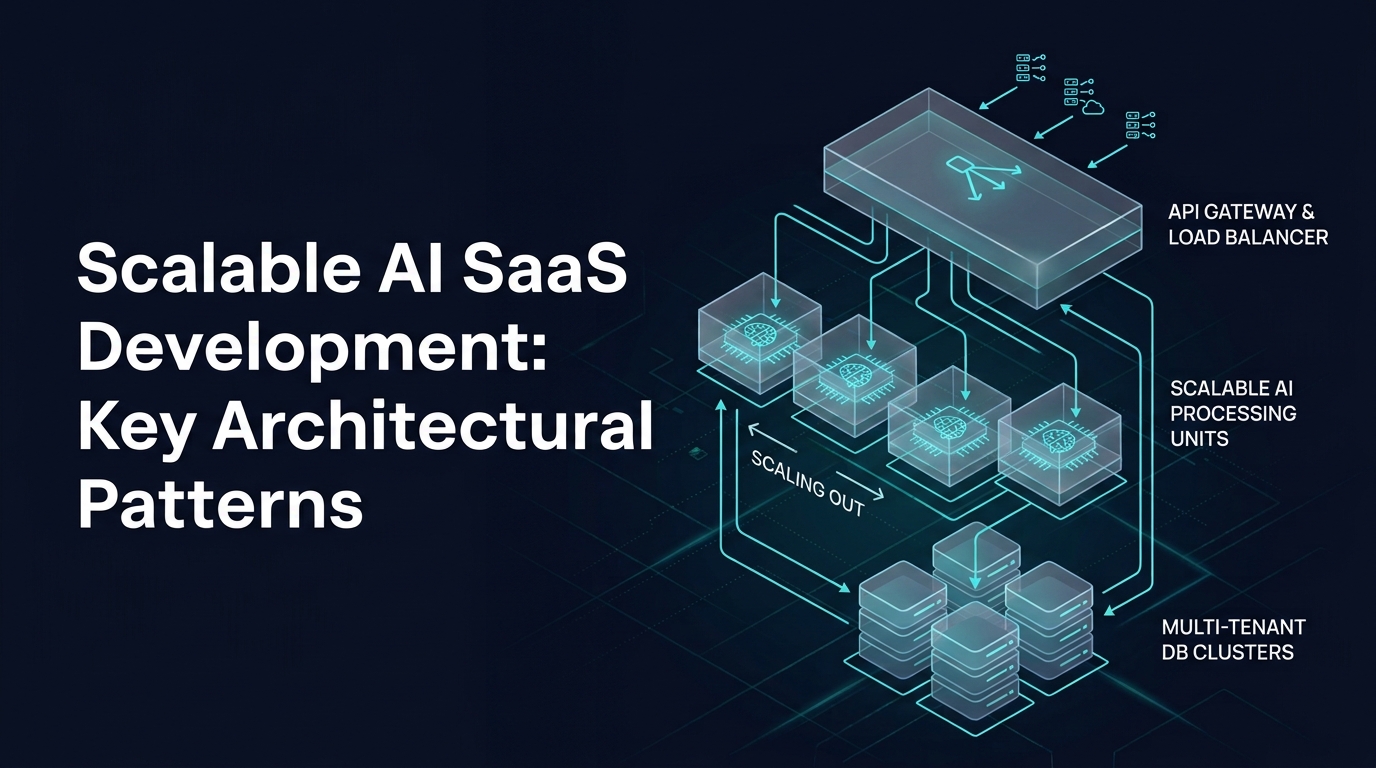
The landscape of software development is undergoing a seismic shift, driven by the rapid evolution and integration of artificial intelligence. While traditional SaaS products demand robust architectural considerations for scalability and reliability, building a truly scalable AI SaaS development platform introduces a new layer of complexity, demanding unique patterns and strategies. From managing unpredictable compute loads to handling sensitive multi-tenant data, the stakes are higher and the technical challenges more intricate.
This post will delve into the critical architectural patterns essential for constructing robust, high-performance, and scalable AI SaaS applications. We'll explore the foundational decisions that will empower your platform for future growth and innovation, ensuring that your initial architectural choices are not just temporary fixes, but strategic pillars supporting sustained success.
Foundational Architectural Layers for AI SaaS Development
At its core, a scalable AI SaaS platform is a symphony of interconnected services, each playing a vital role. Understanding and properly structuring these foundational layers is paramount.
Structuring Your Core AI Layers
A typical, well-architected AI SaaS platform often comprises several distinct layers, each responsible for a specific set of concerns:
API Gateway: The single entry point for all client requests. It handles authentication, authorization, rate limiting, and request routing to downstream services. This layer shields the complexity of your backend while ensuring secure and controlled access.
Orchestration Layer: This central nervous system manages complex, multi-step AI workflows. It coordinates interactions between different models, data sources, and services, often involving state machines or workflow engines to ensure process integrity and resilience.
Model/Inference Layer: Contains your AI models and the infrastructure to run inferences. This layer needs to be highly scalable, often employing autoscaling groups for GPUs or CPUs to handle fluctuating demand efficiently. It can host multiple models, optimized for different tasks or tenant needs.
Data/Vector Store Layer: Crucial for both traditional data storage and specialized AI data. This includes relational databases (PostgreSQL, MySQL), NoSQL databases (MongoDB, Cassandra), and increasingly, vector databases (Pinecone, Milvus, Weaviate) to store embeddings for efficient similarity search, particularly for RAG architectures.
Frontend/Client Applications: The user-facing interfaces (web, mobile, desktop) that interact with the API Gateway, presenting AI-driven insights and capabilities to end-users.
This layered approach allows for independent development, deployment, and scaling of each component, reducing interdependencies and improving overall system resilience.
Monolith vs. Microservices: Right-Sizing Your Architecture
The choice between a monolithic and a microservices architecture is one of the most significant early decisions in scalable AI SaaS development.
Monolithic Architecture: A single, tightly coupled codebase where all components of the application reside together.
Pros: Simpler to develop and deploy in early stages, easier to debug, fewer operational overheads initially. Good for small teams or rapid prototyping.
Cons: Can become unwieldy as complexity grows, scaling individual components is difficult, technology stack is usually uniform, high risk of "single point of failure."
When to choose: Early-stage startups, small teams, applications with well-defined, stable feature sets, or when speed to market is the absolute priority with limited resources.
Modular Monolith: A monolith designed with clear module boundaries, enabling independent development within a single deployment unit. Modules interact via well-defined interfaces, mimicking some benefits of microservices while retaining monolithic deployment simplicity.
Pros: Better separation of concerns than a pure monolith, easier to refactor into microservices later, still simpler to deploy than microservices.
Cons: Still scales as a single unit, potential for module coupling if not managed rigorously.
When to choose: Teams growing in size, applications with increasing complexity but not yet requiring extreme independent scaling, or as an intermediate step towards microservices.
Microservices Architecture: An application broken down into small, independent services, each running in its own process and communicating via APIs.
Pros: Independent scalability of components, technology stack diversity, fault isolation, easier to manage large teams, continuous deployment. Ideal for specialized AI workloads that have distinct scaling requirements (e.g., inference services).
Cons: Significant operational complexity (distributed tracing, service discovery, data consistency), increased network overhead, requires mature DevOps practices.
When to choose: Mature scale-ups, large teams, applications with highly diverse and demanding AI workloads, or when high fault tolerance and independent scaling of specific services (like LLM inference or RAG retrieval) are critical.
For AI SaaS, the ability to independently scale inference engines, data processing pipelines, or vector databases often pushes towards a microservices or at least a modular monolith approach for growth.
Decoupling Workloads with Asynchronous Queues
Many AI tasks, such as model training, complex inference, or data processing, are computationally intensive and can take significant time. Direct, synchronous API calls for these tasks can lead to timeouts, poor user experience, and scalability bottlenecks. This is where message queues and background workers become indispensable.
Message queues (e.g., Apache Kafka, AWS SQS, RabbitMQ, Google Cloud Pub/Sub) allow you to:
Decouple the client request from the AI processing: When a user triggers an AI task, an API service can quickly place a message on a queue and immediately return a response (e.g., "request received, processing in background").
Buffer requests: If a sudden surge of requests occurs, the queue can hold them, preventing your AI processing services from being overwhelmed.
Enable asynchronous processing: Dedicated background workers consume messages from the queue, process the AI task, and then potentially update a database or notify the user of completion.
Improve resilience: If a worker fails, the message can be retried by another worker, preventing data loss and improving system robustness.
For example, an image generation request might follow this flow:
Client Request -> API Gateway -> Orchestration Service -> (Puts message in Queue) -> (Returns "Processing")
Background Worker (listening to Queue) -> Picks up message -> Calls Image Generation Model -> Stores Result -> Notifies Orchestration Service -> Orchestration Notifies Client (e.g., via webhook/WebSocket)
This decoupling is a cornerstone of scalable AI SaaS, allowing individual components to scale based on their specific demand without impacting the responsiveness of the entire system.
Achieving Scalability with Asynchronous Processing and Robust Orchestration
Asynchronous processing and strong orchestration are not just good practices; they are foundational requirements for AI SaaS that must handle unpredictable loads and complex, multi-step workflows.
Implementing Async-First Workflows for AI Tasks
Given the nature of AI workloads, an async-first mindset is crucial. Here are common patterns:
Request Buffering and Task Queues: As discussed, clients make a non-blocking request, and the API gateway immediately queues the task. The API returns a
202 Acceptedresponse with a task ID.Polling: The client periodically checks the status of the task using the provided task ID.
# Example Polling Logic (simplified)
task_id = api_call_for_ai_task(input_data)
status = "pending"
while status == "pending":
    time.sleep(5) # Poll every 5 seconds
    status_response = api_call_get_task_status(task_id)
    status = status_response.get("status")
    if status == "completed":
        result = status_response.get("result")
        break
    elif status == "failed":
        error = status_response.get("error")
        break
Webhooks for Completion Notifications: For server-to-server communication, the AI processing service can send a POST request to a pre-registered webhook URL provided by the client upon task completion or failure. This avoids constant polling overhead for the client.
WebSockets for Real-time Updates: For interactive user interfaces, WebSockets provide a persistent, bi-directional communication channel. The client initiates a WebSocket connection, and the backend can push real-time updates (e.g., progress, intermediate results, final output) as they become available. This is ideal for streaming LLM responses or showing progress bars for lengthy tasks.
By combining these patterns, you can provide a responsive user experience even when underlying AI computations are complex and time-consuming.
The Central Role of Orchestration Services in AI
An explicit orchestration layer is often the secret sauce for managing the complexity inherent in distributed AI systems. It acts as the "traffic controller" and "project manager" for your AI workflows.
What an Orchestration Layer Does:
Manages Complex Workflows: For multi-step AI processes (e.g., user input -> data retrieval -> LLM inference -> post-processing -> external API call), the orchestrator defines and executes the sequence of operations.
State Management: It keeps track of the current state of each AI task, transitioning between stages (e.g.,
RECEIVED -> RAG_RETRIEVAL -> LLM_INFERENCE -> POST_PROCESSING -> COMPLETED).Error Handling and Retries: If a sub-component (e.g., a specific model inference service) fails, the orchestrator can implement retry logic, fallbacks, or mark the task as failed and notify.
Coordination Across Services: It intelligently routes requests to the appropriate models or microservices, ensuring they receive the necessary inputs and pass outputs correctly.
Governance and Observability: Provides a central point for monitoring the progress and performance of all AI tasks, enabling detailed logging, tracing, and auditing.
Tools like AWS Step Functions, Cadence, or even custom state machine implementations can form the backbone of this layer. For instance, a sophisticated RAG pipeline might involve steps for:
Input Pre-processing: Cleaning and parsing the user query.
Context Retrieval: Querying a vector database to fetch relevant documents.
Prompt Construction: Combining the original query with the retrieved context into a coherent prompt.
LLM Inference: Sending the prompt to the selected LLM.
Output Post-processing: Parsing, formatting, and validating the LLM's response.
Response Delivery: Sending the final answer back to the user.
An orchestration service makes defining, monitoring, and debugging such a flow far more manageable, improving reliability and operational efficiency.
Leveraging Retrieval-Augmented Generation (RAG)
Retrieval-Augmented Generation (RAG) has become a core pattern for grounding Large Language Models (LLMs) with up-to-date, proprietary, or domain-specific information, significantly enhancing their accuracy and reducing "hallucinations."
How RAG Works:
Indexing: Your proprietary data (documents, articles, internal knowledge bases) is chunked, embedded into vector representations, and stored in a vector database (e.g., Milvus, Pinecone, Weaviate).
Retrieval: When a user poses a query, the system first converts this query into a vector embedding. This query embedding is then used to perform a similarity search against the vector database to retrieve the most relevant data chunks.
Augmentation: These retrieved chunks of information are then dynamically prepended or inserted into the user's original prompt, creating an "augmented" prompt.
Generation: This augmented prompt is sent to the LLM, which then generates a response informed by both its pre-trained knowledge and the specific, retrieved context.
RAG's Fit in an Asynchronous AI Pipeline: RAG retrieval itself can be a computationally intensive step, especially with vast knowledge bases. It fits perfectly within an asynchronous orchestration layer. The "Context Retrieval" step mentioned earlier is precisely where RAG comes into play. By embedding RAG within your asynchronous pipeline, you ensure that the retrieval process doesn't block the main thread and can be scaled independently, contributing to a more responsive and accurate AI SaaS.
Multi-Tenancy and Robust Isolation in AI SaaS
Designing for multi-tenancy is fundamental for SaaS profitability, but in AI SaaS, it introduces unique challenges around data security, performance isolation, and cost attribution.
Strategies for Tenant Data Isolation
Ensuring one tenant's data is never visible or accidentally accessible by another is paramount.
Separate Databases Per Tenant:
Description: Each tenant gets their own dedicated database instance.
Pros: Strongest isolation, highest security, compliance for highly regulated industries, easier backups/restores per tenant.
Cons: Highest cost (database instances are expensive), higher operational overhead for management, patching, and scaling.
When to choose: Enterprises with strict security/compliance needs, very large tenants, or when cost is less of a concern.
Shared Database, Separate Schemas Per Tenant:
Description: All tenants share a single database server, but each tenant has their own schema within that database.
Pros: Good isolation without the high cost of separate instances, simpler management than separate databases.
Cons: Still requires careful schema management, potential for noisy neighbors if one tenant overloads the shared database server.
When to choose: Most common approach for balanced isolation and cost-efficiency.
Shared Database, Shared Schema with Row-Level Security (RLS):
Description: All tenants share the same database and schema, with a
tenant_idcolumn on every relevant table. Database-level RLS policies enforce that users can only see rows belonging to theirtenant_id.Pros: Lowest cost, easiest to manage (single schema), highly efficient resource utilization.
Cons: Most complex to implement correctly (RLS policies are tricky), security relies entirely on correct RLS implementation, potential for accidental data leakage if RLS isn't perfect.
When to choose: Startups or applications prioritizing cost efficiency and ease of feature development, with mature engineering teams capable of rigorous RLS implementation and testing.
Multi-Tenancy for Vector Databases: Vector databases typically handle multi-tenancy through:
Namespaces/Indexes: Many vector DBs support logical namespaces or indexes, allowing a single cluster to host distinct collections of vectors for different tenants, providing logical separation.
Dedicated Collections/Indices: For stricter isolation or higher performance, critical tenants might get their own dedicated collection or index.
Metadata Filtering: In a shared collection, each vector can be tagged with a
tenant_idmetadata field, and queries filter by this field to ensure only relevant vectors are retrieved.
Caching mechanisms (e.g., Redis) also need multi-tenant awareness, either by using tenant-specific cache keys (tenant_A:cache_key) or by deploying separate cache instances for critical tenants.
Failure Isolation and Blast Radius Reduction
In a multi-tenant environment, a problem with one tenant should never affect others. This concept is called failure isolation or "blast radius reduction."
Tenant-Specific Resource Pooling: For critical components like inference engines or GPU workers, consider dedicating a pool of resources for high-value or high-volume tenants. This ensures their operations are not impacted by other tenants' surges.
Rate Limiting: Implement rate limiting at the API Gateway and service level, both globally and per tenant. This prevents any single tenant from monopolizing resources or launching denial-of-service attacks.
Circuit Breakers: Implement circuit breaker patterns around external dependencies or services that might experience intermittent failures. If a service becomes unresponsive for a specific tenant, the circuit breaker can temporarily bypass it for that tenant, preventing cascading failures while allowing other tenants to continue operating.
Dedicated Queues/Workers: For particularly critical or high-volume AI tasks, assign dedicated message queues and worker pools to specific tenants. This ensures that their tasks are processed with guaranteed resources and are not stuck behind a backlog created by another tenant.
Bulkhead Pattern: Partition your service instances into separate groups (bulkheads), so that a failure or overload in one group does not bring down the entire system. For example, assign specific microservice instances to a group of tenants.
By proactively designing for failure isolation, you protect your business, maintain service level agreements (SLAs), and build trust with your customers.
Controlling Costs and Optimizing Performance with LLM Strategies
LLM usage can quickly become a significant cost center for AI SaaS. Intelligent strategies are needed to balance performance and expenditure.
Dynamic Model Routing for Cost Efficiency
Not every user query or task requires the most powerful, and expensive, LLM. A dynamic model routing layer can intelligently direct requests to the most appropriate model.
Implementation Strategies:
Prompt Characteristic Analysis: Analyze the input prompt for complexity, length, specific keywords, or sentiment.
Example: Short, factual questions might be routed to a smaller, cheaper model (e.g.,
gpt-3.5-turbo), while complex creative writing or code generation prompts go to a larger, more capable model (e.g.,gpt-4).
Tenant Tiers/Subscription Plans: Route requests based on a tenant's subscription level. Premium tenants might always access the best models, while freemium users are directed to cost-optimized alternatives.
Usage Patterns: If a tenant consistently uses the AI for simple summarization, route them to a specific model optimized for that.
Cost vs. Latency Optimization: For tasks where response time is critical but absolute accuracy less so, route to a faster, potentially cheaper model.
Fallback Strategies: If the primary model chosen is unavailable or fails, the routing layer can automatically fall back to a different model.
Effective Model Versioning: The routing layer should also manage different versions of the same model, allowing for A/B testing of new versions or rolling back to stable ones if issues arise. This can be as simple as a configuration table mapping
(tenant_id, task_type) -> (model_provider, model_name, version).
This approach ensures you're not overspending on compute for simple tasks while still delivering high-quality results where they truly matter.
Per-Tenant Cost Attribution and Budget Controls
To manage LLM costs effectively, you need granular visibility and control over usage per tenant.
Accurate Usage Tracking:
Token Usage: Crucially, track input tokens and output tokens for every LLM API call. Providers like OpenAI charge based on tokens.
Compute Time: If running models in-house or on dedicated instances, track GPU/CPU compute time per inference.
API Calls: Track the number of API calls made to LLM providers.
RAG Retrieval Costs: Include costs associated with vector database queries and document storage if they contribute significantly.
This data needs to be logged with
tenant_id,model_id,timestamp, andtask_type.Cost Attribution: Aggregate the tracked usage data and attribute it directly to each tenant. This allows you to generate detailed usage reports for billing, internal accounting, and for the tenants themselves.
Implementing Budget Caps and Automated Alerts:
Allow tenants (or internal admins) to set monthly or daily budget caps for AI usage.
Implement automated alerts (email, dashboard notifications) when tenants approach or exceed their budget limits (e.g., at 75%, 90%, 100%).
Throttling Policies: When a tenant reaches their budget cap, implement throttling policies. This could range from reducing their access to cheaper models, increasing inference latency, or temporarily pausing their access until the next billing cycle or a budget increase.
This level of detail and control is vital for transparency, preventing bill shock for your customers, and ensuring the profitability of your AI SaaS.
Advanced AI-Specific Observability and Prompt Management
Traditional observability metrics (CPU, memory, network, request latency) are important, but AI SaaS demands a deeper, more specialized set of metrics and a robust system for managing the core intelligence: prompts.
Comprehensive LLM Observability Metrics
Beyond traditional metrics, a comprehensive observability strategy for LLMs includes:
Token Usage: Input tokens, output tokens per request. This directly correlates to cost.
Inference Latency: Time taken for the LLM to generate a response (from sending prompt to receiving first token/last token).
RAG Retrieval Latency: Time taken to query the vector database and retrieve context for RAG.
Total Response Time: End-to-end latency from user request to final AI response.
Cost Per Request: Calculate the actual cost for each AI interaction, combining token usage, compute, and any API fees.
Hallucination Rates: While hard to automate perfectly, aggregate metrics from user feedback or automated checks to identify instances where the AI generated factually incorrect or nonsensical information.
User Satisfaction Signals: Capture explicit feedback (e.g., thumbs up/down buttons on AI responses) and implicit signals (e.g., does the user re-phrase the prompt, abandon the task).
Prompt Success Rate/Failure Rate: Track how often prompts lead to desired outcomes or encounter errors.
Correlation for Deep Insights: It's critical to correlate these metrics with:
Specific Prompt Versions: Which prompt template led to better results or higher costs?
Model Types: Does
gpt-4consistently outperformgpt-3.5-turbofor certain tasks, justifying its cost?Tenant IDs: Are certain tenants experiencing higher latency or hallucination rates?
RAG Context Size/Quality: How does the amount or relevance of retrieved context impact LLM output quality?
Dashboards showing trends for these metrics, broken down by model, prompt, and tenant, are invaluable for continuous optimization.
Prompt Engineering Lifecycle Management
Prompts are the "code" for LLMs, and they need to be managed with similar rigor. A robust prompt engineering lifecycle is essential.
Prompt Versioning: Just like code, prompts should be version-controlled. Store prompts in a Git repository or a dedicated prompt management system, allowing tracking of changes, history, and easy rollbacks.
A/B Testing Prompts: Experiment with different prompt variations to optimize for desired outcomes (e.g., accuracy, conciseness, tone, cost). Route a percentage of traffic to a new prompt version and compare metrics.
Automated Prompt Evaluation Pipelines: Integrate prompt evaluation into your CI/CD workflow.
Golden Datasets: Create a set of "golden" input prompts and their expected AI outputs. Automatically run new prompt versions against these datasets and compare outputs using metrics like ROUGE, BLEU, or semantic similarity.
Human-in-the-Loop Feedback: For tasks that are difficult to evaluate automatically, integrate human review into the pipeline for a subset of responses.
Semantic Similarity Scores: Use embedding models to compare the semantic similarity of generated responses to desired responses.
Robust Rollback Mechanisms: If a new prompt version performs poorly, you must have a quick way to roll back to a previous, stable version without service interruption. This can be achieved through configuration management that controls which prompt version is active.
Internal Prompt Playgrounds and Evaluation Dashboards: Provide tools for prompt engineers and product managers to easily experiment with prompts, test them against various inputs, and view performance metrics in a dedicated dashboard. This fosters rapid iteration and continuous improvement.
Treating prompts as first-class citizens in your development pipeline will significantly improve the quality, consistency, and cost-effectiveness of your AI SaaS.
Conclusion
Building a successful AI SaaS platform in today's dynamic technological landscape requires more than just innovative AI models; it demands a meticulously designed and rigorously implemented architecture. From establishing robust foundational layers and embracing asynchronous processing for unyielding scalability, to intelligently managing multi-tenancy and proactively controlling costs, every architectural decision has far-reaching implications.
By prioritizing advanced observability and implementing a mature prompt engineering lifecycle, you empower your team to iterate rapidly, maintain high quality, and stay competitive. A well-designed architecture is not merely a technical blueprint; it's the fundamental enabler for sustainable growth, continuous innovation, and enduring competitive advantage in the rapidly evolving world of AI.
What is the most challenging architectural decision you've faced when building a scalable AI SaaS product, and how did you resolve it?
💬 Join the conversation — share your take in the comments and tell us what you’d add.