
Robust API Development: Best Practices for Real-Time AI Applications
Master robust API development for real-time AI. Explore best practices for performance & scalability in AI applications. Start building better APIs today!
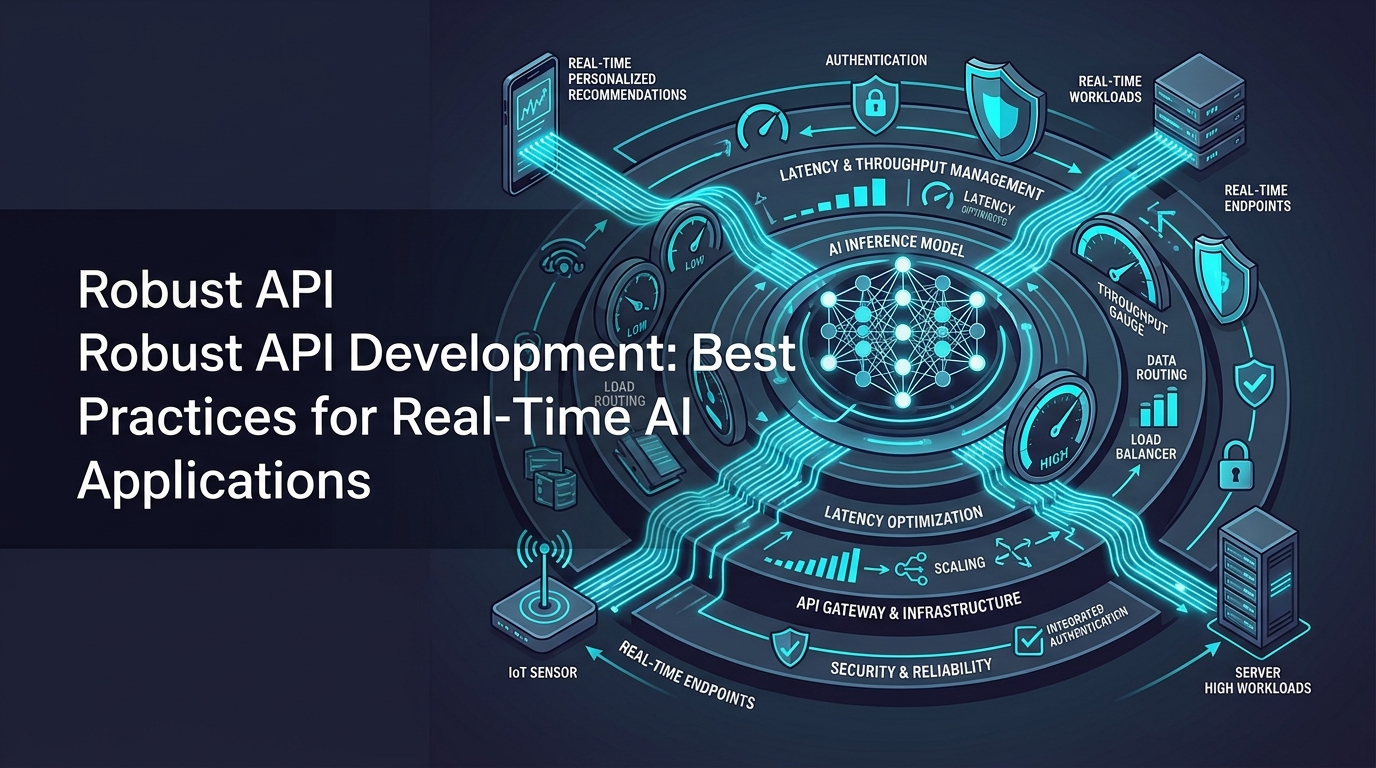
Real-time AI is no longer a futuristic concept; it's actively reshaping applications across every industry, from personalized recommendations to autonomous systems. Yet, harnessing the full power of these intelligent systems demands an API development approach that pushes traditional boundaries, addressing unique challenges like ultra-low latency, sky-high throughput, dynamic workloads, and the inherent complexity of sophisticated inference models. Crafting robust APIs for real-time AI applications requires a meticulous focus on performance, scalability, reliability, and security.
This article delves into practical strategies for building and optimizing such APIs, offering concrete architectural patterns, operational best practices, and design considerations to ensure your AI services perform at their peak, reliably and efficiently.
Introduction: The Unique Demands of Real-Time AI API Development
The integration of artificial intelligence into live applications introduces a new class of demands on API design and infrastructure. Unlike traditional CRUD operations, real-time AI API development contends with a distinct set of hurdles: achieving sub-millisecond latency for critical decisions, managing bursts of high throughput, accommodating dynamic and often unpredictable inference workloads, and handling the computational intensity of complex AI models—all while optimizing for cost.
These challenges necessitate a departure from conventional API paradigms. We'll explore practical strategies to ensure your AI APIs are not only performant and scalable but also reliable and secure, ready to power the next generation of intelligent experiences.
Architecting for Speed: Protocols and Asynchronous Patterns
The foundation of a real-time AI API lies in its architectural choices, particularly the communication protocols and execution patterns. Speed is paramount.
Choosing the Right Protocol for Low-Latency AI Inference
Selecting the appropriate communication protocol is the first critical step. Each has strengths and weaknesses for AI workloads:
REST (Representational State Transfer): Simple, stateless, and widely understood. Excellent for straightforward AI requests where minimal overhead and widespread compatibility are priorities.
Use Case: Simple classification, basic recommendation fetches, or short text summaries where a synchronous, request-response model suffices.
gRPC (gRPC Remote Procedure Call): Built on HTTP/2, gRPC offers significant performance advantages due to its use of Protocol Buffers for efficient serialization and multiplexed streams. It's ideal for high-volume, low-latency communication between internal microservices.
Use Case: High-volume internal microservices communication, real-time feature fetching for AI models, or streaming inference results from an edge device to a central model.
WebSockets: Provides full-duplex, persistent connections over a single TCP connection, enabling real-time, bidirectional communication. Perfect for scenarios requiring continuous updates.
Use Case: Live transcription services, real-time object detection in video streams, collaborative AI applications, or interactive chatbots where continuous dialogue is essential.
SSE (Server-Sent Events): A simpler, unidirectional alternative to WebSockets, allowing servers to push data to clients over a single HTTP connection. Useful when the client only needs to receive updates.
Use Case: Displaying continuous updates from a long-running AI process (e.g., progress of a complex image generation, real-time stock predictions).
Implementing Asynchronous Execution for AI Workloads
Many AI inference tasks, especially with larger models or complex data, can be long-running, taking seconds or even minutes. A synchronous API call would block the client, leading to poor user experience and resource exhaustion. This is where asynchronous execution becomes critical.
Common asynchronous patterns include:
Fire-and-Forget: The client makes a request and immediately receives an acknowledgment, without waiting for the actual result. The API assumes the background task will complete.
Example: Sending data for offline model retraining or logging analytics events.
Polling with Job IDs: The client initiates a long-running task and receives a unique
job_id. It then periodically polls a separate endpoint using thisjob_idto check the status or retrieve the result.// Initiate task POST /inference/summarize { "text": "Long article content..." } // Response HTTP/1.1 202 Accepted { "job_id": "b1a2c3d4e5f6", "status_url": "/inference/status/b1a2c3d4e5f6" } // Poll status GET /inference/status/b1a2c3d4e5f6 // Polling Response (pending) HTTP/1.1 200 OK { "job_id": "b1a2c3d4e5f6", "status": "processing", "progress": 70 } // Polling Response (complete) HTTP/1.1 200 OK { "job_id": "b1a2c3d4e5f6", "status": "completed", "result": { "summary": "..." } }Webhooks: For highly asynchronous operations, the API can call back to a client-provided URL once the task is complete. This eliminates the need for polling and reduces client-side complexity.
// Initiate task with webhook
POST /inference/generate_image
{
  "prompt": "futuristic city",
  "callback_url": "https://client.example.com/webhook/image_complete"
}

// Response
HTTP/1.1 202 Accepted
{ "job_id": "x9y8z7w6v5u4" }

// Server calls webhook when complete
POST https://client.example.com/webhook/image_complete
{
  "job_id": "x9y8z7w6v5u4",
  "status": "completed",
  "image_url": "https://api.example.com/images/x9y8z7w6v5u4.png"
}
Designing API endpoints that clearly communicate their asynchronous behavior (e.g., using 202 Accepted status codes and providing status_url or requiring callback_url parameters) is crucial for developer experience.
Leveraging Response Streaming for Perceived Latency
Even with asynchronous patterns, clients still wait for the full response. Response streaming (e.g., HTTP chunked encoding, SSE) delivers partial results faster, significantly improving the perceived latency for users.
HTTP Chunked Encoding: Allows servers to send data in a series of chunks without needing to know the total size upfront. This is often used for large file downloads or dynamic content generation.
SSE (Server-Sent Events): Specifically designed for streaming text-based events from the server to the client. Each event is a message terminated by
\n\n.// SSE example for LLM token streaming data: {"token": "The", "sequence": 1} data: {"token": "quick", "sequence": 2} data: {"token": "brown", "sequence": 3} data: {"token": "fox", "sequence": 4} data: [DONE] // Custom termination signal
Streaming is particularly effective for scenarios like token-by-token output from large language models (LLMs) or continuous data updates from a real-time monitoring AI. Designing API contracts for streaming responses means defining the structure of each chunk (e.g., JSON objects per line for SSE) and establishing clear termination signals.
Ensuring Scalability: Concurrency, Backpressure, and Caching
As your real-time AI API gains traction, managing increasing loads becomes paramount. Scalability measures are essential to maintain performance and stability.
Effective Rate Limiting and Backpressure Strategies
Rate Limiting is a client-side control, restricting the number of requests a single client can make within a given timeframe. It prevents abuse and ensures fair resource distribution. Backpressure is a server-side mechanism, signaling to upstream components when the server is overwhelmed, preventing overload and cascading failures. ([PAA: 'How do you handle rate limiting and backpressure in AI APIs?'])
Common rate limiting algorithms:
Token Bucket: A bucket holds tokens, refilling at a fixed rate. Each request consumes a token. If the bucket is empty, the request is rejected or queued.
Leaky Bucket: Requests are added to a queue (the bucket) and processed at a fixed rate. If the bucket overflows, new requests are rejected.
For AI APIs, rate limiting can be applied at the user, API key, or even IP level. Implementations often involve an API gateway or middleware.
Backpressure is crucial for protecting the underlying AI inference infrastructure. When the AI model or its hosting environment becomes saturated, the API should signal this to clients:
HTTP 429 Too Many Requests: Clients receive this status code, often accompanied by a
Retry-Afterheader indicating when they can retry.Queue-based Mechanisms: Requests can be temporarily queued if the inference service is busy. If the queue fills up, new requests are rejected or clients receive a
429.
Designing Intelligent Caching for AI Inference
Caching is a powerful tool to reduce latency and load on your AI models, especially for frequently accessed or computationally expensive inferences.
Opportunities for caching in AI:
Frequently Requested Embeddings: Reusing embeddings for common words, phrases, or entities.
Common Prompts/Responses: Caching the output of popular prompts that yield deterministic or near-deterministic results.
Model Weights/Layers: For dynamic model loading or transfer learning, caching parts of models.
Cache levels for AI APIs:
Edge/CDN Caching: For static assets or pre-computed, widely used AI outputs.
API Gateway Caching: Caching responses directly at the gateway layer for common requests.
In-Memory Caching (Application Layer): Fast caching within the application service for immediate reuse.
Distributed Caching (e.g., Redis, Memcached): Shared cache layer across multiple API instances.
Cache invalidation strategies for dynamic AI models require careful thought. Techniques include time-to-live (TTL) policies, explicit invalidation on model updates, or event-driven invalidation.
Request Coalescing and Load Shedding for Peak Performance
Request Coalescing: When multiple clients request the exact same AI inference (e.g., the same image embedding, the same LLM prompt), coalescing groups these identical requests into a single call to the underlying AI model. The result is then fanned out to all waiting clients, significantly reducing redundant computation.
Practical Example: A frontend application might make several requests for the sentiment of a popular news article as different users view it. Request coalescing ensures the sentiment model is only called once for that article.
Load Shedding: As a last resort during extreme load, load shedding prioritizes critical requests and gracefully rejects less critical ones to maintain the overall stability and performance of the API.
Practical Example: In a system with both critical (e.g., fraud detection) and non-critical (e.g., personalized ad generation) AI inferences, during a spike, the ad generation requests might be temporarily shed to ensure fraud detection remains responsive. This often involves configured thresholds and careful logging of shed requests.
Crafting Future-Proof API Contracts for AI Agents & Developers
An API's contract defines its usability and longevity. For real-time AI, clear, stable, and machine-readable contracts are vital for both human developers and autonomous AI agents.
Consumer-First Endpoint Design and Structured Outputs
Design your APIs from the perspective of the consuming application, whether that's a human developer building a frontend or an AI agent orchestrating complex workflows. This "consumer-first" approach leads to intuitive, predictable interfaces.
Clear, Semantic Naming: Endpoints and fields should be descriptive and unambiguous.
Bad:
/api/processGood:
/images/{id}/describe,/text/summarize
Structured, Predictable Output Schemas: AI outputs can be highly variable. Enforcing structured schemas (e.g., JSON, Protobuf) with well-defined data types ensures reliable consumption.
Example JSON output for an image description AI:
{
  "image_id": "img_12345",
  "description": "A vibrant cityscape at dusk with neon lights and tall skyscrapers.",
  "tags": ["city", "night", "neon", "skyscraper"],
  "confidence_score": 0.98
}
This structured output makes it easy for consuming applications to parse and utilize the information programmatically.
OpenAPI-Driven Contracts and Machine-Readable Specs
OpenAPI Specification (formerly Swagger) creates a single source of truth for your API contract, describing endpoints, parameters, authentication methods, and response schemas.
Benefits:
Human Developers: Automatically generated documentation, interactive API explorers, and client SDKs.
AI Agents: AI agents can read OpenAPI specs to understand available tools and their usage, enabling automatic tool invocation and parameter validation. This is crucial for agentic workflows.
Maintaining and evolving these specs often involves integrating their generation into your CI/CD pipeline, ensuring the documentation always reflects the current API.
Semantic Versioning and Backward-Compatible API Evolution
Semantic versioning (MAJOR.MINOR.PATCH) is critical for managing API evolution without breaking existing clients ([PAA: 'How do you version an AI API without breaking existing clients?']).
MAJOR: Incremented for incompatible API changes (breaking changes). Requires clients to update.
MINOR: Incremented for backward-compatible new features (e.g., adding an optional field).
PATCH: Incremented for backward-compatible bug fixes.
Strategies for backward compatibility:
Optional Fields: When adding new data, make new fields optional.
Graceful Deprecation: Clearly mark old endpoints or fields as deprecated, providing a timeline for removal.
Careful Endpoint Naming: Use versioning in the URL (e.g.,
/v1/inference) or via a custom header.
When a breaking change is unavoidable, clearly communicate the change, provide migration guides, and offer a reasonable transition period, potentially running multiple API versions simultaneously.
Unlocking Insights: Observability for Real-Time AI APIs
For real-time AI APIs, comprehensive observability is non-negotiable. It's how you ensure performance, diagnose issues, optimize costs, and understand model behavior in production.
Essential Metrics for Performance Monitoring
Standard API metrics provide the baseline for understanding health and performance:
Request Rate: Total requests per second/minute.
Error Rate: Percentage of requests resulting in errors (e.g., 5xx status codes).
Latency: Critical for real-time AI. Track average, P95, and P99 latencies for both overall API response and the underlying AI inference calls.
P95/P99 Latency: Tracking these percentiles (e.g., 95% of requests complete within X ms) is crucial because average latency can mask long tails of slow requests, which are particularly detrimental to real-time user experiences. ([PAA: 'How do you monitor performance and token usage in production AI APIs?'])
AI-Specific Metrics for Deeper Understanding
Beyond standard metrics, AI APIs require specialized instrumentation to gain deeper insights into model performance, cost, and capacity.
Token Usage (Input/Output): For LLM-based APIs, tracking the number of input and output tokens per request is vital for cost accounting and capacity planning.
Inference Cost: Track the actual cost per inference (if variable based on model size, time, or resource usage).
Queue Depth: Monitor the number of requests waiting for inference. High queue depth indicates saturation.
Model Saturation/Worker Saturation: The percentage of AI inference workers or GPU resources actively processing requests. High saturation suggests a need for scaling.
Provider Error Budgets: If relying on third-party AI models, monitor their error rates and ensure they align with your service level objectives.
Model-Specific Performance Metrics: E.g., accuracy, F1 score, BLEU score calculated on a subset of production data or against known benchmarks.
These metrics inform cost optimization strategies, capacity planning, and allow for proactive scaling before performance degrades.
Distributed Tracing for End-to-End Visibility
In a microservices architecture with multiple service hops and external AI calls, diagnosing latency bottlenecks or errors can be complex. Distributed tracing provides end-to-end visibility into a request's journey.
Each request is assigned a unique trace_id and broken down into spans, which represent operations within services (e.g., database calls, external API calls, AI inference calls). This allows you to visualize the entire flow, pinpointing exactly where delays or failures occur.
Best practices: Instrument your AI API services (and any downstream services) to propagate trace_id and span_id headers across all service boundaries and log the duration of key AI inference calls as individual spans.
Fortifying Your AI APIs: Security and Tenancy
Security is paramount, especially when handling potentially sensitive data or proprietary AI models.
Robust Authentication and Authorization
Authentication: Verify the identity of API callers.
API Keys: Simple for many applications, often used for identifying clients.
OAuth 2.0: Industry standard for delegated authorization, allowing users to grant third-party applications limited access. Ideal for user-facing AI applications.
JWTs (JSON Web Tokens): Compact, URL-safe means of representing claims to be transferred between two parties. Often used with OAuth 2.0.
Authorization (RBAC): Define what authenticated users or systems can do. Implement Role-Based Access Control (RBAC) for AI-specific actions, such as:
model:inference_accessmodel:fine_tunedata:read_embeddings
Multi-Tenant Isolation and Data Protection
When serving multiple customers or tenants from a single AI API, strict isolation is essential to prevent data leakage ([gap: multi-tenant isolation patterns]).
Tenant-ID Propagation: Ensure every request carries a tenant identifier that is strictly enforced at every layer of the API and underlying AI inference system.
Data Partitioning: Design databases and data stores to logically or physically separate tenant data.
Secure Storage of Sensitive Inputs/Outputs: Encrypt sensitive AI inputs (e.g., personal data for analysis) and outputs (e.g., medical diagnoses) both at rest and in transit (using TLS/SSL).
Access Control: Ensure AI models themselves cannot access data from other tenants, even if a programming error occurs upstream.
Abuse Prevention and Attack Mitigation
AI APIs are targets for various attacks:
Denial of Service (DoS/DDoS): Overwhelm the API with traffic. Mitigate with rate limiting, WAFs (Web Application Firewalls), and CDN protection.
Injection Attacks: Traditional SQL/NoSQL injection (if your AI API interacts with databases) and, crucially for LLMs, Prompt Injection. Filter and sanitize all user-provided prompts aggressively. Consider dedicated prompt safety layers.
Data Poisoning: Attempts to subtly manipulate training data to degrade model performance or introduce biases.
Signed Webhooks and Replay Protection: For event-driven architectures using webhooks, sign the webhook payloads with a secret key. The receiver can verify the signature to ensure the request originated from a trusted source and hasn't been tampered with. Implement replay protection by including a timestamp and a unique nonce in the payload, rejecting requests that are too old or have been seen before.
Regularly monitor for unusual usage patterns (e.g., sudden spikes in requests from a single IP, unexpected error rates, strange prompt content) that could indicate abuse or attack attempts.
What is the most significant challenge you've encountered when trying to achieve low-latency responses for real-time AI applications, and how did you address it?
💬 Join the conversation — share your take in the comments and tell us what you’d add.