
Resilient AI System Design: Principles for Fault Tolerance and Self-Healing
Learn essential system design principles for fault-tolerant AI systems. Discover how to create self-healing architectures today!
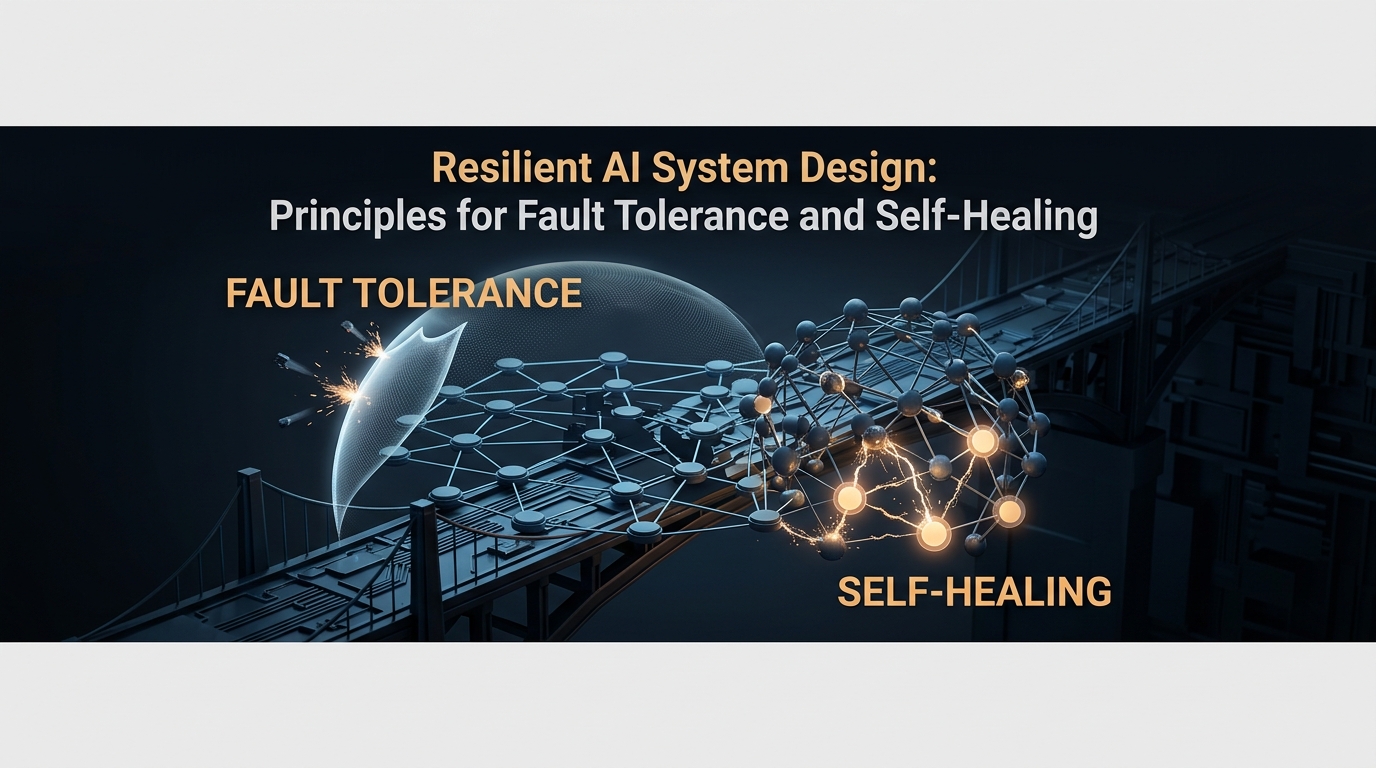
The stakes for AI deployments have never been higher. From guiding autonomous vehicles to powering critical financial systems, AI is increasingly making decisions that impact lives and livelihoods, which means ensuring these systems remain operational and accurate, even when faced with unforeseen challenges, is paramount. This necessitates a robust approach to resilient AI system design, focusing on principles that guarantee fault tolerance and self-healing capabilities.
The Imperative of AI Resilience: Why Your System Needs It
AI resilience is the ability of an AI system to maintain its intended functionality and performance despite internal or external disruptions, failures, or adversarial conditions. In today's rapidly evolving technological landscape, where AI is integrated into everything from mission-critical infrastructure to personalized user experiences, this resilience isn't just a desirable feature—it's an absolute necessity.
Consider the implications of an AI system failure in areas like healthcare diagnostics, autonomous driving, or fraud detection. A lapse in functionality can lead to severe consequences: incorrect decisions, service outages, significant financial losses, and a profound erosion of user trust. The industry's accelerating shift towards autonomous operations further elevates this need, as systems are increasingly expected to operate without constant human oversight, making their capacity to withstand and recover from faults independently critical. Non-resilient AI introduces unacceptable risks, manifesting as unpredictable downtime, unreliable outcomes, and a direct threat to business continuity. This vulnerability is compounded by the increasing complexity and sheer scale of modern AI systems, often distributed across various services, clouds, and data sources, making traditional error handling insufficient.
Deconstructing Resilience: Fault Tolerance vs. Self-Healing
While often used interchangeably, fault tolerance and self-healing represent distinct yet complementary pillars of AI resilience. Understanding their nuances is crucial for designing robust systems.
Understanding Fault Tolerance in AI Systems
Fault tolerance refers to an AI system's inherent ability to continue operating without interruption, or with minimal degradation, even when one or more of its components fail. It's about designing systems that can withstand and gracefully adapt to errors rather than crashing.
Common fault-tolerant techniques include:
Redundancy: This is a foundational principle.
Model Ensembles: Instead of relying on a single model, deploying multiple models (e.g., a voting classifier where several models predict, and the majority vote determines the output) provides inherent robustness. If one model produces an outlier prediction or fails, others can compensate.
Active-Passive or Active-Active Setups: For critical AI services, running duplicate instances where one is active and the other is a passive standby (or both are active, distributing load) ensures that if the primary instance fails, traffic can be seamlessly rerouted.
Error Detection and Correction: Implementing mechanisms like checksums for data integrity, input validation filters, or anomaly detection on intermediate model outputs helps identify issues before they propagate.
Graceful Degradation: Rather than a hard stop, a fault-tolerant system might reduce its service quality (e.g., respond slower, use a less accurate but more robust fallback model, or provide partial functionality) to remain operational during a disruption.
However, AI introduces unique challenges that go beyond traditional software fault tolerance. Issues like model drift (where model performance degrades over time due to changes in data distribution), subtle data corruption that doesn't trigger standard error codes, or sophisticated adversarial attacks designed to trick models, require AI-specific fault tolerance strategies.
The Power of Self-Healing AI
Self-healing goes a step further than fault tolerance, enabling an AI system to automatically detect, diagnose, and recover from failures without human intervention. It’s about proactive and autonomous restoration of full functionality.
Examples of self-healing mechanisms include:
Automated Model Retraining: If monitoring detects a significant drop in model accuracy or an increase in bias, the system can automatically trigger a retraining pipeline using fresh data.
Dynamic Resource Allocation: When an AI service experiences a sudden surge in load or a compute node fails, the system can automatically provision new resources (e.g., spin up more GPU instances) or reallocate existing ones.
Configuration Adjustments: Parameters or thresholds can be automatically tuned. For instance, if an anomaly detection model starts producing too many false positives, its sensitivity threshold might be automatically adjusted within safe bounds.
The role of proactive fault mitigation is central to self-healing. This involves anticipating potential failure modes and building in mechanisms to prevent them or minimize their impact. Integrating advanced AI/ML techniques into the self-healing process itself is a powerful approach. For example, a meta-AI model could monitor the health of other AI services, predict impending failures based on telemetry, and initiate recovery actions before a full outage occurs.
Crucially, feedback loops and continuous learning are integral to effective self-healing. A system doesn't just recover; it learns from each incident, refining its recovery strategies and improving its resilience over time. When a self-healing action is triggered, the outcome is monitored, and this data feeds back into the system to optimize future responses.
Overcoming Obstacles: Common Challenges to AI Resilience
Designing resilient AI systems is a complex endeavor, fraught with unique challenges that often stem from the nature of AI itself.
A primary concern is data quality issues, coupled with data drift and concept drift. Data drift occurs when the statistical properties of the target variable change over time, while concept drift refers to changes in the relationship between input and output variables. Both can severely degrade model performance without explicit software failures. Imagine a fraud detection model trained on historical patterns suddenly facing new, sophisticated fraud schemes; its effectiveness would plummet.
Model fragility and sensitivity to unseen or out-of-distribution data is another significant hurdle. AI models, especially deep learning networks, can perform exceptionally well on data similar to their training set but falter unpredictably when encountering novel inputs. This makes them vulnerable to "edge cases" that were not adequately represented during training.
The inherent complexity of distributed AI architectures and their intricate dependencies adds another layer of difficulty. Modern AI systems often consist of numerous microservices, data pipelines, model serving endpoints, and infrastructure components, all needing to communicate seamlessly. A failure in one seemingly minor component can cascade, causing widespread disruption.
Adversarial attacks represent a growing security concern, actively undermining AI reliability. These deliberate manipulations of input data (e.g., adding imperceptible noise to an image to make a classifier misidentify an object) can force an AI system to make incorrect decisions, even if the system itself is technically "operational."
Furthermore, diagnosing failures in opaque or "black-box" AI models is notoriously difficult. Unlike traditional software with clear error logs, determining why an AI model made a particular incorrect prediction, or why its performance suddenly degraded, often requires extensive analysis and deep domain expertise due to limited explainability. This lack of transparency complicates the design of automated diagnostic and recovery mechanisms.
Finally, the challenge of integrating and maintaining resilience across diverse AI components and services within a complex ecosystem is substantial. Different models, frameworks, data stores, and deployment environments each have their own failure modes and recovery strategies, making a unified, resilient architecture difficult to achieve.
Principles for Robust AI System Design: Achieving Fault Tolerance
Building fault tolerance into AI systems requires a strategic application of proven engineering principles, adapted for the unique characteristics of AI.
Redundancy and Diversity
To mitigate single points of failure, redundancy and diversity are critical.
Implement Model Ensembles: Beyond basic voting classifiers, consider more sophisticated ensemble techniques.
Bagging (Bootstrap Aggregating): Training multiple models on different subsets of the training data and averaging their predictions (e.g., Random Forests).
Boosting: Training models sequentially, with each new model trying to correct the errors of the previous ones (e.g., Gradient Boosting Machines).
Stacking: Training a meta-model to combine the predictions of several base models. This can significantly improve robustness against individual model failures or biases. If one model produces an outlier, the ensemble's aggregate prediction is less likely to be swayed.
Utilize Data Replication and Robust Backup Strategies: For both training data stores and inference data (feature stores, input queues), implement robust replication across multiple storage devices or geographic locations. Regular, verified backups are essential to recover from data corruption or loss. Consider immutable data architectures where historical data versions are always available for retraining or auditing.
Design for Infrastructure Redundancy: For critical AI services, deploy across multiple availability zones or regions in a cloud environment (multi-cloud or multi-region deployments). If one region experiences an outage, traffic can be seamlessly routed to another, ensuring continuous service.
Isolation and Containment
Preventing failures from cascading across the entire system is paramount.
Apply AI-Specific Circuit Breakers: Just like in electrical systems, circuit breakers prevent an overstressed or failing component from taking down dependent services. For AI, if a model service's latency spikes, error rate increases, or prediction confidence drops below a threshold, the circuit breaker can "open," preventing further requests from reaching it.
if (model_service.is_unhealthy()):
    // Redirect to a fallback model or return a default/cached response
    return fallback_prediction()
else:
    return model_service.predict(input_data)
The circuit can "half-open" periodically to check if the service has recovered.
Use Bulkheads to Compartmentalize Resource Usage: Inspired by shipbuilding, bulkheads in AI design involve isolating resources so that a failure in one component doesn't exhaust shared resources needed by others. For example, dedicating separate thread pools, memory segments, or compute instances for different AI microservices or data pipelines prevents one runaway process from consuming all available resources.
Implement Rate Limiting and Throttling: For API calls to your AI services, enforce limits on the number of requests a client can make within a given period. This prevents malicious attacks or unintentional overload from overwhelming your services and ensures stable operation for legitimate users.
Observability and Monitoring
You can't fix what you can't see. Comprehensive monitoring is the eyes and ears of a resilient AI system.
Establish Comprehensive Logging and Metrics: Beyond standard infrastructure metrics (CPU, memory, network), monitor AI model-specific performance indicators in real-time.
Drift: Track changes in input data distribution (data drift) and changes in the relationship between inputs and outputs (concept drift).
Bias: Monitor fairness metrics to detect unintended bias amplification.
Latency and Throughput: For operational efficiency.
Accuracy, Precision, Recall, F1-score: For model quality.
Prediction Confidence: Many models output a confidence score; track its distribution.
Implement Real-time Anomaly Detection: Apply anomaly detection algorithms to both operational infrastructure metrics (e.g., unusual CPU spikes, network egress) and, crucially, to model-specific output metrics. For example, an unexpected drop in average prediction confidence, a sudden increase in a specific error class, or unusual patterns in model outputs can signal an emerging problem.
Describe How Confidence Degradation Can Trigger Actions: If your model's average prediction confidence for a given class of inputs falls below a predefined threshold, this can serve as a powerful trigger. This degradation might initiate fault-tolerant mechanisms (e.g., rerouting to a more robust, albeit potentially slower, model) or flag the event for human intervention, preventing low-confidence, potentially incorrect decisions from being acted upon.
Engineering Self-Healing Capabilities into AI Workflows
Moving beyond merely tolerating faults, true resilience embraces self-healing—the ability for AI systems to fix themselves.
Automated Recovery and Rollbacks
Fast, automated recovery mechanisms minimize downtime and impact.
Implement Automated Model Deployment Pipelines with Rollback: Your CI/CD pipeline for AI models (MLOps pipeline) must include built-in rollback capabilities. If a newly deployed model version shows significant performance degradation, increased errors, or adverse effects (e.g., higher latency, bias, or unexplained behavior) during canary testing or A/B testing, the system should automatically revert to the previous stable version. This requires versioning of models, code, and configurations.
Design Systems for Automated Restart or Reprovisioning: For failed AI services, containers, or even entire compute nodes, implement automatic restart policies. Container orchestration platforms like Kubernetes are excellent for this, as they can detect unhealthy pods and automatically restart them or schedule them on healthy nodes. For more persistent issues, automated reprovisioning can bring up entirely new instances, ensuring failed components are replaced quickly.
Adaptive Learning and Retraining
AI systems should learn and adapt to maintain performance.
Mechanisms for Continuous Monitoring of Model Performance Degradation: Beyond point-in-time metrics, continuously monitor the trend of model performance. MLOps platforms (e.g., MLflow, Kubeflow, Sagemaker) offer tools to track metrics over time, detect drift, and visualize performance degradation. Set up alerts for when accuracy drops, or drift scores exceed thresholds.
Trigger Automated Retraining Pipelines: When continuous monitoring detects performance metrics falling below predefined thresholds or when significant data or concept drift is identified, an automated retraining pipeline should be triggered. This pipeline should:
Collect fresh, relevant data.
Preprocess the data.
Train a new model version.
Evaluate the new model against the old one (A/B testing, champion/challenger).
If the new model is superior, deploy it automatically.
Importance of Data Versioning and Lineage: For reliable and reproducible retraining processes, robust data versioning and lineage tracking are paramount. You must know exactly which dataset version was used to train which model version, and where that data originated. This ensures that when retraining is triggered, the correct, relevant data is used, and the process can be audited and debugged if necessary.
Intelligent Orchestration and Resource Management
Leverage AI to manage the AI itself.
Dynamic Scaling of Computational Resources: Based on real-time load, performance metrics, or even predictive forecasts (e.g., anticipating peak usage times), AI systems can dynamically scale computational resources. If inference requests spike, more GPU instances are spun up. If a model's processing queue grows, more workers are added. This prevents overload and ensures consistent performance.
Intelligent Routing and Load Balancing: Instead of simple round-robin load balancing, an intelligent system can direct requests away from unhealthy services, underperforming models, or regions experiencing high latency. This can be achieved using reinforcement learning models that optimize traffic flow based on real-time service health and performance metrics.
AI for Security Self-Healing: AI can be used to enhance its own security self-healing. For example, an AI-powered intrusion detection system might identify an anomalous access pattern to an AI model's API, automatically block the suspicious IP, and trigger a security audit or a password rotation for the compromised service account without human intervention.
The Human Element: Balancing Autonomy with Oversight
While self-healing capabilities aim for maximum autonomy, completely eliminating human involvement in AI system management is often neither practical nor desirable. The human element remains crucial for true resilience.
It's vital to define clear human intervention points within highly autonomous AI systems. These are specific junctures where the system might pause, escalate, or seek approval before taking critical actions, especially for decisions with high impact or when faced with unprecedented anomalies that fall outside its trained recovery mechanisms.
Implementing 'human-in-the-loop' mechanisms is essential for critical decisions, complex problem-solving, or when dealing with unhandled anomalies. For instance, if an automated retraining pipeline produces a model that performs poorly on a specific, sensitive subset of data, a human expert might be alerted to review the data, model architecture, or hyperparameters before deployment. This ensures that while AI handles routine failures, human judgment guides the response to novel or high-stakes situations.
Furthermore, transparent reporting and explainability for self-healing actions and system status are non-negotiable. Humans need to understand why a self-healing action was taken, what its outcome was, and the current health of the system. This explainability fosters trust and allows human operators to learn from automated responses, fine-tuning the system's rules or models over time. This also facilitates auditing and regulatory compliance. The trend is not to eliminate humans but to empower them with better tools and insights, balancing increased AI autonomy with appropriate human oversight and control, ensuring that the system operates safely, reliably, and ethically.
Considering the principles of fault tolerance and self-healing, what is the most challenging aspect you've encountered when designing resilient AI systems, and how did you address it in your own projects?
💬 Join the conversation — share your take in the comments and tell us what you’d add.