Platform Engineering for AI: Building Future-Ready Internal Developer Platforms
Master platform engineering to create AI-ready internal developer platforms that enhance efficiency and productivity. Start building today!
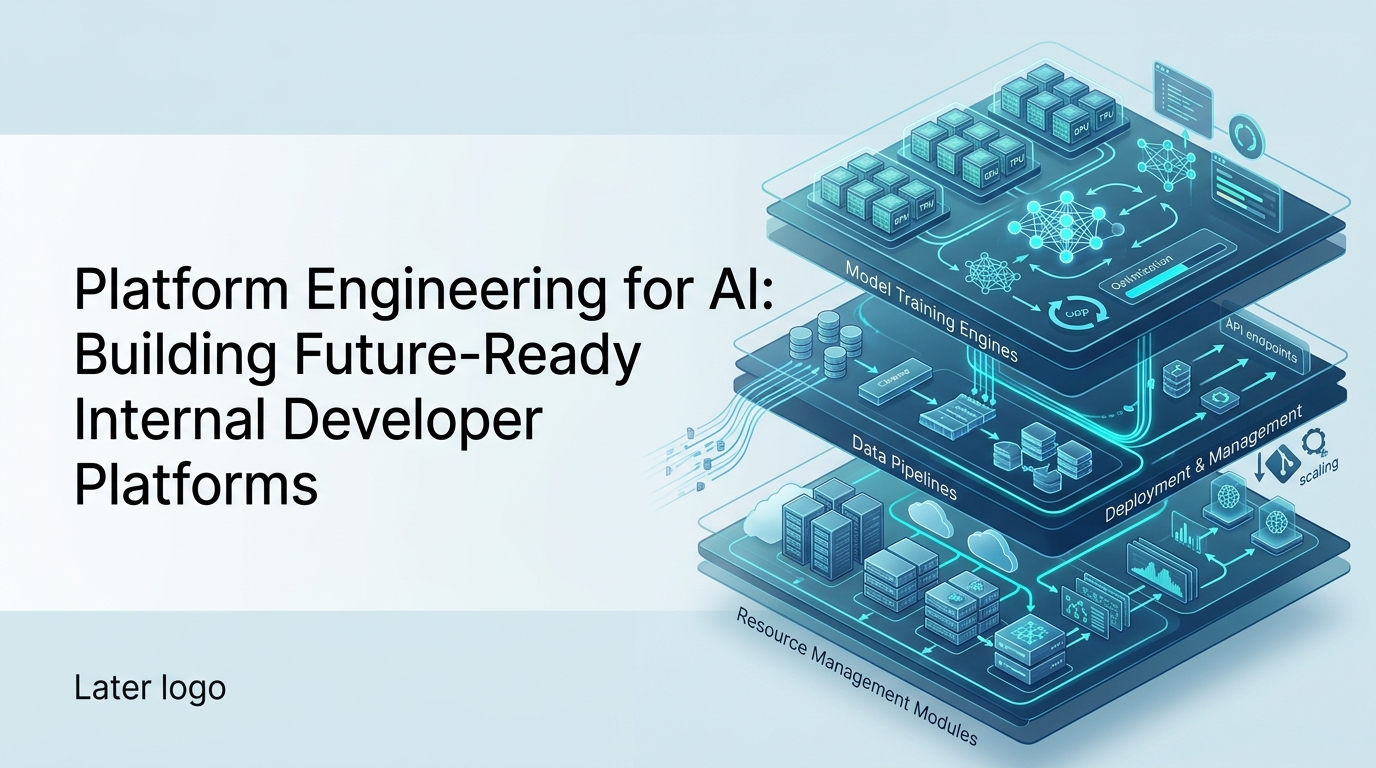
The AI revolution is not just changing what applications do, but fundamentally transforming how they are built. As organizations race to integrate artificial intelligence across their products and operations, the unsung hero enabling this acceleration is Platform Engineering for AI, delivering future-ready Internal Developer Platforms (IDPs). Traditional IDPs, designed for conventional software development, now face unprecedented demands to support the specialized needs of AI workloads, from complex data pipelines to exotic compute requirements.
The role of the IDP is evolving from a mere toolkit for developers to a critical, strategic enabler for AI innovation across the entire enterprise. It's no longer enough to provide CI/CD pipelines and centralized logging; platform teams must now contend with the unique challenges AI introduces: colossal resource demands for training large models, intricate data ingestion and transformation pipelines, and the notoriously complex lifecycle management of AI models themselves. An AI-ready IDP addresses these challenges head-on, providing the scaffolding upon which scalable, responsible, and performant AI solutions can be built.
The Dawn of AI-Ready Platform Engineering
The convergence of Platform Engineering and AI development marks a pivotal shift in how enterprises approach technological innovation. While Platform Engineering has long focused on improving developer experience and operational efficiency for software delivery, the advent of pervasive AI requires a re-evaluation of its core tenets. Suddenly, platform teams are tasked with facilitating workflows that involve massive datasets, specialized hardware like GPUs and TPUs, and a continuous cycle of experimentation, training, and deployment unique to machine learning (ML).
An Internal Developer Platform (IDP), once primarily concerned with abstracting away Kubernetes and cloud infrastructure for microservices, must now become a sophisticated orchestration layer for the entire AI lifecycle. It transforms from a standard developer tool into a critical engine for AI innovation, democratizing access to powerful AI capabilities across an organization. This evolution means the IDP needs to seamlessly integrate MLOps practices, data governance, and specialized compute resources, enabling data scientists and ML engineers to focus on model development rather than infrastructure wrangling.
This shift introduces unique challenges for platform teams. The sheer scale and burstiness of AI workloads often lead to unprecedented resource demands, requiring dynamic provisioning and intelligent scheduling. Managing complex data pipelines—from ingestion and feature engineering to serving—becomes a central concern, as data quality and accessibility are paramount for AI success. Furthermore, the AI model lifecycle, with its iterative experimentation, versioning, evaluation, and continuous deployment, demands entirely new toolchains and governance models within the platform. Building an AI-ready IDP is not merely an upgrade; it's a fundamental reimagining of the platform's scope and capabilities.
Foundational Principles for an AI-Ready Internal Developer Platform
At its core, an AI-ready Internal Developer Platform is built upon principles that prioritize the unique needs of AI practitioners. It aims to accelerate the journey from data to deployed model by providing a streamlined, efficient, and user-friendly experience.
Developer Experience (DevEx) at the Forefront
For AI teams, a superior Developer Experience (DevEx) is paramount. It means streamlining the often-arduous processes of AI model training, inference, and deployment, making them as efficient and intuitive as possible. A strong DevEx specifically tailored for AI users translates directly into faster experimentation cycles, quicker iteration on model improvements, and ultimately, a more rapid productionization of models.
Imagine a data scientist who can spin up a dedicated, GPU-enabled environment with pre-installed ML frameworks and access to relevant datasets with a single click or command-line invocation, rather than spending days configuring infrastructure. This kind of experience significantly reduces friction, allowing them to focus their expertise on the core problem: building better AI. An IDP achieves this by providing intuitive interfaces, sensible defaults, and clear pathways for common AI tasks, reducing cognitive load and maximizing productivity.
Infrastructure Abstraction for AI Workloads
AI workloads often demand specialized infrastructure, from powerful GPUs and TPUs to high-bandwidth storage and distributed computing clusters. One of the primary functions of an AI-ready IDP is to abstract these underlying infrastructure complexities. Developers shouldn't need to be Kubernetes experts or cloud architects to leverage cutting-edge hardware. The IDP provides a simplified interface to these resources, ensuring that AI specialists can request and utilize what they need without deep knowledge of the underlying orchestration layers.
For example, instead of configuring complex Pod specifications with nodeSelectors and resourceLimits for GPU access in Kubernetes, an AI developer might simply specify gpu: 1 in a platform manifest or select "GPU-enabled" from a dropdown. The IDP then handles the intricate details of provisioning, scheduling, and scaling these specialized resources, presenting a clean, consistent API or UI to the user. This abstraction not only simplifies the developer workflow but also ensures efficient resource utilization and adherence to organizational policies.
Enabling Self-Service for AI Teams
Empowering AI teams with self-service capabilities is a game-changer. It means providing on-demand access to the specialized resources and tools they need, reducing reliance on central operations teams and eliminating bottlenecks.
Concrete examples of self-service capabilities for AI development include:
On-demand GPU/TPU Access: Developers can request specific numbers or types of accelerators (e.g., a "high-end GPU" or "4x V100s") through a portal or CLI. The platform dynamically provisions these resources, potentially even bursting to public cloud if private capacity is exhausted.
platform env create my-gpu-project --type ml-gpu --gpu-count 1 --framework pytorchPre-configured ML Frameworks: Self-service environments come pre-loaded with popular ML frameworks (TensorFlow, PyTorch, Scikit-learn), their dependencies, and common libraries, often in containerized, reproducible formats. This eliminates "works on my machine" issues and ensures consistency.
Templated Data Pipeline Setups: Developers can initiate standardized data ingestion or feature engineering pipelines from templates, linking to approved data sources and outputting to designated data stores. This ensures data lineage and compliance from the start.
Managed Experiment Tracking: Integration with MLOps tools like MLflow or Weights & Biases through the platform's self-service interface, allowing developers to track experiments, parameters, and metrics automatically without manual setup.
By providing these self-service options, the IDP directly supports specific AI initiatives by accelerating experimentation and enabling AI teams to autonomously manage their development lifecycle. It answers the question of "How will the IDP provide self-service access to AI-specific resources?" by centralizing and simplifying the provisioning process through intelligent abstraction.
Essential Building Blocks for AI-Powered Development
To effectively support AI workloads, an Internal Developer Platform requires several crucial components that go beyond standard software development tooling. These building blocks specifically address the unique demands of data science and machine learning.
Intelligent Resource Provisioning
At the heart of an AI-ready IDP is its ability to intelligently provision the right resources for the right job. This means providing self-service access to specialized AI compute resources, such as:
GPU/TPU Instances: Allowing developers to request and instantly receive access to accelerators, with the platform handling underlying cloud or on-prem orchestration (e.g., Kubernetes scheduling, specific cloud instance types). The platform can also manage quotas and cost tracking for these expensive resources.
High-Memory VMs: For datasets that don't fit into standard memory, the platform should offer easy provisioning of VMs with large RAM configurations.
High-Performance Storage Solutions: Integration with low-latency, high-throughput storage (e.g., NVMe-based storage, distributed file systems) optimized for large datasets used in training.
Beyond raw compute, the IDP provides mechanisms for standardized environment provisioning for AI development. This includes:
Containerized ML Environments: Pre-built Docker images or OCI-compatible containers with specific versions of ML frameworks, drivers, and libraries, ensuring reproducibility across development, testing, and production.
Pre-configured Jupyter Notebooks: Instant access to managed Jupyter or JupyterLab instances, often running within the containerized ML environments, connected to required data sources and compute. This can be integrated with version control for notebooks.
Reproducible Experiment Setups: Tools and processes that allow AI developers to define their experiment dependencies, data sources, code, and configurations in a way that can be easily re-run by others or at a later date, critical for debugging and auditing.
For example, a developer might use a platform CLI to launch an environment:
platform notebook create my-experiment --gpu-type A100 --data-mount s3://my-bucket/training-data --env pytorch-2.1This single command abstracts away the complexities of Kubernetes, cloud storage mounting, and Docker image selection.
Streamlined Data Pipelines and MLOps
AI thrives on data, and the IDP must provide robust capabilities for managing data throughout the ML lifecycle. This involves integrating:
Data Ingestion: Tools and frameworks for reliably ingesting data from various sources (databases, streaming platforms, APIs) into the platform's data lake or warehouse.
Feature Stores: A centralized repository for sharing, discovering, and serving curated features. This prevents re-computation, ensures consistency, and promotes feature reuse across models.
Robust Model Training Pipelines: Automated, version-controlled pipelines (e.g., using Kubeflow Pipelines, Apache Airflow, or Argo Workflows) that orchestrate data preprocessing, model training, hyperparameter tuning, and evaluation.
Automated Model Deployment: Seamless integration with CI/CD systems to deploy trained models as API endpoints (for real-time inference) or batch processing jobs. This includes canary deployments, A/B testing, and rollback capabilities.
An IDP integrates these components to offer an end-to-end MLOps solution, allowing data scientists to define their model logic and have the platform handle the operational heavy lifting, from data access to deployment.
AI Model Registry and Versioning
A centralized AI model registry is indispensable for mature AI operations. It acts as a single source of truth for all machine learning models within an organization, providing capabilities for:
Governance: Enforcing standards for model documentation, approval workflows, and lifecycle management.
Discoverability: Allowing different teams to find and reuse existing models, preventing redundant efforts.
Auditability: Tracking who developed a model, when it was trained, what data it used, and how it performs in production. This is crucial for compliance and debugging.
Version Control: Storing metadata, artifacts (model weights, Docker images), and lineage information for each model version, enabling easy rollbacks and comparisons.
A model registry within the IDP ensures that models are treated as first-class citizens, with the same rigor and control applied to traditional software artifacts. It also facilitates model sharing and collaboration, acting as a crucial component for enterprise-scale AI adoption.
Securing and Governing AI Workloads within the Platform
As AI models become central to business operations, securing and governing their data and lifecycle becomes paramount. An AI-ready IDP embeds these considerations by design.
Robust Data Governance Strategies
Data is the lifeblood of AI, and its governance within the platform must be stringent. Strategies specific to AI include:
Access Control (RBAC): Granular, role-based access control to sensitive datasets, ensuring only authorized individuals and services can access specific data for training or inference.
Data Lineage Tracking: Comprehensive tracking of data from its source through all transformations, model training, and deployment. This provides transparency and aids in debugging data-related issues.
Quality Assurance: Automated tools and processes to monitor data quality, detect anomalies, and ensure data integrity before it's used for model training. This can involve schema validation, missing value checks, and outlier detection.
Automated Data Retention Policies: Enforcing rules for how long data can be stored and when it must be purged or archived, aligning with regulatory requirements and internal policies.
Metadata Management: Centralized cataloging of all datasets with rich metadata, making data discoverable and understandable for AI teams.
These strategies collectively ensure that the data used by AI models is trustworthy, compliant, and appropriately managed throughout its lifecycle.
Compliance and Privacy by Design
The IDP plays a critical role in enforcing data privacy and regulatory compliance throughout the AI lifecycle. This means implementing:
Data Anonymization and Pseudonymization Tools: Integrating privacy-enhancing technologies that allow data to be used for training while protecting sensitive personal information.
Secure Data Enclaves: Providing isolated and secure environments for processing highly sensitive data, preventing unauthorized access or leakage.
Regulatory Compliance Tools: Building in mechanisms that help meet specific regulatory requirements (e.g., GDPR, HIPAA, CCPA). This could include automated checks for data residency, consent management, and data access logging.
Furthermore, the IDP is the ideal place to implement guardrails for responsible AI development and deployment. This includes integrating:
Fairness and Bias Detection Tools: Automated scanners and evaluation frameworks that assess models for potential biases against protected groups or unfair outcomes, alerting developers and flagging models for review before deployment.
Explainability (XAI) Tooling: Providing integrated tools that help interpret model predictions, making AI decisions more transparent and understandable, which is crucial for ethical AI and regulatory scrutiny.
Adherence to AI Ethics Principles: Enforcing organizational policies around acceptable AI use cases and model behavior, potentially through automated policy checks during model deployment.
By embedding these capabilities, the IDP directly answers the question of "How will the IDP ensure data privacy and compliance with regulations?" by making ethical and compliant AI the default path for developers.
Observability and Auditing for AI
Monitoring and auditing are critical for ensuring the health, performance, and security of AI workloads. Within the IDP, this involves:
Monitoring AI Model Performance: Implementing dashboards and alerting systems that track key performance indicators (KPIs) of deployed models, such as accuracy, precision, recall, latency, and throughput.
Detecting Data Drift: Continuously monitoring the statistical properties of incoming production data against the data the model was trained on. Alerts are triggered when significant drift occurs, indicating potential model degradation.
Ensuring Security Vulnerabilities are Addressed: Integrating security scanning tools for model artifacts and container images, and enforcing security best practices for AI service endpoints.
Comprehensive Auditing: Logging all significant actions and events related to AI models—from data access and training runs to deployment and inference requests. This creates an immutable audit trail for governance, debugging, and compliance.
These observability and auditing strategies are essential for proactively identifying issues, maintaining model quality, and providing transparency into AI operations.
Implementing Your AI-Ready IDP: A Phased Approach
Building a sophisticated AI-ready IDP is a significant undertaking. A phased, iterative approach is key to success, allowing organizations to learn, adapt, and demonstrate value incrementally.
Assessing Current State and Identifying Gaps
The first step for platform teams is to conduct a thorough assessment of their existing IDP capabilities and identify specific gaps for AI readiness. This involves:
Inventory Existing Tools: List all current infrastructure, MLOps tools, data platforms, and developer workflows.
Interview AI Teams: Engage with data scientists and ML engineers to understand their current pain points, desired tools, resource needs (GPU types, memory), and preferred workflows.
Map the AI Lifecycle: Trace the typical journey of an AI project from idea to production at your organization, noting every manual step, bottleneck, and missing component.
Identify Infrastructure Deficiencies: Determine if current compute (CPU, GPU, TPU), storage, and networking can handle current and projected AI demands.
Evaluate Data Governance: Assess existing data access controls, lineage, and privacy mechanisms against AI-specific requirements.
The output of this assessment should be a clear list of priorities and a roadmap for evolving the IDP to support AI.
Iterative Development and Feedback Loops
Rather than attempting a big-bang launch, an iterative approach is far more effective:
Start with a Pilot AI Project/Team: Select a critical but manageable AI project or a specific AI team to act as early adopters. Focus on addressing their most pressing needs first. This provides a confined environment to validate the platform's new capabilities and gather initial insights.
Develop in Sprints: Build out new AI-centric features (e.g., self-service GPU provisioning, a basic model registry) in short, focused sprints.
Gather Continuous Feedback: Establish formal and informal channels for feedback from the pilot AI developers. This could involve regular sync-up meetings, dedicated Slack channels, or anonymous surveys. Critically, act on this feedback quickly.
Foster a Culture of Continuous Improvement: Encourage platform engineers to iterate based on usage patterns and evolving AI requirements. The platform should be seen as a living product that adapts to user needs.
This iterative approach minimizes risk, ensures relevance, and builds trust with AI teams.
Measuring Success and Evolving the Platform
Defining clear metrics is crucial for tracking progress and demonstrating the value of the AI-ready IDP. Key metrics for success include:
AI Developer Onboarding Time: How long does it take a new AI developer to get access to necessary tools, data, and compute and run their first experiment? A reduction indicates improved DevEx.
Frequency of Model Deployment: How often are new or updated models successfully deployed to production? An increase suggests more efficient MLOps.
Resource Utilization Efficiency: Track GPU/TPU utilization rates and cost per training run. Improvements indicate better scheduling and resource management.
Experiment Iteration Time: The average time it takes for an AI developer to make a change and see its impact on model performance. Faster iterations lead to quicker innovation.
Incident Reduction Rates: Fewer production incidents related to AI models, data pipelines, or infrastructure.
Regularly review these metrics and use them to inform further evolution of the platform. The AI landscape changes rapidly, so the IDP must be designed to adapt and integrate new tools and best practices as they emerge. This might involve adopting new feature store technologies, integrating advanced explainability tools, or supporting novel model architectures.
Beyond Today: The Evolving Landscape of AI-Powered Platforms
The journey to an AI-ready IDP is not a destination but a continuous evolution. As AI technology advances, so too will the platforms that enable it.
AI itself can become a powerful enhancement for the IDP. Imagine:
AI-driven Automation for Infrastructure: Predictive scaling of GPU clusters based on anticipated workload patterns, using machine learning to optimize resource allocation and minimize costs.
Smart Recommendations for Resource Allocation: AI suggesting optimal compute and memory configurations for specific model training tasks, based on historical performance data.
Predictive Maintenance: AI models analyzing platform logs and metrics to identify potential infrastructure failures before they impact AI workloads, enabling proactive intervention.
Intelligent Debugging: AI-powered anomaly detection in logs to pinpoint root causes of training job failures or model performance degradation.
Looking further ahead, future trends in Platform Engineering for AI point towards even deeper integration and specialized capabilities:
Deeper Integration with Specialized AI Hardware: Seamless support for next-generation accelerators (e.g., neuromorphic chips, quantum processors) as they become viable for specific AI tasks.
Advanced Ethical AI Toolchains: More sophisticated and integrated tools for bias detection, fairness evaluation, privacy preservation (e.g., federated learning frameworks), and robust explainability built directly into the platform's core.
Federated Learning Capabilities: The IDP facilitating secure, distributed model training across decentralized datasets without centralizing raw data, critical for privacy-sensitive industries.
Multimodal AI Support: Platforms designed from the ground up to handle and integrate diverse data types (text, images, audio, video) for advanced multimodal AI models.
Ultimately, Platform Engineering for AI reinforces its strategic importance as the foundational layer enabling rapid, responsible, and scalable AI innovation within enterprises. By providing a well-engineered, developer-centric platform, organizations can unlock the full potential of AI, transforming complex ideas into impactful solutions at an unprecedented pace.
What specific challenges or successes have you encountered when integrating AI capabilities into your existing Internal Developer Platform? Share your experiences and insights in the comments below!
💬 Join the conversation — share your take in the comments and tell us what you’d add.