Platform Engineering: Accelerating AI Development & Deployment
Platform Engineering speeds AI delivery with reusable workflows, faster deployment, and simpler ops. See how to build smarter teams.
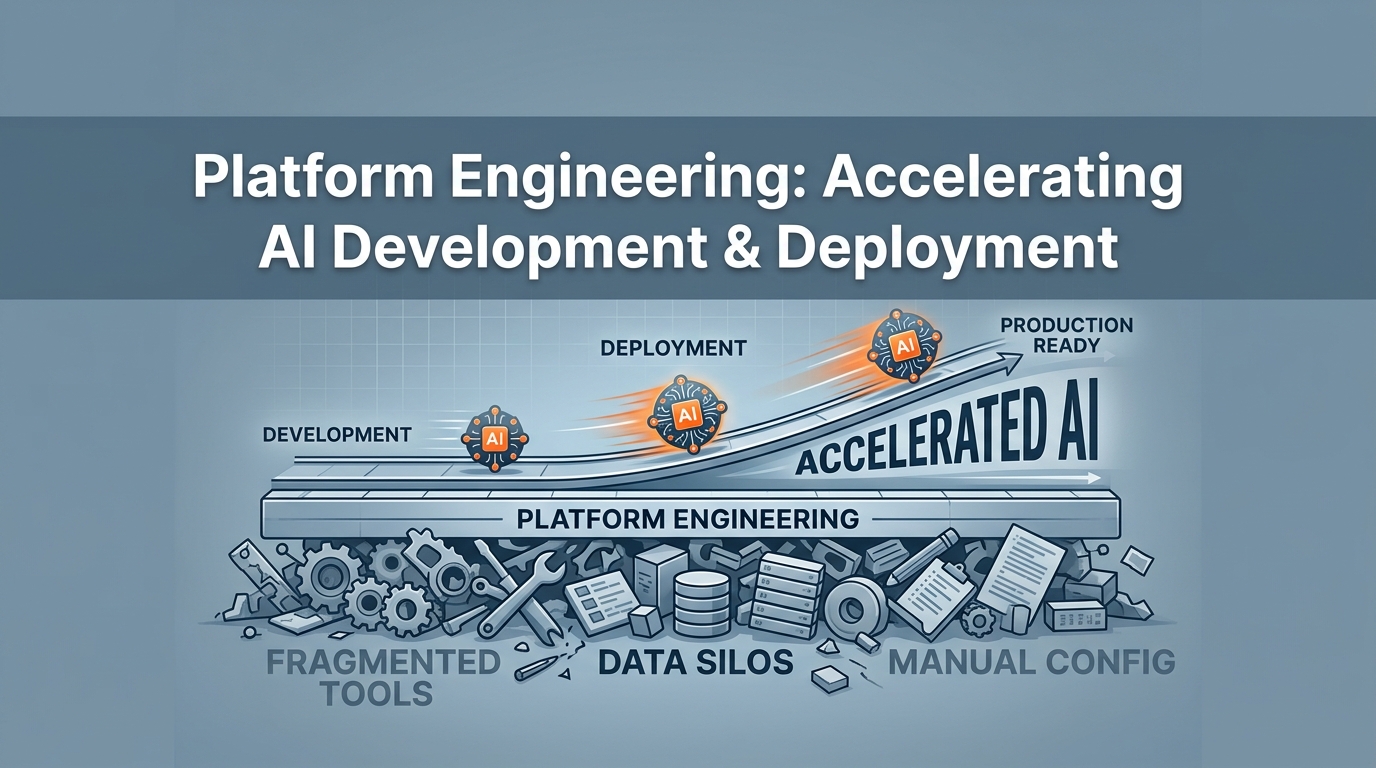
The rapid ascent of Artificial Intelligence promises transformative innovation, yet its true potential is often held back by complex development and deployment hurdles. For many organizations, the journey from AI concept to production-ready application is a labyrinth of manual configurations, inconsistent environments, and fragmented tools. This is precisely where platform engineering steps in, offering a strategic approach to streamline the entire AI lifecycle, significantly accelerating development and deployment.
The AI Development Bottleneck: Why Platform Engineering is Crucial
Developing and deploying AI models is inherently more complex than traditional software. It involves intricate data management, resource-intensive model training, specialized infrastructure requirements (like GPUs), and a continuous cycle of experimentation, iteration, and re-evaluation. These unique complexities often lead to significant bottlenecks for AI/ML teams. Imagine data scientists spending valuable hours wrestling with environment setup, infrastructure provisioning, or debugging inconsistent deployments across different stages. Compliance and governance also become a monumental challenge without standardized processes.
These common points of friction — from provisioning compute resources to orchestrating complex MLOps pipelines — drain productivity and delay time-to-market for critical AI applications. Platform engineering emerges as the strategic solution, providing a streamlined, self-service developer experience tailored specifically for the demands of AI. By abstracting underlying complexity and offering standardized "golden paths," platform engineering reduces friction, empowers AI teams, and dramatically accelerates the journey of AI applications from concept to impactful production.
How Platform Engineering Streamlines AI Workflows
Platform engineering provides the scaffolding necessary for AI teams to build, deploy, and manage models efficiently. It achieves this through a combination of standardized pathways, self-service capabilities, and robust infrastructure abstraction.
Establishing Golden Paths for AI Application Development
Golden paths, in the context of AI, are opinionated, standardized templates for common AI application patterns. Think of them as pre-configured blueprints for building an LLM-powered chatbot, a computer vision model inference service, or a fraud detection system. These paths are designed to encapsulate best practices and include:
Pre-configured Infrastructure: Ready-to-use environments complete with necessary compute (CPU/GPU), storage, and networking, often orchestrated via Kubernetes.
Code Repositories: Boilerplate code, project structure, and example model implementations.
CI/CD Pipelines: Automated workflows for model training, testing, packaging, and deployment.
MLOps Tooling Integrations: Seamless connections to experiment tracking, model registries, and feature stores.
For instance, a "Golden Path for Real-time LLM Inference" might include a Kubernetes deployment manifest, a pre-configured Flask API endpoint, an integrated model server (like Triton Inference Server), and a CI/CD pipeline that automatically builds a container image and deploys it upon code commit.
This approach abstracts away significant infrastructure complexity. AI developers don't need to be Kubernetes experts or infrastructure architects; they can simply select a golden path, clone the template, and focus their energy on model logic and data science.
Self-Service Capabilities for AI Teams
Internal Developer Platforms (IDPs) are central to platform engineering's self-service promise. For AI teams, this translates into one-click provisioning for AI-specific resources:
Jupyter Notebook Environments: Spin up isolated, pre-configured notebooks with popular ML libraries and GPU access.
Specialized Compute: Request and provision GPU clusters, TPUs, or high-memory instances on demand.
Experiment Tracking Environments: Instantly set up a dedicated instance of an experiment tracking system (e.g., MLflow, Weights & Biases).
A comprehensive service catalog within the IDP is crucial. This catalog empowers AI developers to easily discover and provision tools such as:
Model Registries: For versioning, managing, and promoting models.
Feature Stores: For centralized feature engineering and serving.
Data Pipelines: Pre-built or configurable pipelines for data ingestion and transformation.
This self-service model drastically reduces reliance on central operations teams, eliminating ticketing queues and manual handoffs. AI developers gain autonomy, accelerating their ability to iterate and experiment.
Reducing AI Infrastructure Complexity
Platform engineering acts as a vital abstraction layer, simplifying the underlying AI infrastructure. It achieves this by:
Abstracting Cloud Services and Kubernetes: Developers interact with simple APIs and declarative configurations rather than direct Kubernetes manifests or complex cloud SDKs. For example, instead of writing a complex
DeploymentandServiceYAML for a GPU-enabled inference endpoint, a developer might simply specify:aiService: name: my-llm-inference model: text-generation-model:v2.1 resources: gpu: 1 memory: 16Gi endpoints: - path: /predict port: 8000The platform then translates this into the necessary Kubernetes resources and cloud configurations.
Centralized Management of Specialized Hardware: The platform handles the orchestration of GPUs and other specialized hardware, ensuring efficient allocation, sharing, and utilization across multiple AI workloads.
Standardized Environments: From development notebooks to staging and production inference endpoints, the platform ensures consistent environments. This minimizes "works on my machine" issues and ensures models behave predictably across the lifecycle.
Core Components of an AI-Accelerated Platform
A robust AI-accelerated platform integrates crucial MLOps tooling, robust data management, and streamlined model deployment capabilities.
Integrated MLOps Tooling and Workflows
Platform engineering stitches together disparate MLOps tools into a cohesive, unified workflow. Key integrations include:
Experiment Tracking: Automatically log model parameters, metrics, code versions, and artifacts for every training run.
Model Registries: Centralized repository for managing model versions, metadata, and lifecycle stages (staging, production).
Feature Stores: Shared, versioned repository for curated features, ensuring consistency between training and inference.
Data Versioning: Track changes to datasets, ensuring reproducibility of training runs.
The platform provides seamless handoffs between these tools. For example, once an experiment run is complete and a model is deemed suitable, it can be automatically registered in the model registry with all its associated metadata and metrics. Automated model testing, validation, and versioning are baked into the CI/CD pipelines, ensuring that only high-quality, validated models proceed to deployment.
Data Management and Governance
Data is the lifeblood of AI, and platform engineering provides robust mechanisms for managing and governing it:
Data Source Access: Securely connect to and manage access to various data sources (data lakes, warehouses, streaming platforms).
Data Pipelines: Offer tools or integrations for building, orchestrating, and monitoring data ingestion and transformation pipelines.
Data Quality Checks: Implement automated checks to ensure the integrity and validity of data before it's used for training.
Data Cataloging: Centralize metadata about datasets, making them easily discoverable and understandable for AI teams.
Crucially, the platform enforces secure and compliant data access mechanisms, adhering to regulations like GDPR or HIPAA. Role-based access control (RBAC) ensures that only authorized personnel and services can access sensitive data, while audit trails provide accountability.
Robust Model Deployment and Inference
Getting a trained model into production reliably is a critical step. The platform provides standardized inference deployment patterns:
Containerization: Packaging models with their dependencies into Docker containers for portability and consistency.
Serverless Functions: Deploying smaller, event-driven models as serverless functions (e.g., AWS Lambda, Azure Functions).
Managed Inference Services: Leveraging cloud provider services or open-source solutions like Kubeflow Serving.
Built-in capabilities ensure robust, high-performance inference:
Monitoring: Real-time dashboards track model performance, latency, error rates, and resource utilization.
A/B Testing and Canary Releases: Facilitate phased rollouts and experimentation with new model versions.
Model Rollback: Automated mechanisms to revert to previous stable model versions in case of issues.
Auto-scaling: Dynamically adjust inference resources (e.g., GPU instances) based on demand, optimizing costs and performance.
Accelerating the AI Lifecycle: From Experiment to Production
Platform engineering doesn't just improve individual steps; it collapses the entire AI lifecycle, creating a frictionless journey from nascent idea to impactful production system.
Rapid Experimentation and Development
By providing instant access to isolated and reproducible environments, the platform fosters a culture of rapid experimentation. Data scientists can spin up a new environment for a novel idea, knowing it won't interfere with others and can be easily reproduced.
Quick Environment Provisioning: Access to pre-configured notebooks and compute resources means less time spent on setup and more on actual model development.
Streamlined Data Access and Feature Engineering: Integrated data pipelines and feature stores provide quick, consistent access to relevant data, accelerating the process of feature creation and selection.
Efficient Resource Allocation for Training: The platform intelligently allocates GPU pools and other compute resources, ensuring training runs are efficient and developers aren't waiting for hardware. Dynamic resource scaling means larger experiments can be run without manual intervention.
Seamless Deployment and Operations
The true acceleration comes from automating the path to production.
Automated CI/CD Pipelines for AI Models: These pipelines go beyond typical software CI/CD. They include model-specific validation steps, such as:
Data Schema Validation: Ensuring incoming data matches the expected format.
Model Performance Baselines: Comparing new model metrics against established thresholds.
Bias and Fairness Checks: Automated evaluation for potential ethical issues.
Latency and Throughput Tests: Verifying the model meets operational requirements.
Once validated, the pipeline handles artifact packaging, container image creation, and deployment to specified environments.
Proactive Monitoring for AI Systems: Beyond infrastructure health, the platform monitors model-specific metrics like:
Model Drift: Detecting changes in prediction patterns or data distributions that indicate model decay.
Data Quality: Continuous checks on inference data to flag anomalies.
Performance Metrics: Tracking accuracy, precision, recall, and other relevant business KPIs.
Incident Response and Automated Rollback: When issues like model drift or performance degradation are detected, the platform can trigger alerts and, in critical cases, initiate automated rollbacks to a previously stable model version, minimizing downtime and business impact.
Building Governance and Security into AI Workflows
The ethical and regulatory landscape around AI is rapidly evolving. Platform engineering provides the framework to embed governance and security directly into the development and deployment process, not as an afterthought.
Policy Checks and Compliance Guardrails
A well-designed platform engineering approach ensures that organizational policies and regulatory requirements are enforced automatically, providing guardrails for AI development:
Automated Policy Enforcement: Integrate policy-as-code tools that check for data privacy violations, ensure ethical AI guidelines are followed, and enforce resource tagging for cost management.
Security Scans and Vulnerability Checks: Bake security into AI pipelines. This includes scanning container images for known vulnerabilities, checking dependencies for CVEs, and static analysis of model code.
Audit Trails and Compliance Reporting: Maintain detailed logs of every action, change, and deployment related to AI models. This provides a clear audit trail for compliance purposes, demonstrating adherence to internal policies and external regulations.
Responsible AI and Ethical Deployment
Platform engineering facilitates the integration of Responsible AI (RAI) tools and practices, ensuring models are fair, transparent, and accountable.
Explainability (XAI) Tools: The platform can integrate libraries and services that help explain model predictions (e.g., SHAP, LIME). These explanations can be generated during development and, in some cases, provided alongside inference results in production.
Fairness and Bias Detection: Automated checks can be integrated into CI/CD pipelines to detect and flag potential biases in model predictions or training data. If a model exhibits bias beyond an acceptable threshold, the pipeline can halt deployment and notify the responsible team.
Pre-deployment Ethical Checks: Before a model goes live, the platform can enforce a set of ethical checkpoints, perhaps requiring human review of bias reports or explainability outputs, ensuring that ethical considerations are addressed proactively.
The Tangible Benefits: Measuring AI Acceleration with Platform Engineering
The impact of platform engineering on AI initiatives is quantifiable, delivering clear benefits across the organization.
Quantifiable Impact on Developer Velocity: AI teams report significantly faster iteration cycles and drastically reduced setup times. Instead of days spent provisioning resources, it becomes minutes. This translates directly into more experiments, faster feature delivery, and quicker problem-solving.
Improved Deployment Frequency and Reliability of AI Models: Automated CI/CD, robust monitoring, and self-healing capabilities mean models can be deployed more frequently with higher confidence, reducing the risk of errors and downtime.
Reduced Operational Overhead and Infrastructure Costs: By standardizing environments, optimizing resource allocation, and enabling self-service, the need for manual operational tasks decreases. This frees up operations teams and reduces cloud spend by ensuring resources are used efficiently.
Enhanced Governance and Compliance Posture: Built-in policy enforcement, audit trails, and security scanning capabilities provide a stronger, more automated governance framework, reducing compliance risks and making audits smoother.
The Evolution of AI and Platform Engineering
The relationship between AI and platform engineering is dynamic, with each influencing the other in exciting ways.
From Developer Assistants to Operational AI Agents
We're seeing a trend where AI isn't just a consumer of the platform but also an integral part of the platform itself.
AI-Enhanced Platform Templates: Imagine platform templates that can generate agent-friendly configuration files or automatically create Architecture Decision Records (ADRs) based on best practices and context. AI can assist in templating and provisioning.
Self-Service AI Agents: The future could see AI agents within the platform's service catalog capable of automating more complex tasks. For example, an "AI Ops Agent" might autonomously scale resources, diagnose common issues, or even suggest optimal model retraining schedules based on performance data. This takes "self-service" to an entirely new level, where AI helps orchestrate the platform itself.
AI-Enhanced Platform Engineering vs. Platforms for AI
It's important to clarify a key distinction:
AI-Enhanced Platform Engineering: This refers to the integration of AI into platform engineering practices. It means using AI to make the platform itself smarter, more efficient, and more capable (e.g., AI for incident prediction, intelligent resource allocation, or automated documentation).
Platforms for AI (MLOps Platforms): This refers to building a dedicated platform for AI development and deployment, leveraging platform engineering principles. This is what much of this article has focused on – providing tools and infrastructure for MLOps.
While distinct, these two concepts are converging. An MLOps platform built using platform engineering principles will inherently benefit from AI-enhanced platform engineering. The ultimate goal is for platform engineering to provide the robust, intelligent foundation that supports both the creation of AI applications and the enhancement of the platform's own capabilities through AI. This convergence will lead to even more powerful and autonomous development environments for the next generation of AI innovation.
What specific AI development or deployment bottleneck has platform engineering helped your team overcome most effectively? Share your experience in the comments below!
💬 Join the conversation — share your take in the comments and tell us what you’d add.