Optimizing Anthropic AI Workflows with NextGen AI DEV
Boost generative AI workflows with Anthropic models on NextGen AI DEV. Get a smarter setup, better outputs, and a faster path to value.
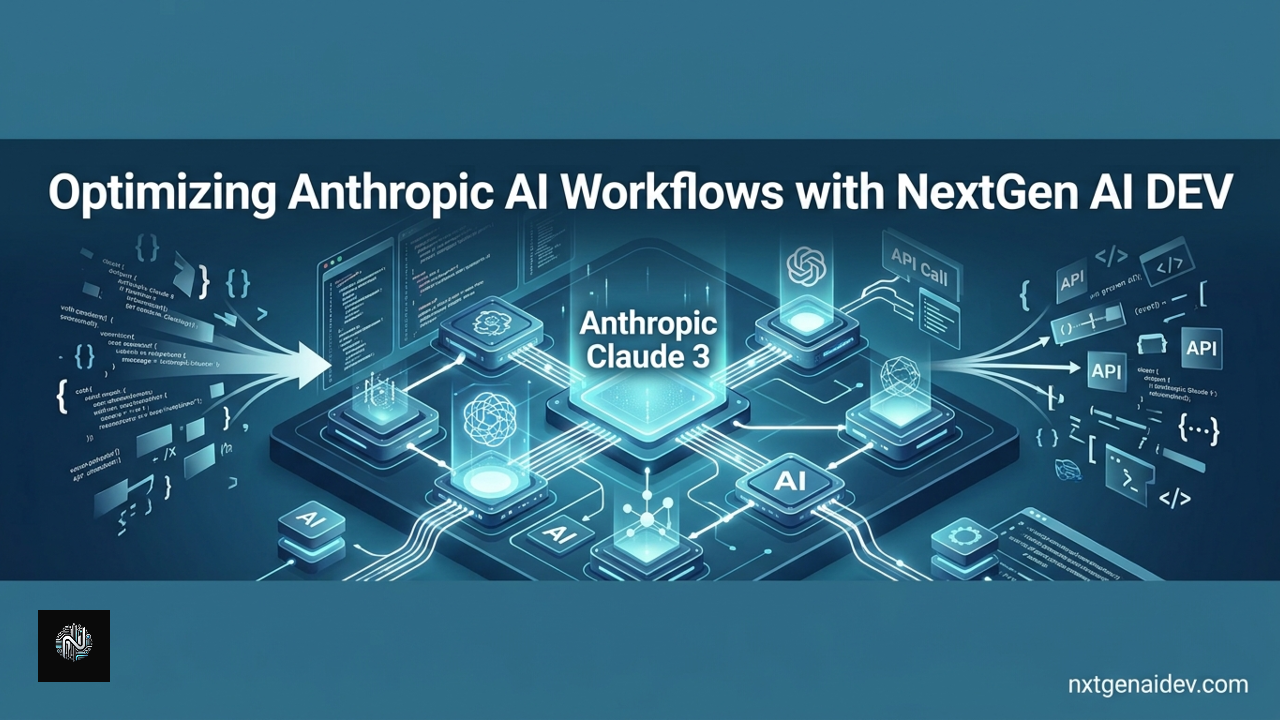
The landscape of artificial intelligence is evolving at lightning speed, and harnessing the power of advanced models like Anthropic's Claude 3 requires a strategic approach. To truly unlock their potential and integrate them seamlessly into your applications, you need more than just direct API access—you need a unified, intelligent platform. That's precisely what NextGen AI DEV offers, providing a robust solution for optimizing Anthropic AI workflows.
Unlocking Anthropic's Potential with NextGen AI DEV
Imagine a single platform that serves as your command center for over 20 AI models from more than 10 providers. NextGen AI DEV is precisely that—a unified AI platform designed to simplify the complex world of multi-model AI development. Among the powerful models it integrates are Anthropic's cutting-edge Claude 3 series: Haiku, Sonnet, and Opus.
Developers often face the challenge of integrating disparate APIs, managing varying authentication schemes, and adapting codebases for each new model. NextGen AI DEV eliminates this friction by offering a single, compatible API. This means you can effortlessly integrate Anthropic models, along with others, into your projects with significantly reduced boilerplate code. The result? Faster iteration cycles, smoother development, and a quicker path to production for your generative AI applications.
Anthropic models, particularly Claude 3 Opus, are renowned for their robust reasoning capabilities, extended context windows, and adherence to safety principles, making them ideal for trust-critical and complex reasoning-heavy applications. Within a multi-model strategy powered by NextGen AI DEV, Anthropic models become a cornerstone. You can leverage Claude's advanced understanding for critical tasks while still maintaining the flexibility to use other specialized models for different parts of your workflow, all managed from one cohesive environment. This strategic positioning ensures that you're always using the best tool for the job, optimized through a singular platform.
Seamless Integration and Multi-Model Orchestration
Integrating diverse AI models into a cohesive application can quickly become an engineering hurdle. NextGen AI DEV transforms this challenge into a streamlined process, offering a unified approach to model management and intelligent orchestration for your Anthropic AI workflows.
Unified API for Anthropic and Beyond
NextGen AI DEV's core strength lies in its unified API. Instead of wrestling with distinct API formats, authentication methods, and SDKs for each provider, you interact with a single, consistent interface. This API is designed to abstract away the underlying complexities, allowing you to call Anthropic's claude-opus-4-1 model using the same intuitive methods you'd use for models from other providers. The platform normalizes requests and responses, providing a common language for all your AI interactions. This consistency dramatically reduces development time, simplifies debugging, and allows your team to focus on building innovative features rather than managing API minutiae. Whether you're making a simple text generation request or engaging in complex tool-use scenarios, the unified API ensures a predictable and efficient experience across all integrated models, including Anthropic's full suite.
Intelligent Model Routing and Fallbacks
Optimizing an AI workflow isn't just about integration; it's about intelligent resource allocation. NextGen AI DEV empowers you with sophisticated routing rules, enabling dynamic task distribution to the most appropriate Anthropic model. For instance, you can configure your application to direct time-sensitive requests, such as real-time chat responses, to Claude 3 Haiku for its unparalleled speed and cost-effectiveness. Conversely, complex analytical tasks requiring deep reasoning and extensive context, like legal document analysis or scientific research summaries, can be automatically routed to Claude 3 Opus.
Beyond specific model selection, NextGen AI DEV also supports robust fallback mechanisms. Should a primary Anthropic model become unavailable or hit a rate limit, the platform can automatically reroute the request to another Anthropic model (e.g., from Opus to Sonnet) or even to a compatible model from a different provider, ensuring your applications remain resilient and continuously operational. This intelligent orchestration minimizes downtime and maximizes efficiency, providing a truly fault-tolerant system.
Leveraging Anthropic-Specific Features
NextGen AI DEV doesn't just offer generic access to models; it provides deep support for provider-specific capabilities, ensuring you can fully leverage the unique strengths of Anthropic's offerings. This includes comprehensive support for Claude's impressive long context windows, allowing your applications to process and reason over vast amounts of information without truncation. For applications requiring advanced interaction, NextGen AI DEV enables detailed tool-use descriptions, empowering Claude to interact effectively with external systems, APIs, and databases as if they were native extensions of its capabilities.
Furthermore, to refine model behavior and ensure consistent, high-quality outputs, the platform supports input_examples for Anthropic models. This feature allows you to provide few-shot examples directly in your prompts, guiding the model toward desired responses and significantly improving performance for specific tasks. By supporting these Anthropic-specific nuances, NextGen AI DEV ensures that you can extract maximum value and performance from Claude, making your generative AI applications more powerful and precise.
Cost Optimization and Performance Tuning for Claude
Managing the costs and performance of AI models, especially at scale, is a critical concern for developers and product managers. NextGen AI DEV provides a comprehensive suite of tools designed to give you granular control over your Anthropic model usage, ensuring efficiency without compromising capability.
Strategic Model Tiering with Anthropic Models
Anthropic's Claude 3 family offers a spectrum of capabilities, latencies, and price points: Haiku (fastest, most cost-effective), Sonnet (balanced, robust), and Opus (most capable, highest cost). NextGen AI DEV allows you to implement a strategic model tiering approach that intelligently matches your application's needs with the right Claude model. For example, a customer service chatbot handling routine inquiries can be configured to use Claude 3 Haiku, significantly reducing per-query costs while maintaining rapid response times. For more complex support issues that require deeper understanding and longer conversations, the system can dynamically escalate to Claude 3 Sonnet. Critical decision-making processes or intricate content generation tasks, where accuracy and nuance are paramount, can leverage Claude 3 Opus. This dynamic tiering, managed within NextGen AI DEV, ensures you're always balancing capability, latency, and cost for each specific use case, preventing overspending on computationally intensive models when a lighter one would suffice.
Advanced Token Management and Prompt Caching
Token usage is directly tied to cost. NextGen AI DEV offers advanced features to optimize token consumption across your Anthropic workflows. One powerful feature is prompt caching. For recurring prompts or common queries, the platform can store and retrieve responses, preventing redundant calls to the underlying Anthropic model and significantly reducing token spend. This is particularly effective for static content generation, common FAQs, or initial conversational turns.
Additionally, NextGen AI DEV provides granular control over max_tokens settings. You can enforce strict limits on the length of responses from Anthropic models, ensuring that you pay only for the necessary output and preventing runaway generation that inflates costs. These intelligent token management strategies within the platform allow you to extract maximum value from every interaction with Claude models.
Monitoring and Analytics for Cost Control
True cost optimization requires visibility. NextGen AI DEV offers robust monitoring and analytics capabilities specifically tailored for your AI model consumption. The platform provides detailed usage analytics, breaking down your spend by model, organization, and even individual user, giving you complete transparency into how your Anthropic models are being utilized.
Unified billing simplifies financial management, consolidating all your Anthropic model usage (and other providers) into a single, digestible invoice via per-org credits, payable through Stripe, PayPal, Razorpay, or Paddle. To prevent unexpected expenditure, NextGen AI DEV includes configurable low-credit alerts, which can be sent directly to your team via Slack or Discord. These proactive notifications ensure that you're always aware of your budget status, allowing you to make timely adjustments and maintain tight control over your Anthropic model spend.
Enhanced Security and Enterprise Governance
For enterprise-grade applications, security and governance are non-negotiable. Integrating powerful AI models like Anthropic's Claude requires a platform that prioritizes data integrity, access control, and auditability. NextGen AI DEV is built from the ground up with these critical requirements in mind, offering a secure and compliant environment for your Anthropic AI workflows.
Robust API Key Management and Access Control
Directly embedding API keys into applications or exposing them broadly creates significant security vulnerabilities. NextGen AI DEV provides secure API key management, acting as a central proxy for all your Anthropic model interactions. Your actual Anthropic API keys are stored securely within the platform, never directly exposed to your client-side applications. Instead, your applications interact with NextGen AI DEV's API using platform-issued keys, which can be easily rotated and revoked.
Furthermore, the platform supports environment separation, allowing you to maintain distinct development, staging, and production environments for your Anthropic models. This ensures that testing and experimentation in non-production environments do not impact sensitive production workloads or expose valuable API keys. This robust control framework is essential for maintaining a strong security posture.
Centralized Governance for Anthropic Workloads
As organizations scale, managing access to AI models across various teams and projects becomes complex. NextGen AI DEV addresses this with multi-org RBAC (Role-Based Access Control). This powerful feature allows administrators to define granular permissions, controlling precisely who can access specific Anthropic models, configure routing rules, or manage spending limits. For instance, a junior developer might have access to Claude 3 Haiku for prototyping, while only senior engineers or project leads can configure access to the more powerful and costly Claude 3 Opus for production deployments. This centralized governance ensures that your Anthropic workloads are managed responsibly, preventing unauthorized usage and maintaining adherence to internal policies.
Auditability and Compliance
In highly regulated industries or for applications handling sensitive data, comprehensive audit trails are paramount. NextGen AI DEV automatically generates detailed audit logs for all interactions with Anthropic models. Every request, response, configuration change, and access attempt is meticulously recorded, providing an immutable record of all activity. These audit logs offer unparalleled transparency, simplifying compliance efforts and enabling rapid investigation in case of anomalies or security incidents.
For enterprises requiring the highest level of control and compliance, NextGen AI DEV offers self-hosted deployment options. This allows organizations to deploy the entire NextGen AI DEV platform within their own infrastructure, behind their firewalls. This means all data, including prompts and responses processed by Anthropic models through the platform, remains entirely within the enterprise's control, meeting stringent data residency, privacy, and security requirements. Self-hosted deployments provide the ultimate assurance that your Anthropic model usage aligns perfectly with your organization's unique compliance obligations.
Seamless Migration and Future-Proofing
The decision to adopt a new platform often comes with concerns about migration complexity and future flexibility. NextGen AI DEV is engineered to simplify the transition for existing Anthropic applications and to future-proof your generative AI investments, ensuring agility and resilience.
Migrating Existing Anthropic Applications
If you've already built applications directly interacting with Anthropic's API, migrating to NextGen AI DEV is designed to be a smooth process. We provide a clear playbook for transitioning your existing code. Because NextGen AI DEV normalizes API interactions, much of your existing logic for prompt construction and response parsing can remain largely intact. The primary change involves re-pointing your API calls from Anthropic's direct endpoints to NextGen AI DEV's unified API. This often requires minimal code changes, primarily around API client initialization and authentication. The platform's compatibility ensures that you can quickly integrate your current Anthropic-powered features, immediately gaining the benefits of intelligent routing, cost optimization, and enhanced security without a complete rewrite.
A/B Testing and Model Evaluation
The AI landscape is constantly evolving, with new models and updates emerging regularly. NextGen AI DEV provides powerful tools for A/B testing and model evaluation, allowing you to rigorously compare different Anthropic models or even pit Anthropic against other providers using the same prompts. You can easily set up experiments to send a percentage of traffic to Claude 3 Haiku and another to Sonnet, or even compare Claude 3 Opus with a model from a completely different provider, all while measuring key metrics like latency, accuracy, and cost. This empirical approach enables data-driven decisions, ensuring you're always using the best-performing and most cost-effective model for your specific use cases. The platform's analytics dashboards provide clear insights into these comparative tests, making model selection an informed strategic choice rather than guesswork.
Building Resilient Generative AI Workflows
True future-proofing comes from building resilient workflows that can adapt to change. NextGen AI DEV facilitates this by enabling advanced deployment strategies like canary deployments and regression testing for your Anthropic-based features. With canary deployments, you can gradually roll out new model configurations or prompt variations to a small subset of users, monitoring performance and stability before a full release. This minimizes risk and allows you to catch potential issues before they impact your entire user base.
Regression testing ensures that updates or changes to your AI workflow don't inadvertently break existing functionalities. By using NextGen AI DEV's unified API, your code becomes inherently provider-agnostic. This is a massive benefit for future flexibility: if a new, more performant, or more cost-effective model emerges—whether it's an update to Claude or an entirely new model from another provider—you can seamlessly integrate it into your workflow with minimal code changes. This abstracted approach means your application logic isn't tightly coupled to a specific vendor's API, giving you the freedom to innovate and adapt without the burden of extensive refactoring. This architecture ensures your generative AI applications are not just powerful today but remain agile and future-ready tomorrow.
Ready to elevate your AI applications with optimized Anthropic workflows? Explore NextGen AI DEV's platform and start building today.