
Optimize Voice AI Monetization with Per-Org Credits & Flexible Payments
Per-org credits help Voice AI SaaS scale smarter with flexible payments and clearer spend control. Learn how to grow without friction.
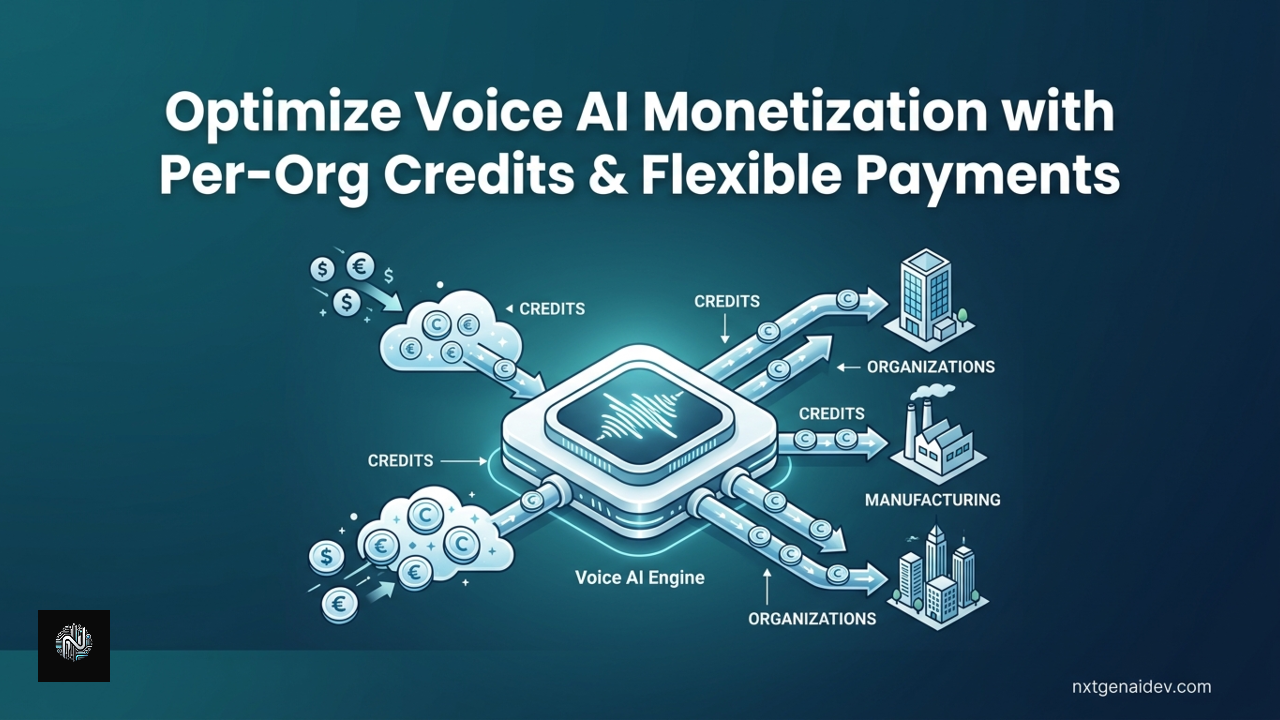
Building a successful Voice AI SaaS isn't just about groundbreaking technology; it's about monetizing that innovation effectively. Traditional billing models often fall short, leaving founders and product managers grappling with unpredictable revenue and frustrated customers. The key to unlocking sustainable growth and clear value for your B2B Voice AI offering lies in a sophisticated, flexible, and transparent monetization strategy, and that's precisely where NextGen AI DEV's per-org credit system shines.
Why Voice AI SaaS Needs Next-Gen Per-Org Credits
Voice AI applications, by their very nature, involve unpredictable and fluctuating usage patterns. A customer might have periods of intense activity for transcription or voice synthesis, followed by lulls, or usage could scale dramatically with new projects. Traditional billing models like per-seat licenses or flat-rate subscriptions are fundamentally ill-suited for this dynamic environment. They either undercharge for high-value usage, leaving revenue on the table, or overcharge for infrequent use, leading to customer churn.
The industry is rapidly shifting towards usage-based and credit-based pricing, especially for AI products, as these models more accurately align revenue with the actual value customers derive. NextGen AI DEV recognized this critical need and built a per-org credit system specifically designed for B2B Voice AI monetization. This innovative approach ensures that your revenue directly correlates with actual customer usage and value across an entire organization. Instead of rigid per-user fees, per-org credits allow for shared pools across various projects and users within a single customer account, providing unmatched flexibility and fairness. This means your customers can allocate credits as needed, optimizing their spend while you benefit from a revenue model that scales precisely with their adoption and success.
Unifying Multi-Model Voice AI Usage with a Single Credit Pool
The complexity of modern Voice AI isn't just about speech-to-text (STT) or text-to-speech (TTS); it often involves a sophisticated interplay of multiple underlying AI models from various providers.
Metering Across Diverse AI Models (Anthropic, OpenAI, etc.)
Imagine the challenge of tracking granular usage—minutes of audio processed, tokens generated, or characters synthesized—across different Voice AI components and multiple underlying AI providers like Anthropic, OpenAI, or Together. Each provider and model might have its own distinct pricing structure and unit of measurement, creating a complex web of data points that are nearly impossible to manage manually. This complexity often leads to inconsistent billing, operational overhead, and confusion for both the SaaS provider and the end customer.
NextGen AI DEV's platform cuts through this complexity by normalizing these disparate usage units into a single, unified per-org credit system. Whether your customer is generating voice with a high-fidelity TTS model, transcribing hours of audio with a leading STT engine, or leveraging a large language model (LLM) for conversational AI, all these activities deduct from a single, transparent credit balance. The NextGen AI DEV API abstracts away the intricacies of individual model costs and conversion rates, providing a consistent, predictable credit deduction mechanism for every Voice AI interaction. This simplification allows you to focus on building innovative features, not on untangling billing logic.
Real-time Analytics for Clear Consumption Tracking
In a usage-based model, real-time visibility into credit consumption is not just a nice-to-have; it's critical for both providers and customers. Without it, customers risk unexpected costs, and providers struggle to understand product adoption and potential revenue opportunities.
NextGen AI DEV delivers granular usage analytics at both the organization and project level, accessible through an intuitive dashboard. This means you can see precisely how credits are being consumed across different departments or specific Voice AI initiatives within an organization. For your customers, these analytics empower them to understand their spend, track project usage, and optimize their Voice AI consumption. Clear, real-time data informs better decision-making, helping customers manage their budgets effectively and allowing your team to identify power users, potential upsells, or areas where usage might be optimized. This transparency builds trust and fosters a healthier, more predictable customer relationship.
Flexible Global Payments for Your Voice AI SaaS
Reaching a global customer base means embracing diverse payment preferences and currencies. Limiting your payment options can significantly restrict your market reach and create friction for international clients.
Seamless Integration with Leading Payment Gateways
The challenge of supporting various payment methods and currencies without building complex, custom integrations can be a major hurdle for Voice AI SaaS providers. Each new gateway adds development time, maintenance, and security considerations.
NextGen AI DEV solves this by offering out-of-the-box integration with leading payment gateways, including Stripe, PayPal, Razorpay, and Paddle. This robust multi-gateway support simplifies the process for your customers to purchase and replenish their per-org credits, no matter where they are in the world. By leveraging these established platforms, you expand your market reach without the burden of complex custom integrations. This means smoother billing operations for your team and a frictionless experience for your customers, whether they're in North America, Europe, Asia, or beyond. Offering familiar and trusted payment options is crucial for converting prospects into loyal, paying customers.
Automating Credit Top-ups and Subscription Hybrids
Managing credit balances manually can be a full-time job. Customers risk service interruptions if credits run low, and you risk losing revenue.
NextGen AI DEV facilitates automated credit top-ups, ensuring uninterrupted service for your customers. When an organization's credit balance falls below a predefined threshold, the system can automatically trigger a top-up via their preferred payment method, ensuring their Voice AI applications continue to run seamlessly. This automation not only enhances customer experience by preventing service downtime but also provides a predictable revenue stream for your business.
Beyond simple credit purchases, NextGen AI DEV empowers you to implement effective hybrid billing models. For example, you can offer a base subscription with a set amount of included credits, combined with metered overages for additional usage. This model balances predictable recurring revenue from the subscription with the scalable, consumption-based growth of credits. You might offer a "Starter Pack" subscription that includes 1000 credits per month, with the option to automatically purchase more credits at a discounted rate if usage exceeds this amount. This flexibility allows you to cater to a wider range of customer needs, from those requiring a stable baseline to high-volume enterprises, all while maintaining a clear and consistent billing structure.
Empowering Organizations with Control and Transparency
Usage-based billing, while flexible, can sometimes lead to concerns about runaway usage and unexpected costs – a phenomenon often dubbed "bill shock." Mitigating these concerns is paramount for building trust and long-term customer relationships.
Preventing Bill Shock with Proactive Alerts and Controls
One of the biggest anxieties for customers on usage-based plans is losing control over their spend. Unchecked usage can lead to unpleasant surprises at the end of the billing cycle, damaging trust and leading to churn.
NextGen AI DEV addresses this head-on with features for proactive low-credit alerts and customizable usage caps. Administrators can set thresholds to receive notifications (e.g., via Slack or Discord integration) when an organization's or project's credit balance drops below a certain level. More importantly, NextGen AI DEV allows for setting hard usage caps at both the organization and individual project level. This means a customer can cap an experimental project at 500 credits to prevent excessive spend, or set an organizational cap to ensure overall budget adherence. These safeguards provide administrators with granular control over their Voice AI spend, offering peace of mind and preventing "bill shock" by making consumption predictable and manageable.
Multi-Org RBAC and Audit Logs for Enterprise Governance
For B2B Voice AI platforms, especially those targeting enterprise clients, robust access control and governance are non-negotiable. Organizations need to control who can purchase credits, allocate them, and view usage across different teams and projects.
NextGen AI DEV's multi-org RBAC (Role-Based Access Control) features are designed with enterprise governance in mind. This system allows you to define specific roles—such as "Finance Manager," "Project Lead," or "Developer"—each with tailored permissions. A Finance Manager, for instance, might have the ability to purchase new credits and set organizational caps, while a Project Lead can allocate existing credits to their specific team's projects but not purchase new ones. This granular control ensures that only authorized personnel can manage organizational budgets and Voice AI resources.
Furthermore, NextGen AI DEV provides comprehensive audit logs that track all credit usage and management activities. Every credit purchase, allocation, deduction, and cap modification is recorded, providing an immutable record for compliance, troubleshooting, and internal transparency. These logs are invaluable for enterprise clients who require detailed accountability and traceability for their expenditures, reinforcing trust and facilitating seamless internal auditing processes.
Scaling Voice AI Monetization: From Startup to Enterprise
The journey from a promising Voice AI startup to an enterprise-grade solution demands a monetization strategy that can evolve. Founders face unique challenges in pricing, while scaling requires flexibility in deployment.
Deriving Profitable Per-Org Credit Pricing
For founders, accurately pricing Voice AI credits to cover underlying costs (telephony, STT, LLM, TTS) while maintaining healthy margins can feel like navigating a maze. Each model and service component has its own cost, making it complex to define a single, profitable credit conversion rate.
NextGen AI DEV's unified metering and cost attribution features provide the clarity needed for this crucial task. By normalizing all usage into a single credit unit and tracking the actual underlying costs associated with each AI model (e.g., Anthropic, OpenAI, Together) you leverage, NextGen AI DEV helps founders perform accurate cost-plus analysis. This data-driven approach allows you to set profitable per-org credit conversion rates confidently. Moreover, the detailed usage analytics available within NextGen AI DEV inform iterative pricing adjustments. As you gather more data on customer consumption patterns and feature adoption, you can optimize credit tiers, bundle offerings, and identify opportunities for expansion revenue, ensuring your pricing strategy remains competitive and profitable as your product matures.
Supporting Self-Hosted and Enterprise Deployments
While many Voice AI platforms start as pure SaaS, scaling to enterprise clients often necessitates more flexible deployment options, including self-hosted or private cloud environments due to data residency, security, or compliance requirements.
NextGen AI DEV is built to accommodate this evolution. It supports self-hosted and enterprise deployments while seamlessly integrating with cloud payment gateways like Stripe, PayPal, Razorpay, and Paddle. This hybrid approach allows enterprises to maintain control over their data and infrastructure while still leveraging NextGen AI DEV's robust, unified per-org credit ledger for billing and monetization. This capability highlights NextGen AI DEV's commitment to catering to enterprise-grade solutions, offering tailored billing and deployment models that meet the diverse and stringent requirements of large organizations, ensuring your Voice AI SaaS can grow into any market segment.
Conclusion: Grow Your Voice AI SaaS with NextGen AI DEV
The future of Voice AI monetization isn't about rigid, outdated billing—it's about flexibility, transparency, and aligning value with usage. NextGen AI DEV's per-org credit system simplifies the complex world of multi-model Voice AI billing, providing unparalleled control and insight for both you and your customers. From unifying diverse AI model usage into a single credit pool and offering global payment flexibility, to empowering organizations with proactive alerts and robust governance through multi-org RBAC and audit logs, NextGen AI DEV is engineered for your success. It helps you accurately price your services, scale from startup to enterprise, and ensure predictable, sustainable growth.
Ready to revolutionize your Voice AI SaaS monetization strategy? Explore NextGen AI DEV's per-org credit system today and start building for scalable growth.