Architecting Secure AI: NextGen AI DEV's Passwordless, RBAC & Audit Logs
Passwordless auth, multi-org RBAC, and audit logs explained to secure AI apps—see how to improve access control, compliance, and visibility.
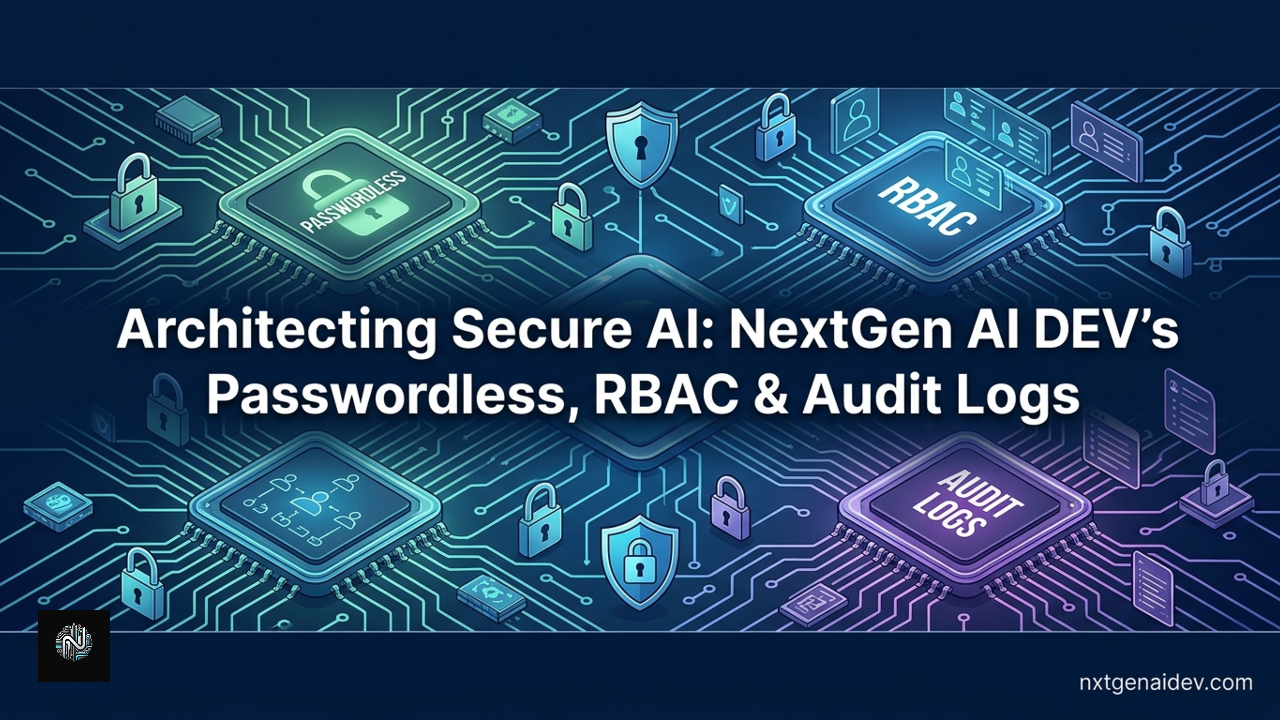
In the rapidly evolving landscape of artificial intelligence, robust security and uncompromising compliance are no longer optional—they are fundamental requirements for any enterprise-grade AI development. Building AI applications that are both innovative and secure demands a platform that integrates security from the ground up. This is precisely where NextGen AI DEV excels, providing an integrated suite of features including passwordless authentication, multi-organization Role-Based Access Control (RBAC), and comprehensive audit logs. This guide will walk engineers through leveraging these powerful features to architect secure, compliant, and scalable AI solutions.
The Foundation of Secure AI: Why NextGen AI DEV Leads
The proliferation of AI models and applications across enterprises brings immense potential, but also introduces complex security challenges. From safeguarding sensitive data used for training to ensuring compliant access to production models, the stakes are incredibly high. NextGen AI DEV provides a unified AI platform, serving as the backbone for cutting-edge applications like ClipCam, EvenlySplit, Echo AI, and Elevence AI, by integrating critical security measures directly into its core functionality. Our approach focuses on reducing attack surfaces, enforcing granular access, and maintaining an immutable record of all activities. This article will demonstrate how engineers can harness NextGen AI DEV's capabilities to meet the most stringent enterprise security and compliance standards, building trust and accelerating AI adoption securely.
Streamlined & Secure Access: NextGen AI DEV's Passwordless Authentication
Traditional password-based authentication is a known vulnerability, often leading to phishing attacks, credential stuffing, and user frustration. NextGen AI DEV eliminates these common pitfalls by embracing passwordless authentication, enhancing both security posture and user experience across your AI platform. By removing the need for users to create, remember, and periodically change complex passwords, the platform drastically reduces the attack surface associated with credential theft.
How Passwordless Works with NextGen AI DEV
NextGen AI DEV supports multiple passwordless authentication flows, designed for ease of use without compromising security. Engineers can configure email-based One-Time Passcodes (OTP), allowing users to log in securely by receiving a temporary code in their inbox. This method is highly effective for quick, secure access and minimizes the risk associated with static passwords. For an even more seamless and robust experience, NextGen AI DEV also supports biometric login flows, integrating with device-native features like Face ID or Touch ID where available. This provides a truly frictionless login experience while leveraging hardware-level security, ensuring that only authorized individuals can access the AI development environment.
Configuring Passwordless Methods for Your Users
NextGen AI DEV empowers engineers to tailor authentication methods to specific organizational needs and user groups. Within the platform, you can define which passwordless methods are available for different organizations or teams. For instance, a highly regulated department might be restricted to biometric logins for critical AI projects, while a less sensitive internal team could utilize email OTP. This granular control allows administrators to enforce appropriate security policies without hindering productivity. By leveraging NextGen AI DEV's integrated passwordless system, enterprises can significantly mitigate risks associated with password reuse, weak passwords, and phishing campaigns, fostering a more secure and efficient AI development ecosystem.
Granular Control for AI Platforms: NextGen AI DEV's Multi-Organization RBAC
In enterprise environments, AI platforms often serve multiple departments, projects, or even distinct client organizations, each with unique data, resources, and access requirements. Managing this complexity requires a robust access control system. NextGen AI DEV's multi-organization Role-Based Access Control (RBAC) provides the centralized policy enforcement needed to secure your AI architectures, ensuring precise control over who can access what, and under what conditions.
Designing RBAC for Multi-Tenant AI Architectures
NextGen AI DEV is architected to support complex multi-tenant AI environments by design. It allows for the creation of distinct organizational boundaries, each with its own set of users, resources, and policies. This means that an AI platform running on NextGen AI DEV can seamlessly host independent development environments for, say, a financial analytics team, a healthcare research division, and an internal marketing group, all while maintaining strict segregation. Engineers can define roles and permissions that apply specifically within the context of each organization, ensuring that policies are enforced at the appropriate level and preventing any accidental or malicious cross-pollination of access rights.
Preventing Cross-Organization Data and Credit Access
A critical concern in multi-tenant platforms is ensuring that users from one organization cannot access the data, models, or even computational credits of another. NextGen AI DEV addresses this with several built-in mechanisms:
Strict Data Isolation: All data, including datasets, model artifacts, and logs, are logically and often physically separated per organization. NextGen AI DEV enforces robust isolation policies at the storage and processing layers, ensuring that an AI Developer in Organization A cannot query or even discover resources belonging to Organization B.
Per-Organization Credits: Computational resources and model usage are often tied to credits. NextGen AI DEV integrates seamlessly with popular payment gateways like Stripe, PayPal, Razorpay, and Paddle to manage per-organization credits. This means each organization operates within its own allocated credit budget, and a user’s actions only consume credits from their specific organization. This financial segregation is a powerful mechanism for preventing unauthorized resource consumption and provides clear billing boundaries. A user attempting to access an AI model from another organization will be denied not only due to RBAC policies but also by the platform's credit enforcement mechanism.
These mechanisms combine to create an airtight boundary, giving enterprises confidence that their sensitive AI projects and resources remain entirely compartmentalized within their designated organizational structures.
Defining Standard Enterprise AI Roles in NextGen AI DEV
To simplify the deployment of secure AI applications, NextGen AI DEV comes with a set of predefined, yet customizable, roles tailored for typical enterprise AI workflows. These roles embody the principle of least privilege, ensuring users only have the access necessary to perform their duties.
Examples of common roles and their permissions within NextGen AI DEV include:
Organization Admin: Possesses full administrative control within their specific organization. This includes managing users, defining custom roles, configuring security policies, viewing all organizational resources, and managing credit allocations. They can onboard new AI Developers and oversee compliance.
AI Developer: Can create, train, deploy, and manage AI models (e.g., using Anthropic or Together models available via NextGen AI DEV's unified API), access specific datasets approved for their projects, and review their own project logs. They have no access to other organizations' data or administrative settings.
Billing Manager: Has read-only access to an organization's credit usage, invoices, and payment gateway configurations. They can monitor spending and receive low-credit alerts via Slack or Discord, but cannot modify AI models or development resources.
Viewer: Has read-only access to specific project dashboards, model performance metrics, and general organizational information. They cannot initiate any changes or access sensitive data.
NextGen AI DEV's RBAC system ensures that every interaction—whether it’s deploying a new model, accessing a dataset, or viewing usage analytics—is evaluated against the user’s assigned roles and the specific permissions granted within their organization. This granular control is essential for maintaining security and compliance across diverse enterprise AI initiatives.
Unwavering Traceability: NextGen AI DEV's Comprehensive Audit Logs
In any enterprise system, especially one handling sensitive AI models and data, traceability is paramount for security, debugging, and regulatory compliance. NextGen AI DEV provides comprehensive audit logs that record every significant event, offering an immutable and detailed history of activity within your AI environment. This level of transparency is crucial for accountability and for rapidly addressing any security incidents.
What NextGen AI DEV Audits: Beyond Sign-ins
NextGen AI DEV's audit logs go far beyond simple sign-in records. They capture a rich tapestry of events, providing deep insights into operational and security posture. For every model request and a multitude of other actions, the platform records:
Model Requests & Inference Activity: Every invocation of an AI model, including the model ID, input parameters (sanitized as necessary), output (or reference to it), and the outcome (success/failure).
Security Events: Failed authorization attempts, suspicious login patterns, changes to security policies, and any attempts to access unauthorized resources.
Role Changes: Any modification to user roles, permissions, or organizational memberships, including who initiated the change and when.
Deployments: The initiation, update, or deletion of AI model deployments, including versioning information.
Policy Decisions: Records of access control decisions made by the RBAC system, including the specific policy rule that permitted or denied an action.
System Configuration Changes: Modifications to platform settings, integrations, or credit allocation.
Each entry in NextGen AI DEV's audit log includes structured event fields such as actor (who performed the action), target (what resource was affected), action (what was done), outcome (success/failure), timestamp (when it happened), and policy basis (the rule that governed the action). This level of detail is invaluable for forensic analysis and ensuring compliance.
Leveraging Audit Logs for AI Compliance
NextGen AI DEV's comprehensive audit logs are a cornerstone for achieving and demonstrating compliance with various industry regulations (e.g., GDPR, HIPAA, SOC 2). They provide immutable evidence of actions taken within the AI system, allowing organizations to:
Prove Accountability: Clearly identify who performed what action, when, and on which resource, mapping directly to authorized personnel and their least-privilege roles.
Demonstrate Policy Enforcement: Show that access control policies were correctly applied and enforced, especially for sensitive data or model access.
Facilitate Forensic Analysis: In the event of a security incident or data breach, audit logs provide the critical trail needed to understand the scope, identify the root cause, and formulate a response.
Support Regulatory Reporting: Generate detailed reports for auditors, showcasing adherence to data governance and security best practices.
By providing a verifiable history of all interactions with AI models, data, and system configurations, NextGen AI DEV helps enterprises navigate complex regulatory landscapes with confidence.
Securing Your Audit Trails in NextGen AI DEV
The integrity of audit logs is as crucial as their existence. Tampering with logs can undermine their value for security and compliance. NextGen AI DEV implements robust measures to protect its audit trails:
Restricted Access: Access to read or export AI audit logs is tightly controlled via RBAC, typically restricted to a very limited set of designated roles (e.g., Organization Admin, Security Officer). Access to the logs themselves is also logged.
Append-Only Storage: Audit logs are stored in an append-only fashion, meaning once an entry is written, it cannot be modified or deleted. This ensures their immutability and integrity.
Retention Policies: Configurable retention policies allow enterprises to define how long audit logs are stored, meeting specific regulatory requirements. Older logs can be archived securely.
Logging of Log Access: Even attempts to access, view, or export audit logs are themselves recorded, creating an audit trail for the audit trail. This layered security ensures that the logs remain trustworthy and reliable as a source of truth.
Engineers leveraging NextGen AI DEV can thus assure stakeholders that their AI operations are not only traceable but also that the records themselves are tamper-resistant and fully auditable.
Seamless Integration and Enterprise Control: NextGen AI DEV Deployments
Beyond individual features, the true power of NextGen AI DEV lies in its integrated approach and deployment flexibility, offering enterprises unparalleled control over their AI infrastructure and security posture.
Testing the Security Triad: Passwordless, RBAC, and Audit Logs
For engineers, ensuring the security mechanisms work as intended is vital. NextGen AI DEV provides the environment to thoroughly test the combined functionality of its security triad. This includes:
Passwordless Flows: Verifying that email OTP and biometric logins function correctly across different devices and user types.
Cross-Organization Authorization: Actively testing scenarios where users attempt to access resources outside their authorized organization, confirming that RBAC correctly denies these requests.
Privilege Changes: Simulating role changes and verifying that permissions are immediately updated and enforced across the platform. For example, testing that revoking an AI Developer role instantly removes access to model deployment.
Audit Log Completeness: After executing various scenarios, reviewing the audit logs to confirm that every action, successful or failed, is accurately recorded with all relevant details. This includes model requests, security events, and administrative changes.
This rigorous testing ensures that the deployed AI systems are resilient against unauthorized access and fully transparent in their operation, leveraging NextGen AI DEV's native capabilities.
Self-Hosted Deployments for Ultimate Control
For enterprises with stringent data residency requirements, unique security policies, or a preference for complete operational autonomy, NextGen AI DEV offers self-hosted deployment options. This critical feature allows organizations to run the entire NextGen AI DEV platform within their own on-premises infrastructure or private cloud.
The benefits of self-hosting are substantial:
Maximum Control over Authorization Data: All user identities, roles, and access policies reside entirely within the enterprise's controlled environment.
Ownership of Audit Records: Audit logs remain within the enterprise's data perimeter, ensuring compliance with internal and external regulations.
Customizable Operational Boundaries: The platform can be deeply integrated into existing enterprise security frameworks, network configurations, and monitoring systems.
Data Sovereignty: Critical AI data and models never leave the enterprise's defined boundaries.
This flexibility ensures that NextGen AI DEV can meet the unique demands of even the most security-conscious organizations, providing a powerful platform without compromising on control.
Operational Governance with Usage Analytics
Effective operational governance in AI systems requires visibility into resource consumption and user activity. NextGen AI DEV's integrated usage analytics provide deep insights into how your AI models are being utilized, enabling proactive management and enhanced security.
Resource Monitoring: Engineers and billing managers can track credit consumption across different organizations and projects in real-time, helping to optimize resource allocation for models from 20+ providers via NextGen AI DEV's one API, including Anthropic and Together.
Low-Credit Alerts: Configurable alerts, delivered via Slack or Discord, notify relevant personnel when an organization's credits are running low, preventing service interruptions and facilitating timely top-ups through integrated payment gateways.
Tracing Access to Shared AI Models: Usage analytics provide a clear trail of which users or organizations are accessing specific shared AI models. Combined with audit logs, this allows for precise tracing of model invocations, which is crucial for chargebacks, performance monitoring, and compliance. For example, if a specific shared model experiences an unusual spike in usage, engineers can quickly identify the source and reason for the activity.
By combining detailed usage metrics with robust security features, NextGen AI DEV empowers enterprises to not only build secure AI applications but also to manage and govern their AI operations efficiently and transparently.
Architecting Trust with NextGen AI DEV
Building the next generation of AI applications demands a foundation of unwavering security and clear compliance. NextGen AI DEV provides this foundation through its thoughtfully integrated passwordless authentication, multi-organization RBAC, and comprehensive audit logs. These features work in concert to reduce risk, simplify the path to compliance, and enhance operational oversight across your entire AI development lifecycle. By leveraging NextGen AI DEV, engineers can confidently architect AI systems that are not only innovative and powerful but also inherently secure and trustworthy.
Ready to build AI applications with unparalleled security and compliance? Explore NextGen AI DEV's integrated features and empower your team.