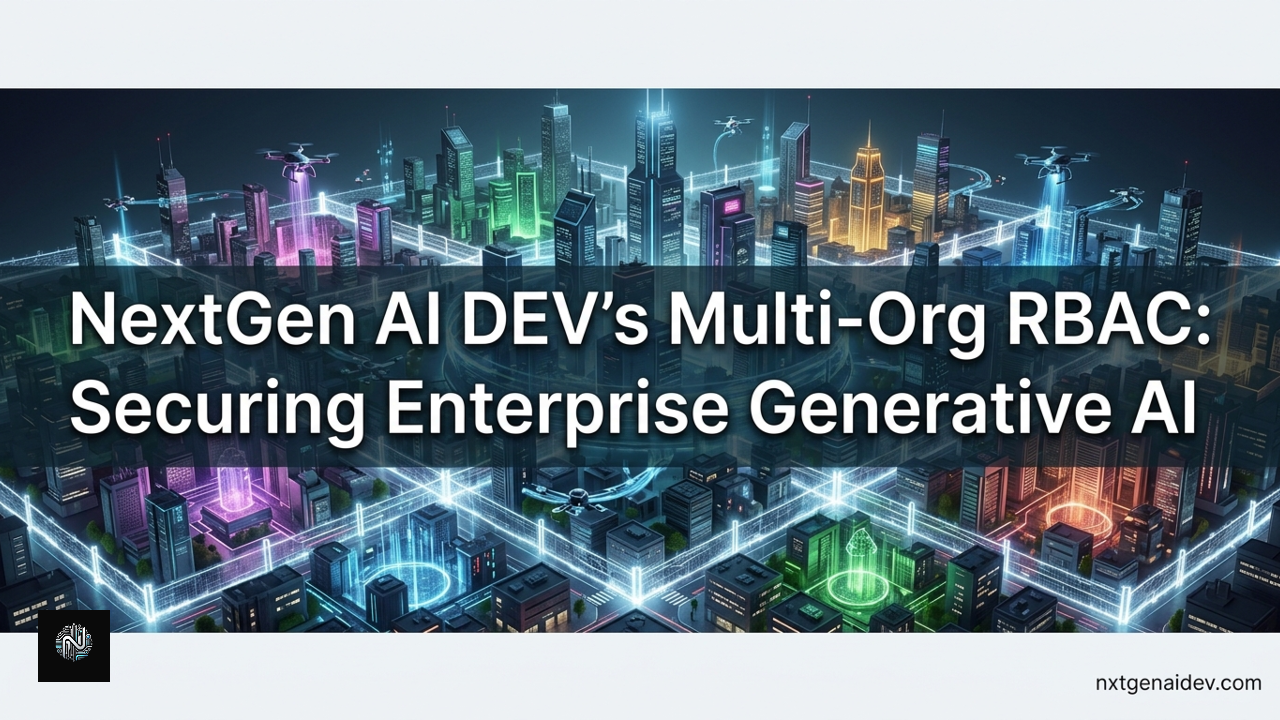
NextGen AI DEV's Multi-Org RBAC: Securing Enterprise Generative AI
Multi-org RBAC helps secure enterprise generative AI initiatives with controlled access, faster governance, and safer collaboration. Learn how.
Unleashing the full potential of generative AI across a large enterprise presents a powerful opportunity, but it also introduces complex security and governance challenges. How do you empower every department to innovate with AI while ensuring data remains secure, resources are managed effectively, and compliance is maintained across diverse business units? This is precisely where NextGen AI DEV's Multi-Org RBAC (Role-Based Access Control) for enterprise generative AI becomes not just a feature, but an indispensable foundation for secure, scalable AI adoption.
For Chief Technology Officers and AI team leads, navigating the labyrinth of access control within a unified AI platform is critical. NextGen AI DEV steps in to simplify this, providing the robust framework needed to integrate advanced AI capabilities securely across an organization with multiple internal "orgs" or business units.
What is Multi-Org RBAC for Enterprise Generative AI?
Imagine a vast digital workbench where every team, from marketing to product development, is building with generative AI. Without strict separation, models trained by one team could inadvertently access sensitive data from another, or critical resources could be misallocated. Multi-Org RBAC, specifically within the context of an enterprise generative AI platform like NextGen AI DEV, is the architectural backbone that prevents such scenarios.
Beyond Traditional RBAC: The Multi-Organizational Imperative
Traditional RBAC systems are effective for managing user permissions within a single, cohesive environment. However, when an enterprise AI platform serves multiple distinct business units—each with its own data, projects, budget, and compliance requirements—the complexity multiplies exponentially. NextGen AI DEV addresses this by enabling these different business units or departments (which we refer to as 'organizations' or 'orgs') to securely operate within a unified AI platform.
The core distinction lies in isolation. Standard, single-tenant RBAC might manage who can do what within one AI workspace. Multi-org RBAC, as implemented by NextGen AI DEV, manages who can do what within which segregated workspace, ensuring that each internal 'org' has its own secure, sandboxed environment. This sophisticated architecture allows NextGen AI DEV to segregate access, usage, and data across these multiple internal organizations, effectively creating secure boundaries within a shared infrastructure. This design ensures that the AI models, data, and applications of the 'Marketing' org remain distinct and inaccessible to the 'R&D' org, unless explicit permissions are granted.
Solving Enterprise AI's Toughest Challenge: Cross-Org Isolation
The promise of enterprise generative AI is often hampered by the fear of its most significant challenge: maintaining strict isolation between different business units. Data privacy, intellectual property protection, and regulatory compliance all depend on preventing unintended interactions or visibility between organizational silos.
Preventing Cross-Tenant Data Leakage
NextGen AI DEV's multi-org RBAC directly confronts the challenge of isolating AI usage across multiple business units. Its design ensures that each organization's activities—from prompt engineering to model fine-tuning and data ingestion—are confined to its designated scope. This feature is paramount in preventing unauthorized data access or leakage between different business units sharing the NextGen AI DEV platform. For example, a customer service department's proprietary interaction logs used to train a support chatbot will never be accessible to the sales team, whose AI might be analyzing market trends, unless explicitly configured and approved by an administrator within both orgs. The platform’s robust isolation mechanisms enforce these boundaries at every layer of the AI stack.
Governing AI Resources Across Business Units
Beyond data isolation, effective governance of AI resources is equally vital. NextGen AI DEV provides granular control over which AI resources each organization can access. This includes specific models (e.g., GPT-4 vs. Anthropic Claude, or specialized open-source models available through providers like Together), custom datasets, approved prompt templates, and integrated tools. An administrator can configure NextGen AI DEV so that the 'Finance' org can only use a pre-approved set of highly regulated models for reporting, while the 'Creative' org has access to a broader range of image generation and text-to-video models.
By applying organizational scopes and least privilege principles, NextGen AI DEV ensures secure access to AI infrastructure. This means users and AI agents within an organization only have the minimum necessary access to perform their designated tasks, preventing accidental or malicious overreach into other organizational resources or sensitive platform functionalities.
Crafting Granular Access: Roles, Permissions, and Identity Integration with NextGen AI DEV
Effective multi-org RBAC isn't just about drawing lines between departments; it's about meticulously defining who stands where within those lines and what they can do. NextGen AI DEV provides the tools for this precise level of control.
Best Practices for Role Design within NextGen AI DEV
Enterprise CTOs can structure roles within NextGen AI DEV with exceptional granularity, mirroring their internal operational structures. Consider roles such as:
Org Admin: Full control over their specific organization's settings, users, and resources within NextGen AI DEV, but no access outside their org.
AI Developer: Access to deploy models, create custom datasets, and integrate with development tools, confined to their org.
Data Scientist: Permissions to upload and manage datasets, perform model fine-tuning, and analyze AI outputs within their designated org.
Business Analyst: Access to approved prompt templates, run specific reports, and consume AI outputs without direct model deployment capabilities.
Each of these roles can be assigned specific permissions (e.g., 'read-only access to prompt templates', 'execute model X', 'upload dataset Y') scoped strictly to their organization's allocated resources.
Seamless Integration with Enterprise Identity Providers
A fragmented identity management system is a security liability. NextGen AI DEV eliminates this by offering seamless integration with existing enterprise identity providers such as Okta, Azure AD, SAML, and OIDC. This unified authentication mechanism means employees use their familiar corporate credentials to access the NextGen AI DEV platform, simplifying user management and enforcing existing security policies.
Moreover, NextGen AI DEV intelligently maps corporate group structures and hierarchies directly to AI platform roles and organizations. If your 'Marketing EMEA' group exists in Azure AD, NextGen AI DEV can automatically assign its members to the 'Marketing EMEA' organization within the platform, granting them the pre-defined roles and permissions associated with that org. This automated provisioning drastically reduces administrative overhead and ensures consistency between corporate identity and AI platform access.
Scoping RBAC for Diverse GenAI Personas
The generative AI landscape demands varied access for different personas. A prompt engineer needs a different set of permissions than a machine learning engineer or a compliance officer. NextGen AI DEV helps organizations scope RBAC for various GenAI personas, ensuring each role has precisely appropriate access. For instance, a "Compliance Officer" persona might have read-only access to all prompts and model outputs within their org for auditing purposes, while an "AI Application User" might only have access to specific, pre-built applications with no direct model interaction. This targeted approach prevents over-privileging and reduces the attack surface.
Unifying Security, Governance, and Cost Management with NextGen AI DEV
Beyond access control, the true power of NextGen AI DEV's multi-org RBAC lies in its ability to unify security, governance, and even cost management under a single, coherent framework.
Per-Organization Credits and Usage Quotas
One of the most innovative aspects of NextGen AI DEV is its unique per-organization credits system. This system seamlessly combines with RBAC to control AI consumption and budgets across different business units. Each organization can be allocated a specific number of credits, which are then consumed as they utilize models (e.g., API calls to GPT-4, Anthropic Claude, or fine-tuning operations). Once an organization's credits are depleted, its AI usage can be paused or limited until more credits are allocated.
To facilitate this, NextGen AI DEV integrates directly with leading billing platforms like Stripe, PayPal, Razorpay, and Paddle for managing these per-org limits. This means CTOs and finance teams can easily track and manage AI expenditure at a departmental level, gaining unprecedented visibility and control over their generative AI investments.
Comprehensive Audit Logs for Compliance and Transparency
In an era of increasing regulatory scrutiny (GDPR, HIPAA, SOC 2), comprehensive auditability is non-negotiable for enterprise AI. NextGen AI DEV provides robust and detailed audit logging capabilities, essential for compliance reporting and internal transparency. Every significant action on the platform is logged, including:
User: Who performed the action.
Org: Which organization the user belongs to.
Model: Which generative AI model was used.
Prompt: The input prompt (or a hashed/redacted version for sensitive data).
Data Source: Any data used for fine-tuning or RAG.
Tool: Any integrated external tools called.
Outcome: The result of the action (e.g., successful model generation, error).
These granular logs provide an immutable record of all AI interactions, allowing for forensic analysis, policy validation, and straightforward generation of compliance reports.
Securing AI Agents and Tools
As enterprises increasingly deploy autonomous AI agents and automated tools to interact with generative models, securing these non-human entities becomes paramount. NextGen AI DEV treats AI agents and automated tools as first-class principals, enabling the assignment of scoped roles and permissions across organizations, just like human users. An 'invoice processing agent' within the 'Finance' org can be given precise permissions to access specific models and tools necessary for its function, but absolutely no access to the 'HR' org's sensitive data or models. Furthermore, NextGen AI DEV supports passwordless authentication, a core security feature that complements RBAC by reducing credential-based vulnerabilities and streamlining secure access for both human users and automated systems.
Flexible Deployment & Migration: NextGen AI DEV in Action
Implementing a multi-org RBAC strategy shouldn't force enterprises into a rigid deployment model. NextGen AI DEV understands this, offering flexibility while maintaining security.
Self-Hosted and VPC Deployments
For enterprises with stringent data residency, security, and compliance requirements, NextGen AI DEV offers self-hosted and Virtual Private Cloud (VPC) deployment options. These deployments ensure that your entire generative AI infrastructure, including all data and model interactions, remains within your controlled environment. Crucially, these self-hosted and VPC options enforce multi-org RBAC consistently, tightly integrated with your corporate identity providers, ensuring a unified and secure experience whether hosted on-premises or in a private cloud. This provides maximum control without compromising the advanced multi-org capabilities.
Migrating to Structured Multi-Org RBAC
Many enterprises start their AI journey with ad-hoc API key access, a quick but ultimately unsustainable and insecure approach. NextGen AI DEV provides practical steps and best practices for migrating from these fragmented setups to a structured multi-org RBAC framework. This involves:
Auditing Existing Access: Identifying all current API keys and their associated usage.
Defining Organizations & Roles: Mapping existing business units to NextGen AI DEV organizations and defining granular roles (e.g., 'Org Admin', 'Developer') based on function.
Integrating Identity Providers: Connecting NextGen AI DEV to your corporate IdP (Okta, Azure AD).
Phased User Migration: Gradually onboarding users and assigning them roles within their respective organizations, revoking old API keys as new access is granted.
This structured migration, powered by NextGen AI DEV's platform, ensures a smooth transition, reducing security risks and improving governance. Moreover, NextGen AI DEV's unified API simplifies managing access to its 20+ models from 10+ providers (including industry leaders like Anthropic and those available via Together) under a consistent multi-org RBAC framework. Instead of managing separate keys and permissions for each model provider, everything is streamlined through a single point of control.
Avoiding Common Pitfalls: NextGen AI DEV's Proactive Approach
Even with a robust RBAC system, ongoing vigilance is key. NextGen AI DEV helps enterprises avoid common mistakes in implementing RBAC for generative AI.
Regular Access Reviews and Policy Adjustments
One common pitfall is setting up RBAC once and forgetting it. As organizational structures evolve, projects change, and team members move, access policies can quickly become outdated, leading to "privilege creep." NextGen AI DEV facilitates regular access reviews and policy adjustments to ensure RBAC policies remain aligned with evolving AI usage and regulatory requirements. Administrators can easily audit user permissions, review role assignments, and make necessary modifications through the intuitive NextGen AI DEV interface, ensuring that the principle of least privilege is continuously upheld.
Leveraging Usage Analytics for Validation
Another mistake is failing to validate whether RBAC policies are actually effective. NextGen AI DEV's comprehensive usage analytics provide deep insights into how generative AI is being used across all organizations. CTOs can see which models are most popular, which teams are consuming the most resources, and how often certain features are accessed. These analytics, combined with proactive low-credit Slack/Discord alerts, provide critical data to validate RBAC policies. If a particular organization is consistently hitting its credit limits, it might indicate a need for a budget adjustment or a review of its AI usage patterns, ensuring resources are allocated efficiently and securely according to policy. This data-driven approach allows for continuous improvement of your AI governance strategy.
Explore how NextGen AI DEV's multi-org RBAC can transform your enterprise's generative AI security and governance. Speak to our team for a tailored demonstration.