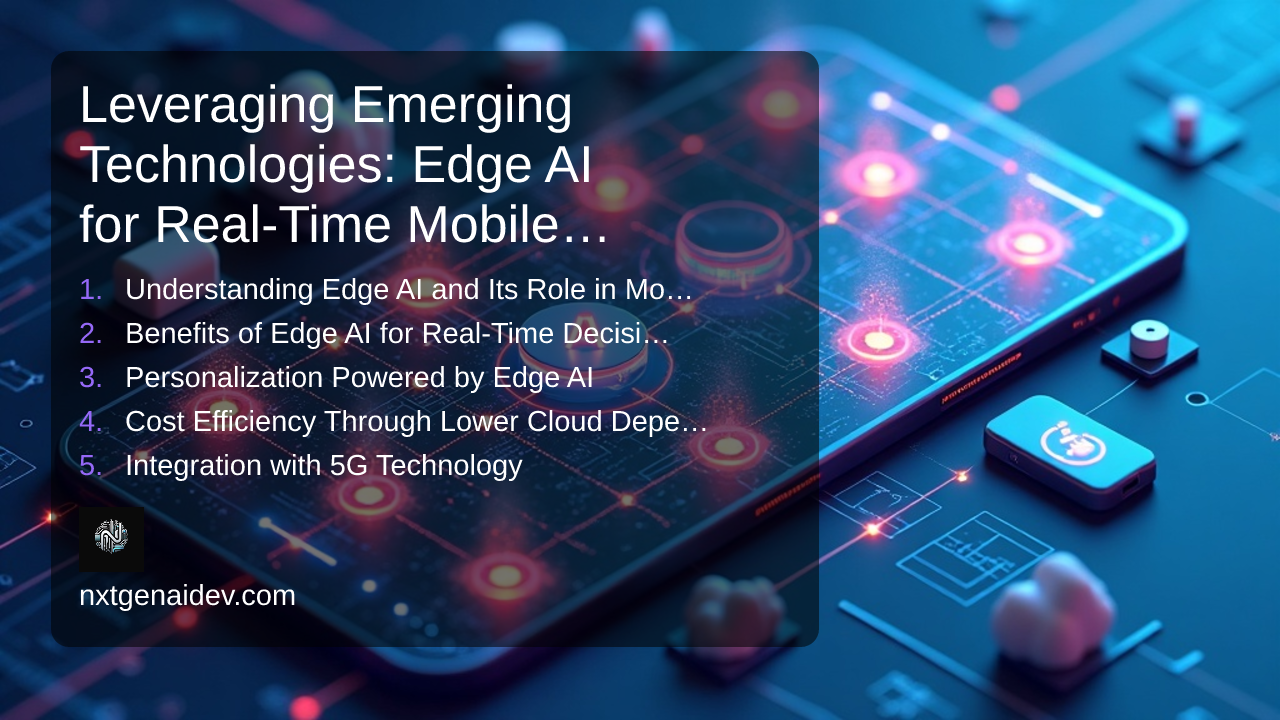
Leveraging Emerging Technologies: Edge AI for Real-Time Mobile Decisions
Discover how emerging technologies like Edge AI enhance real-time decision making in mobile apps. Transform your approach today!
Leveraging Emerging Technologies: Edge AI for Real-Time Mobile Decisions
In an age where speed is paramount, Edge AI is revolutionizing the way mobile applications make real-time decisions. Imagine an app that understands user intent instantly, providing personalized suggestions while keeping sensitive data secure. This isn’t a future concept; it’s the now, thanks to Edge AI.
Understanding Edge AI and Its Role in Mobile Applications
What is Edge AI?
Edge AI refers to the processing and analysis of data at the edge of the network, close to where it is generated. This foundational principle leverages local devices—like smartphones and IoT gadgets—to perform computations without relying heavily on centralized cloud infrastructure. Edge AI enables immediate insights by making use of on-device processing power, which translates to reduced latency and increased speed in decision-making processes.
How Does Edge AI Differ from Cloud AI?
The primary distinction between Edge AI and Cloud AI lies in data processing. While Cloud AI sends data to centralized servers for analysis, Edge AI processes information locally, providing characteristics that distinctly set it apart. Notably, Edge AI can function offline, drastically reducing the amount of data sent back and forth.
Some examples of Edge AI applications in mobile devices include voice assistants that understand context without a constant internet connection and mobile games that adapt in real-time to players' behaviors, enriching user experiences while minimizing lag.
Benefits of Edge AI for Real-Time Decision Making
Decreased Latency for Faster Responses
One of the most significant advantages of Edge AI is decreased latency. By processing data locally, mobile applications can deliver responses in a fraction of the time it would take if reliant on cloud servers. For instance, self-driving vehicles utilize Edge AI to analyze sensor data immediately for timely decision making. More importantly, in app development, milliseconds can define user satisfaction, making Edge AI vital for performance-sensitive applications.
Improved Data Privacy
Enhancing user privacy is another compelling benefit of Edge AI. Processing data on-device means that sensitive information stays personal and secure. For example, fitness apps that collect health data can now analyze it right on the user's smartphone without uploading sensitive metrics to the cloud, safeguarding user trust while managing compliance with data protection regulations such as GDPR.
Enhanced Offline Capabilities
Edge AI empowers mobile applications with enhanced offline functionalities. Consider navigation apps that can reroute without needing constant connectivity—this reliability proves critical in areas with poor reception. By utilizing Edge AI, these apps deliver a seamless experience even when users are offline, a crucial feature for many mobile applications in today’s world.
Personalization Powered by Edge AI
Creating Tailored Experiences for Users
Edge AI has the unique ability to create tailored user experiences through immediate data analysis. For example, retail apps can analyze shopping habits in real-time, recommending products based on user preferences and past purchases—all without relying on cloud connectivity. The more personalized the experience, the higher the user engagement.
Leveraging User Data Responsibly
While Edge AI offers remarkable personalization opportunities, leveraging user data responsibly is paramount. Users should provide informed consent regarding how their data is used. App developers must prioritize transparency and ethical considerations to ensure that they build long-lasting relationships based on trust and respect for privacy.
Cost Efficiency Through Lower Cloud Dependency
Reducing Operational Costs
Edge AI can help companies significantly cut operational costs by minimizing reliance on cloud services. This reduction results in fewer data transfer fees and less bandwidth consumption, making it especially beneficial for businesses operating at scale. For instance, a health monitoring app could operate efficiently on user devices, drastically cutting server maintenance and operational expenses.
Impact on Scalability
Businesses looking to scale their mobile applications can benefit from Edge AI's decentralized architecture. This structure allows for agile adjustments without the added pressure of increasing cloud capabilities. As a result, developers can focus on innovating their applications rather than grappling with cloud limits or costs.
Integration with 5G Technology
How 5G Improves Edge AI Adoption
The synergy between 5G technology and Edge AI can't be overstated. 5G networks offer enhanced speed, lower latency, and higher capacity—all of which complement Edge AI's capabilities. Consequently, mobile applications can process vast amounts of data in real-time, enabling applications like augmented reality gaming and instant video streaming to flourish.
Devices Supporting Edge AI and 5G
Several devices currently support both Edge AI and 5G technologies, enhancing application capabilities. Examples include:
Samsung Galaxy S21: This smartphone leverages Edge AI for photography enhancements and smooth gaming experiences.
Apple’s iPhone 12: Equipped with a powerful A14 chip, it offers Edge AI functionalities for real-time processing in applications like Face ID and gaming.
OnePlus 9: Known for its gaming optimization features, leveraging Edge AI for a better user experience.
Future Trends and Challenges of Edge AI
Exploring Hybrid Edge-Cloud AI Models
As the technology landscape evolves, hybrid models that utilize both Edge and Cloud AI are emerging as a viable trend. By intelligently distributing tasks between edge devices and cloud infrastructure, businesses can enhance efficiency and functionality, optimizing data processing for diverse applications.
Addressing Technical Challenges
Despite promising advantages, the implementation of Edge AI isn’t without its challenges. Technical hurdles, such as compatibility issues between different devices and network conditions, can complicate deployment. Developers must remain vigilant and adaptive to overcome these barriers while ensuring robust application performance.
Edge AI has shaped the future of mobile applications, making real-time decision-making not only possible but efficient and user-centric. Have you implemented Edge AI in your mobile applications? Share your experiences and insights!
💬 Join the conversation — share your take in the comments and tell us what you’d add.