
Key Trends in AI Innovation Shaping the Future Landscape
Explore key trends in AI innovation and discover how they are reshaping our future. Stay ahead with insights and strategies. Learn more!
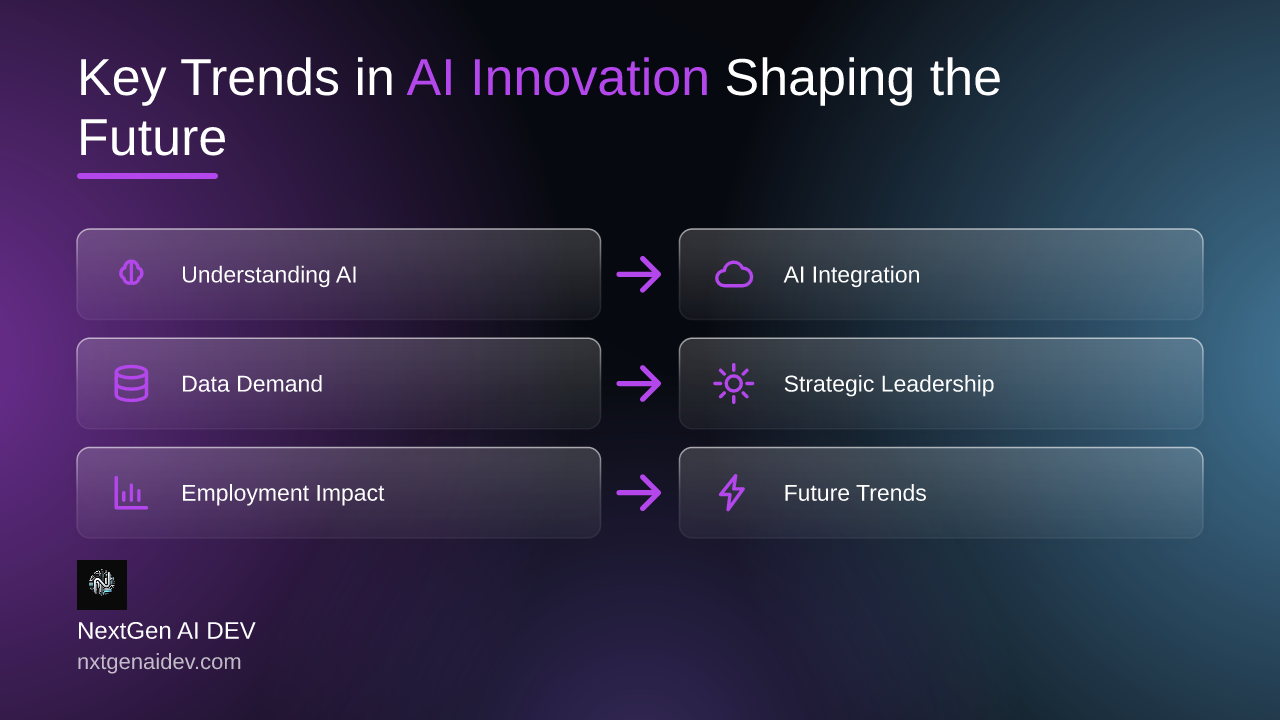
Key Trends in AI Innovation Shaping the Future Landscape
The rapid evolution of AI technology is not just transforming industries; it’s redefining how we interact with the world. Understanding what's behind this innovation is crucial for anyone looking to stay relevant in a landscape that’s evolving at lightning speed.
Understanding AI Innovation
What is AI?
Artificial intelligence (AI) encompasses a range of technologies designed to simulate human intelligence processes. These include learning (acquiring information and rules for using it), reasoning (using rules to reach approximate or definite conclusions), and self-correction. Core components of AI include machine learning (ML), natural language processing, robotics, and neural networks. Machine learning enables systems to learn from data and improve over time without specific programming for each task.
How Does AI Work?
At the heart of AI is machine learning, a method where algorithms analyze data patterns to make predictions or decisions without being explicitly programmed for each scenario. Neural networks, inspired by the human brain, are a vital technology in AI. These networks consist of interconnected nodes (or neurons) that process input data and find relationships among various factors. The efficiency of these networks has led to groundbreaking advancements in image recognition, natural language processing, and speech recognition.
AI Integration Across Industries
Healthcare
AI is making significant strides in healthcare by enhancing diagnostics and patient care. For instance, AI algorithms can analyze medical images faster and more accurately than human radiologists, leading to timely diagnoses. Systems powered by AI can also predict patient deterioration, allowing healthcare professionals to intervene before complications arise. Companies such as Zebra Medical Vision highlight how AI can identify conditions like pneumonia and diabetic retinopathy with impressive accuracy, thus improving patient outcomes and operating efficiency.
Finance
In the finance industry, AI plays a pivotal role in risk assessment, fraud detection, and customer service. Financial institutions utilize machine learning models to evaluate credit risk by analyzing historical data and predicting future behavior. Chatbots powered by AI are transforming customer interactions, providing personalized advice and improving service round-the-clock. The automation of back-office operations using AI further enhances efficiency, allowing staff to focus on more complex tasks.
Manufacturing
Manufacturing is witnessing a revolution thanks to AI, with automation and predictive analytics leading the charge. AI-driven machines optimize supply chain management by predicting when equipment will fail or when restocking is necessary, minimizing downtime and conserving resources. Integrating smart robotics into production lines allows for more precise and efficient operations, driving down costs and increasing output. Ge through its use of AI in predictive maintenance is a great example, saving millions in operational costs.
Demand for High-Quality Data in AI
Importance of Data Quality
The performance of AI systems is intrinsically linked to data quality. Poor data can lead to misleading outcomes and undermine the effectiveness of AI applications. In fact, a study by McKinsey revealed that organizations that prioritize data quality see up to 20 times more return on their AI investments. Consequently, ensuring high-quality datasets is a fundamental step in the AI deployment process.
Strategies for Data Collection
To gather clean and relevant data, companies can adopt several methods:
Data Auditing: Regularly inspect existing data to remove inaccuracies.
Diverse Sources: Utilize various data sources to ensure comprehensive datasets.
User Feedback: Engage with end-users to identify gaps in data coverage.
Automated Data Entry: Implement tools that can automatically flag and correct anomalies in real time.
Utilizing these strategies can help organizations gather the vital data needed for effective AI training and application.
Strategic Leadership in AI Projects
Building AI-Ready Teams
Leading successful AI projects requires a unique blend of skills. Team members should have proficiency in data science, machine learning, and domain-specific knowledge relevant to their field. Furthermore, fostering a culture of collaboration and continuous learning is fundamental, as AI roles often intersect with various functions across an organization.
Navigating Ethical Implications
AI also brings forth ethical considerations that leaders must navigate thoughtfully. Issues such as bias inherent in algorithms, data privacy, and the implications of automation are pressing concerns. Leaders should prioritize ethical frameworks and encourage transparency in AI project implementations, aiming to eliminate biases and protect user data.
Impact of AI on Employment
Job Creation vs. Displacement
As AI technologies evolve, there is a dual impact on employment—job creation and displacement. While certain roles may become obsolete, AI generates new jobs that require skills in managing and interacting with AI systems. Roles in data oversight and AI ethics are emerging, indicating a shift in the job market landscape.
Reskilling Workforce for the AI Era
To navigate this transformation, organizations must invest in reskilling programs. A robust framework could include:
Upskilling initiatives: Offering training in AI-related tools and technologies.
Collaborative learning: Encouraging knowledge sharing among employees to promote a culture of learning.
Partnerships: Working with educational institutions to develop specialized courses that equip employees with necessary skills for the AI-driven future.
Proactively reskilling the workforce ensures that employees remain relevant and engaged in their roles.
Future Trends in AI Innovation
Advancements in Machine Learning
The future of AI is likely to see tremendous advancements in machine learning, especially in areas like reinforcement learning and deep learning. With these technologies, AI systems can autonomously learn from their environment and optimize their performance across complex tasks, from game playing to autonomous driving. New frameworks and tools, such as TensorFlow and PyTorch, continue to emerge, facilitating rapid development and deployment of machine learning models.
The Rise of Generative AI
Generative AI is ushering in a new era of creativity across various fields. From generating synthetic art and music to writing content, generative AI tools are transforming what’s possible. Applications like OpenAI's GPT-3 highlight the potential of AI in creative endeavors. Industries that traditionally relied on human imagination can now leverage AI to amplify creative processes.
As AI continues to advance, its implications will undoubtedly deepen across every sector, from healthcare to entertainment.
What specific trends in AI innovation have you observed in your industry, and how are they impacting your work?
💬 Join the conversation — share your take in the comments and tell us what you’d add.