
Implementing Multimodal AI: Challenges & Solutions for Vision-Language Integration
Multimodal AI integration made practical: solve vision-language challenges and build smarter workflows. Read the guide to get started.
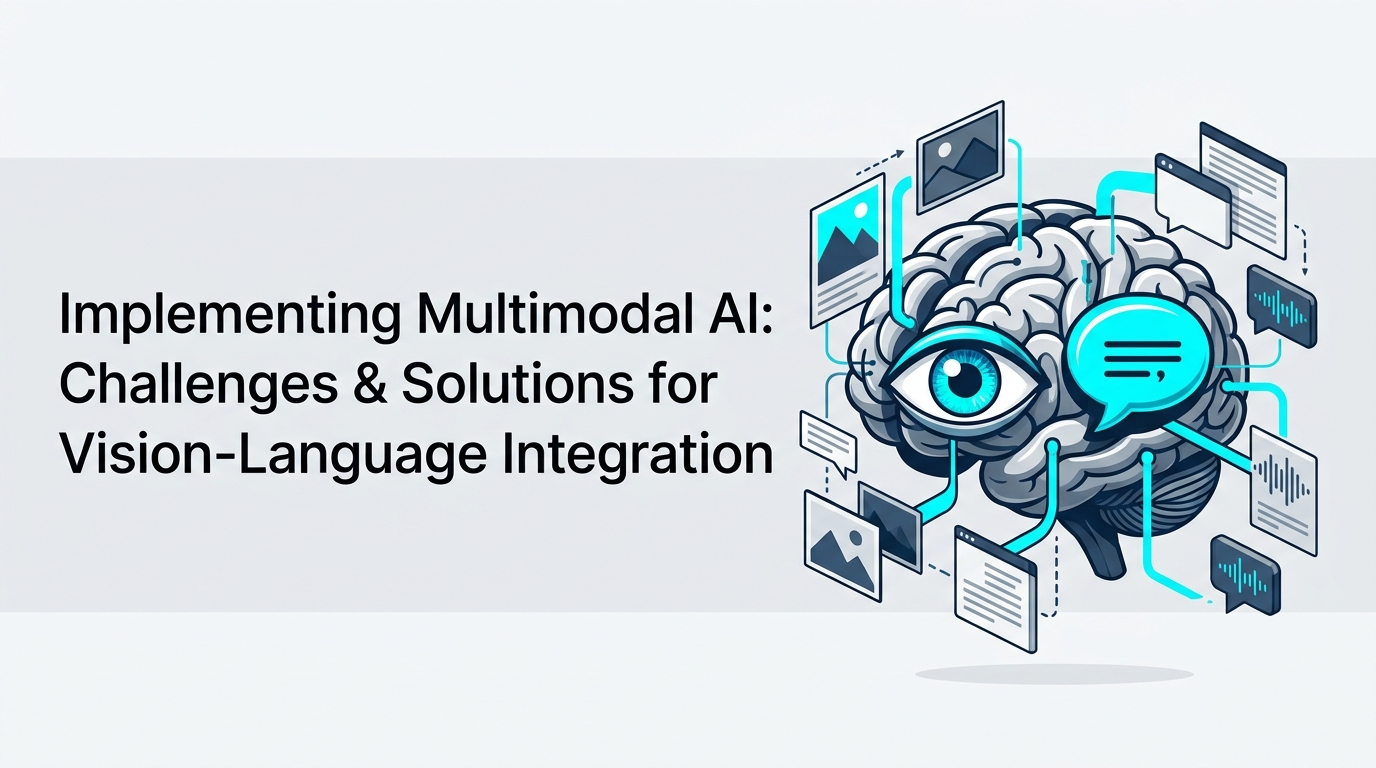
The digital world is awash with information, but much of its richness lies in how we perceive and interpret multiple sensory cues simultaneously. Imagine a system that doesn't just see an image or read text, but understands the interplay between them. This is the promise of implementing multimodal AI, particularly the integration of vision and language models, a frontier that is fundamentally changing how machines understand and interact with our complex world.
Multimodal AI involves combining and processing information from various data modalities—be it vision (images, video), language (text, speech), or audio—to achieve a more comprehensive and human-like understanding. This holistic approach moves beyond the limitations of single-modality systems, enabling richer context, more intuitive interactions, and unlocking entirely new application possibilities. From generating descriptive captions for images and visually answering complex questions to analyzing sentiment from video footage (combining facial expressions, tone of voice, and spoken words), and performing sophisticated cross-modal retrieval, multimodal AI is set to redefine intelligent systems.
Navigating the Hurdles: Key Challenges in Multimodal AI Deployment
While the potential of multimodal AI is immense, its implementation comes with a unique set of technical and operational challenges. Effectively bridging the gap between disparate data types requires careful consideration of alignment, data integrity, computational demands, and robust evaluation.
The Modality Mismatch: Alignment and Synchronization
One of the foremost challenges is the inherent "modality mismatch." Vision and language, for instance, are represented and encoded in fundamentally different ways. Images are grids of pixels, while text comprises discrete tokens. Making these disparate data types "speak the same language" and maintaining temporal or semantic correspondence is a significant hurdle. Problems arise from misaligned modality encodings, where the representations derived from an image don't naturally align with those from descriptive text, or when a video frame doesn't precisely correspond to the spoken word it's meant to illustrate. Achieving tight semantic alignment, where specific words map accurately to relevant regions within an image, requires sophisticated techniques.
Data Scarcity and Quality: The Foundation Problem
Multimodal AI models thrive on vast, high-quality datasets, yet these are notoriously difficult and expensive to acquire and annotate. A common issue is missing or incomplete modalities, where, for example, a video might lack an audio track, or a textual description might be absent for an image. The high cost of collecting and meticulously annotating multimodal datasets—requiring human experts to precisely label visual elements and link them to linguistic descriptions—is a major barrier. Furthermore, privacy constraints often limit access to large-scale, diverse real-world multimodal data. Ensuring consistency and quality across different data streams, particularly when sourced from diverse origins, is a continuous battle.
Computational Intensity: Resource Demands
The complexity of multimodal models, especially those built on large foundation models, translates directly into high computational effort for both training and inference. Integrating and processing information from multiple data streams simultaneously often requires significantly more parameters and operations than single-modality models. This poses substantial infrastructure and cost barriers, demanding powerful GPUs, TPUs, or specialized hardware, and incurring considerable energy consumption. Deploying such models at scale in production environments further exacerbates these resource demands.
Evaluation and Interpretability: Knowing if it Works and Why
Accurately evaluating multimodal AI performance is a complex task. The field currently suffers from weak multimodal evaluation, lacking standardized metrics that comprehensively capture cross-modal understanding beyond simple accuracy scores. A model might generate grammatically correct captions, but are they semantically accurate given the image? Does it truly understand the visual nuances described by the text? Furthermore, due to the intricate interaction of multiple modalities within deep learning architectures, understanding model decisions and pinpointing why a certain output was generated remains a significant challenge. This difficulty in interpretability hinders trust and debuggability.
Architectural Solutions: Integrating Vision and Language Models
The way vision and language features are integrated within an AI architecture profoundly impacts the model's performance and capabilities. Different fusion strategies offer distinct advantages and trade-offs.
Early Fusion: Combining at the Input
Early fusion involves concatenating raw or pre-processed features from different modalities at an initial input layer, typically before they enter a shared encoder. For instance, you might flatten image pixels and combine them directly with word embeddings.
Pros: This approach allows for rich, early interaction between modalities, theoretically enabling the model to learn deep, integrated representations from the outset.
Cons: Early fusion can lead to extremely high dimensionality, making training computationally intensive and prone to overfitting. It's also highly sensitive to noise in either modality and can struggle with direct temporal or semantic synchronization if the initial features aren't perfectly aligned. It also makes handling missing modalities difficult, as the input structure is rigid.
Conceptual Example: Imagine taking a low-level vector representation of an image (e.g., from a CNN layer) and directly concatenating it with the word embeddings of a sentence. This combined vector then serves as the input to a shared neural network that processes both vision and language simultaneously.
Late Fusion: Combining at the Output
Late fusion takes a more modular approach. Each modality is processed independently through separate encoders (e.g., a CNN for vision, an RNN/Transformer for language) to extract high-level features. Their predictions or high-level semantic representations are then merged at a later stage, often just before the final output layer.
Pros: This strategy is simpler to design and implement, highly modular, and more robust to missing modalities (as one stream can still provide input). It reduces the dimensionality of cross-modal interaction to high-level concepts.
Cons: The primary drawback is that late fusion potentially loses early cross-modal context. The models might have already made "decisions" or formed representations independently before they can interact, leading to a potentially weaker or less nuanced interaction.
Conceptual Example: You could train a separate image classification model and a separate text classification model. For a multimodal task, the logits (pre-softmax outputs) or probabilities from both models are combined (e.g., averaged, concatenated, or fed into a small decision-making neural network) to produce a final, combined prediction.
Cross-Attention and Hybrid Approaches
Modern multimodal architectures, especially those based on transformers, often employ hybrid approaches centered around cross-attention mechanisms. These allow for dynamic and flexible interaction, and information exchange between modalities at various layers of the network.
How it works: In a cross-attention layer, a "query" from one modality (e.g., a linguistic token) attends to "keys" and "values" from another modality (e.g., visual patches from an image). This allows each element in one modality to selectively focus on and gather relevant information from the other modality, creating a rich, context-aware interaction.
Benefits: Cross-attention avoids the irreversible commitment of early fusion while enabling deeper interaction than late fusion. It allows the model to learn which parts of an image are relevant to which words, and vice-versa, fostering a truly intertwined understanding. These architectures are highly flexible and have become the dominant paradigm.
Conceptual Example: Consider models like CLIP (Contrastive Language-Image Pre-training). A Visual Transformer (ViT) might encode image patches into a sequence of embeddings, and a language model (e.g., BERT-like) encodes text tokens. A cross-attention layer would then allow each text token embedding to attend to the visual patch embeddings, enriching its understanding with visual context, and conversely, allow visual patch embeddings to attend to text tokens. This dynamic querying and value-sharing facilitate deep, context-dependent fusion.
Overcoming Data Hurdles and Enhancing Alignment
The quest for robust multimodal AI often boils down to intelligent data management and sophisticated alignment strategies.
Strategic Data Augmentation for Multimodal Datasets
Data augmentation isn't just for single modalities anymore. For multimodal systems, techniques need to go beyond simple image rotations or text paraphrasing.
Synthetic Data Generation: Tools can generate synthetic images paired with descriptive text, creating diverse examples without real-world collection constraints.
Adversarial Training for Multimodal Consistency: Generative Adversarial Networks (GANs) can be used to generate new multimodal pairs (e.g., an image and a corresponding caption) that are consistent across modalities, improving the model's robustness to varying data.
Creative Cross-Modal Augmentation: This involves transforming one modality and making corresponding changes in the other. For instance, applying an image transformation (e.g., cropping, blurring a specific object) and simultaneously paraphrasing or altering the descriptive text to reflect that change (e.g., "A blurry cat" instead of "A cat"). Similarly, generating visual question variations for the same image can expand the training data.
Leveraging Pre-trained Models and Transfer Learning
The sheer scale of pre-trained vision models (e.g., Vision Transformers, ResNets) and large language models (e.g., BERT, GPT-series) offers a powerful solution to data scarcity.
Feature Extraction: These models can be used as powerful, off-the-shelf feature extractors. You can extract high-quality embeddings from an image using a pre-trained ViT and from text using a pre-trained BERT, then feed these embeddings into a smaller, multimodal fusion network. This significantly reduces the amount of multimodal data needed for fine-tuning.
Fine-tuning: Alternatively, a pre-trained multimodal model (like CLIP or ViLBERT) can be fine-tuned on a smaller, task-specific multimodal dataset. This transfers the broad knowledge gained from massive datasets to a niche application, often with remarkable efficiency. This strategy dramatically mitigates the "cold start" problem for new multimodal tasks.
Robust Alignment Techniques
Explicitly aligning features from different modalities into a common, semantically rich embedding space is crucial for effective multimodal understanding.
Contrastive Learning Objectives: Techniques like those employed in CLIP are highly effective. CLIP learns to align image and text embeddings by pushing representations of matching pairs (e.g., an image and its correct caption) closer together in an embedding space, while simultaneously pushing non-matching pairs further apart. This results in a shared latent space where semantic similarity directly correlates with distance.
Canonical Correlation Analysis (CCA): A statistical method that finds linear projections of two (or more) sets of variables such that their correlation is maximized. While more traditional, it provides a principled way to find shared subspaces.
Shared Latent Representations: Designing architectures that force different modalities to contribute to a single, shared latent representation (e.g., through autoencoders or variational autoencoders) can also promote alignment.
Handling Missing Modalities:
Imputation: Filling in missing data points based on other available modalities or statistical models. For instance, if text is missing, a captioning model could generate a synthetic caption based on the image.
Modality Dropout: During training, randomly dropping out one or more modalities to force the model to learn robust representations from partial inputs.
Architectural Robustness: Designing architectures (like some late fusion models) that can gracefully handle inputs with fewer than the full set of expected modalities without breaking.
From Lab to Production: Optimizing for Performance and Scalability
Moving multimodal AI from experimental success to robust production deployment requires a keen focus on efficiency, reliable evaluation, and ongoing maintenance.
Reducing Computational Overhead
The resource demands of multimodal AI necessitate strategic optimization for production environments.
Model Compression:
Quantization: Reducing the precision of model weights (e.g., from 32-bit floating point to 8-bit integers) significantly cuts down memory footprint and speeds up inference with minimal accuracy loss.
Pruning: Removing redundant weights or neurons from the model without substantially impacting performance.
Knowledge Distillation: Training a smaller, "student" model to mimic the behavior of a larger, more complex "teacher" model. This allows for faster inference with a smaller model while retaining much of the performance.
Efficient Model Architectures: Utilizing specialized, lightweight architectures designed for efficiency, such as MobileNets for vision tasks or small BERT variants for language, can dramatically reduce the computational burden.
Specialized Hardware Accelerators: Leveraging GPUs, TPUs, and emerging Neural Processing Units (NPUs) specifically designed for AI workloads is critical for achieving high throughput and low latency in production.
Rigorous Evaluation Frameworks
Moving beyond simple accuracy requires comprehensive evaluation that considers the nuanced interplay of modalities.
Task-Specific Performance: Evaluate the model against a diverse set of tasks (e.g., image captioning, visual question answering, cross-modal retrieval) using appropriate metrics for each.
Consistency Checks: Assess if the model's outputs across different modalities are consistent. For example, if a model captions an image as "a cat playing with a ball," does it also correctly answer "What is the cat playing with?" as "a ball"?
Robustness Testing: Evaluate performance against noisy inputs, adversarial examples, or real-world variations (e.g., images with poor lighting, distorted audio, grammatically incorrect text).
Human Evaluation: For tasks requiring subjective judgment (like caption quality, relevance of retrieval), human evaluators remain indispensable for capturing nuanced understanding that automated metrics might miss.
Bias Detection: Crucially, evaluate performance across diverse subsets of data to detect and quantify potential biases related to demographics, gender, race, or other sensitive attributes.
Monitoring and Maintenance in Production
Once deployed, multimodal AI systems require continuous monitoring and proactive maintenance.
Monitoring Key Performance Indicators (KPIs): Track metrics like latency, throughput, error rates, and resource utilization for both individual modalities and the integrated system.
Detecting Data Drift: Input distributions for either modality can change over time (e.g., new image styles, evolving language usage). Monitoring for data drift helps identify when the model's training data no longer accurately represents the production inputs, indicating a need for retraining.
Conceptual Drift: The relationship between modalities might change (e.g., a new meme associating an image with a previously unrelated phrase). Monitoring conceptual drift is harder but essential for long-term relevance.
A/B Testing: Continuously test new model versions or configurations against existing ones in a live environment to measure real-world impact before full deployment.
Robust Rollback Strategies: Have clear procedures to quickly revert to a previous, stable model version if issues arise in production.
Logging and Observability: Implement comprehensive logging for multimodal inputs, intermediate representations, and outputs. Observability tools help diagnose issues by visualizing the data flow and interactions between modalities within the model.
Building Trust: Interpretability, Bias, and Ethical AI
As multimodal AI becomes more pervasive, ensuring fairness, transparency, and ethical operation is paramount.
Ensuring Fair and Unbiased Multimodal Systems
Bias is not just a single-modality problem; it can be amplified in multimodal systems. Biases inherent in individual modalities (e.g., gender stereotypes in image datasets, racial biases in text corpora) can reinforce each other or even create new biases when combined.
Bias Detection: Employ fairness metrics to quantitatively assess model performance across different demographic groups or sensitive attributes. This could involve checking if image captioning accuracy differs for images depicting various ethnicities or if visual question answering performs differently based on gender implied in the text.
Mitigation Strategies:
Balanced Multimodal Datasets: Curate or re-balance datasets to ensure equitable representation across sensitive categories. This is often an iterative and challenging process.
Fairness-Aware Training Algorithms: Incorporate fairness constraints into the model's objective function during training, penalizing outcomes that exhibit undesirable biases.
Adversarial Debiasing: Train an adversary to detect and mitigate bias in the multimodal representations.
Techniques for Enhanced Interpretability
Making multimodal AI decisions more transparent is vital for trust and debugging.
Attention Visualization: For transformer-based models, attention maps can visualize which parts of an image (e.g., specific objects or regions) or which text tokens the model "paid most attention to" when generating a specific output. This helps understand the model's focus.
# Conceptual Python snippet for attention visualization (simplified)
# Assuming 'attention_weights' is a tensor from a cross-attention layer
# and 'image_patches' are the regions corresponding to visual tokens.

# Example: Visualize attention of a specific word token to image patches
word_index = 5 # Index of the word token (e.g., 'cat')
attention_to_image = attention_weights[word_index, :] # Attention scores for this word across all image patches

# Overlay attention_to_image onto the original image patches
# Higher scores indicate more focus.
Saliency Maps: These highlight the most influential pixels in an image or tokens in a text that contributed to a model's prediction. For multimodal systems, you can generate saliency maps for both modalities to see their individual contributions.
Feature Attribution Techniques: Methods like LIME (Local Interpretable Model-agnostic Explanations) and SHAP (SHapley Additive exPlanations) can be adapted for multimodal inputs. They explain individual predictions by approximating the complex model locally with a simpler, interpretable model, showing how each input feature (e.g., a visual patch, a word) contributes to the output.
Counterfactual Explanations: By slightly altering input modalities (e.g., changing a single word or a small visual feature) and observing the change in prediction, one can understand what minimal changes would lead to a different outcome. This helps in understanding causal relationships learned by the model.
Implementing multimodal AI, especially the integration of vision and language, is a complex yet incredibly rewarding endeavor. By systematically addressing challenges related to data, architecture, computation, and ethics, practitioners can unlock the full potential of these transformative technologies.
What specific challenges have you encountered in your own journey implementing multimodal AI, particularly when integrating vision and language, and how did you overcome them?
💬 Join the conversation — share your take in the comments and tell us what you’d add.