How AI Agents Can Transform Your Business Strategies Today
Unlock growth with AI Agents. Discover how Agentic AI can elevate your business strategies today!
How AI Agents Can Transform Your Business Strategies Today
Imagine a world where your business processes operate seamlessly, driven by AI technologies that eliminate inefficiencies and elevate decision-making to new heights. This isn't a distant dream—it's the reality that AI agents can create in your organization today.
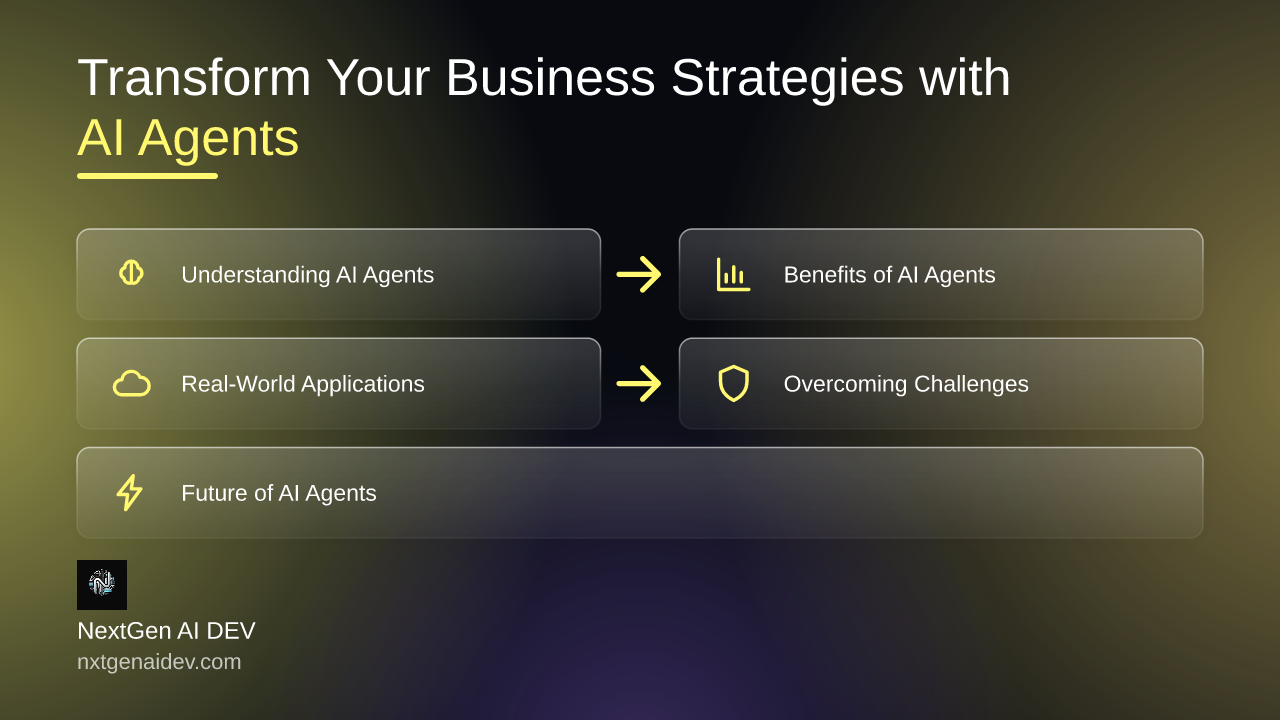
Understanding AI Agents: What Are They?
Definition of AI Agents
AI agents are sophisticated programs designed to perform tasks autonomously, a step beyond traditional AI that typically relies on human input for action. These agents serve a pivotal role in business automation, making decisions based on their programming and data inputs in real time. They go beyond mere tools; they are capable of learning and adapting their strategies to optimize outcomes.
How AI Agents Function
The essence of AI agents lies in their components: machine learning models, decision-making frameworks, and an ability to interact with data. Unlike traditional AI systems, which make decisions based on predetermined algorithms, AI agents handle tasks with a degree of autonomy. By utilizing techniques such as reinforcement learning and natural language processing, they can process information and act in ways that continually improve efficiency and effectiveness.
The Benefits of Implementing AI Agents in Business Strategies
Improving Efficiency
Integrating AI agents into your business can streamline numerous operations. From automating customer service inquiries to managing inventory and supply chains, AI agents can handle repetitive tasks, freeing up human employees to focus on higher-level strategic initiatives. Statistically, companies that have adopted AI notes a significant productivity boost; for instance, a McKinsey report indicates that organizations implementing AI agents can increase productivity by up to 40% in specific areas.
Enhancing Decision-Making
AI agents provide actionable insights gleaned from vast amounts of data. They analyze patterns, predict outcomes, and present information in digestible formats, enabling stakeholders to make informed decisions more quickly. This data-driven approach mitigates risks and allows for strategic pivots based on real-time information.
Real-World Applications of AI Agents
Case Studies
Consider the case of a global retail giant that deployed AI agents to optimize their supply chain. By analyzing real-time data and predicting demand patterns, they reduced excess inventory by 30%, leading to substantial cost savings and increased profitability (McKinsey insights). In another example, a healthcare provider utilized AI agents for patient processing, which resulted in a 20% reduction in wait times and a notable increase in patient satisfaction.
Industry-Specific Use Cases
Different industries have found transformative applications for AI agents:
Finance: Automating fraud detection and risk assessment while minimizing human error.
Healthcare: Assisting in diagnostics and predictive analytics for patient care.
Manufacturing: Streamlining production lines and predictive maintenance scheduling.
These examples reveal not only the potential benefits but also highlight the practical hurdles faced during implementation. Common challenges include integrating new technologies with existing workflows and training staff to work alongside AI agents.
Overcoming Challenges in Implementing AI Agents
Integration with Legacy Systems
One of the foremost challenges businesses encounter involves integrating AI agents with their legacy systems. Older infrastructures may not be equipped to communicate effectively with newer technologies, creating potential data silos. Businesses must consider a phased approach for integration, allowing for testing and adjustments along the way.
Data Quality and Trust Issues
The efficiency of AI agents is heavily reliant on data quality. Poor data can lead to flawed insights and decisions. Companies must invest in data governance processes to ensure accuracy and reliability. Additionally, ethical considerations surrounding data usage must be prioritized, as customers are increasingly aware of privacy and data governance issues.
The Future of AI Agents in Business
Trends and Predictions
As we look toward 2028, a significant trend emerges: an increased adoption of AI agents across various sectors. According to industry forecasts, up to 50% of tasks could be handled by AI agents in the coming years, suggesting a monumental shift in business operations.
Preparing for Adoption
To prepare for this future, businesses should focus on staff training, robust data management practices, and ensuring that ethical standards are in place. This proactive stance will help organizations smoothly transition into the era of AI, reducing friction and maximizing benefits.
Comparing AI Agents to Traditional AI
Key Differences
The primary difference between AI agents and traditional AI systems lies in their degree of autonomy and adaptability. While traditional AI often requires ongoing human supervision and intervention, AI agents operate independently—an important distinction that impacts their implementation.
When to Use Which
In scenarios requiring real-time decision-making, such as fraud detection or inventory management, AI agents are generally more effective than traditional AI systems. Businesses must assess their needs carefully to determine the most appropriate technology to deploy.
Adopting AI agents represents a paradigm shift in how businesses approach strategy and operations. Questions around implementation, ethics, and integration will undoubtedly arise.
What challenges have you faced or do you foresee in adopting AI agents in your business strategies?
💬 Join the conversation — share your take in the comments and tell us what you’d add.