How AI Agents are Transforming Software Development Practices
Discover how AI Agents can streamline your software development for better efficiency and innovation. Start transforming today!
Introduction to AI Agents in Software Development
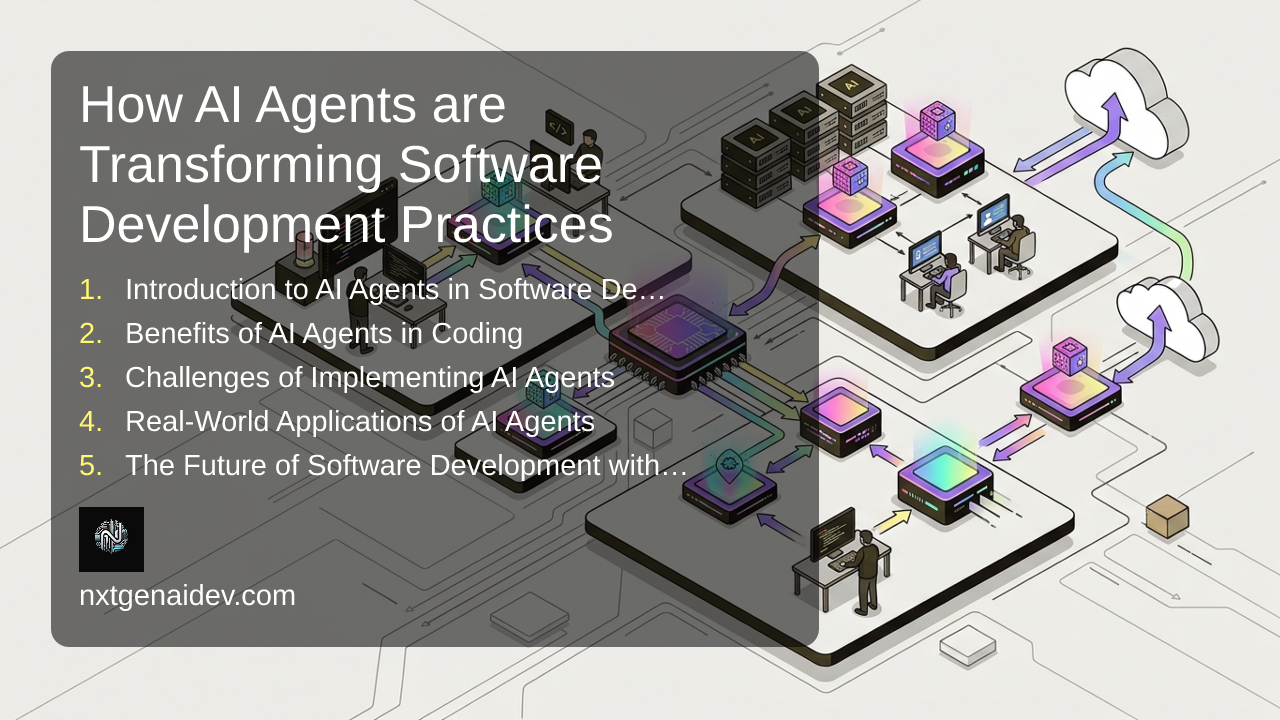
AI agents are revolutionizing the landscape of software development, serving as intelligent tools that can adapt, learn, and assist in various tasks throughout the development life cycle. Unlike traditional methodologies that rely heavily on human intervention, these agents orchestrate workflows, automate mundane tasks, and support developers in decision-making, significantly enhancing productivity and efficiency.
The transition from conventional Software Development Life Cycles (SDLC) to agent-orchestrated models marks a profound shift. In a world increasingly driven by AI, development processes are evolving into dynamic frameworks optimized by continuous learning and adaptability.
Benefits of AI Agents in Coding
Improved Code Quality
One of the most compelling benefits of AI agents in coding is the enhancement of code quality. By providing real-time feedback and detecting errors as the code is written, these agents serve as both guides and assistants. For example, utilizing tools like GitHub Copilot or TabNine enables developers to receive context-aware suggestions, which can lead to fewer bugs and more efficient code structures. According to research, teams employing AI assistance see a reduction in code review times by as much as 30% because issues are identified before they can escalate into larger problems (source).
Accelerated Delivery Timelines
The automation capabilities of AI agents significantly contribute to accelerated project completion timelines. Tasks that were once time-consuming, such as testing and deployment, can now be automated with the use of various tools. For instance, Continuous Integration/Continuous Deployment (CI/CD) pipelines can be enhanced using AI-driven services, such as Jenkins with AI plugins, to automate deployment, monitor performance, and even rollback changes if necessary. This level of automation often translates into faster delivery, allowing teams to meet tighter deadlines without sacrificing quality.
Enhanced Collaboration
AI agents facilitate improved collaboration among developers by orchestrating workflows and ensuring that all team members stay aligned. Tools like Slack integrated with AI bots can notify developers about pending issues, status updates, or even code merges requiring attention. This kind of automated communication reduces bottlenecks and fosters a more collaborative environment, enabling teams to work more cohesively and efficiently.
Challenges of Implementing AI Agents
Integration Issues
Despite the immense potential of AI agents, integration into existing workflows presents several challenges. Many legacy systems are not designed to accommodate AI technologies, leading to incompatibilities and increasing implementation costs. Organizations may need to invest in upgrading their infrastructure and modifying established workflows, which can hamper short-term productivity during the transition phase.
Security Concerns
The introduction of AI agents brings about security vulnerabilities that need to be addressed. Automated systems can introduce new attack vectors, particularly if sensitive data is involved. A comprehensive security strategy should encompass threat modeling, regular auditing, and the implementation of robust access controls to protect against potential exploits. Furthermore, organizations must continuously monitor the AI systems for unexpected behaviors that could result from learning anomalies or data biases.
Ethical Considerations
As AI agents take on more responsibilities, ethical concerns regarding job displacement and decision-making arise. While AI can enhance productivity, there is a fear that it may render certain jobs obsolete. Furthermore, ethical dilemmas emerge when AI systems encounter situations requiring human judgment. It’s essential for organizations to address these concerns proactively, ensuring transparency in the use of AI technologies while focusing on upskilling their workforce.
Real-World Applications of AI Agents
Case Studies
Several organizations have already begun reaping the benefits of AI agents. For instance, Microsoft’s GitHub Copilot has been used by teams to streamline their coding processes, resulting in a 30% increase in productivity and a notable reduction in defects. Similarly, companies like Google have successfully integrated AI-driven project management tools, which have improved their overall workflow efficiency.
Tools and Platforms
Numerous specialized tools support agentic software engineering. Beyond GitHub Copilot, platforms like Repl.it allow developers to collaborate and receive AI-driven assistance on-the-fly. Furthermore, AI-enhanced testing tools such as Testim offer automation capabilities that greatly reduce the manual effort involved in quality assurance.
The Future of Software Development with AI Agents
Evolving Roles of Engineers
As AI agents become integral to the development lifecycle, the roles of software engineers are evolving. Engineers are required to acquire a new set of skills, including understanding AI algorithms, machine learning, and data analytics. This transformative shift cultivates a new type of developer—one who is equally proficient in coding and AI literacy.
The Rise of Multi-Agent Systems
The future may witness the emergence of multi-agent systems designed for enhanced orchestration and collaboration. These systems allow multiple AI agents to coordinate various aspects of software development, sharing knowledge and skills in real-time to optimize processes. In scenarios where agents can collectively solve complex problems, the synergy can lead to breakthroughs in functionality and performance that wouldn't be possible with a singular focus.
Conclusion and Discussion
The introduction of AI agents in software development is a transformative journey characterized by opportunities and challenges. From improving code quality and accelerating timelines to addressing ethical considerations, the integration of AI offers a new frontier for development practices. As businesses navigate this evolving landscape, it’s crucial to reflect on past experiences and anticipate future developments.
What challenges have you faced or observed when incorporating AI agents into your development process?
💬 Join the conversation — share your take in the comments and tell us what you’d add.