Harnessing Emerging Technologies: Edge AI for Real-Time Decision-Making
Discover how emerging technologies like Edge AI can revolutionize real-time decision-making in your business. Start transforming today!
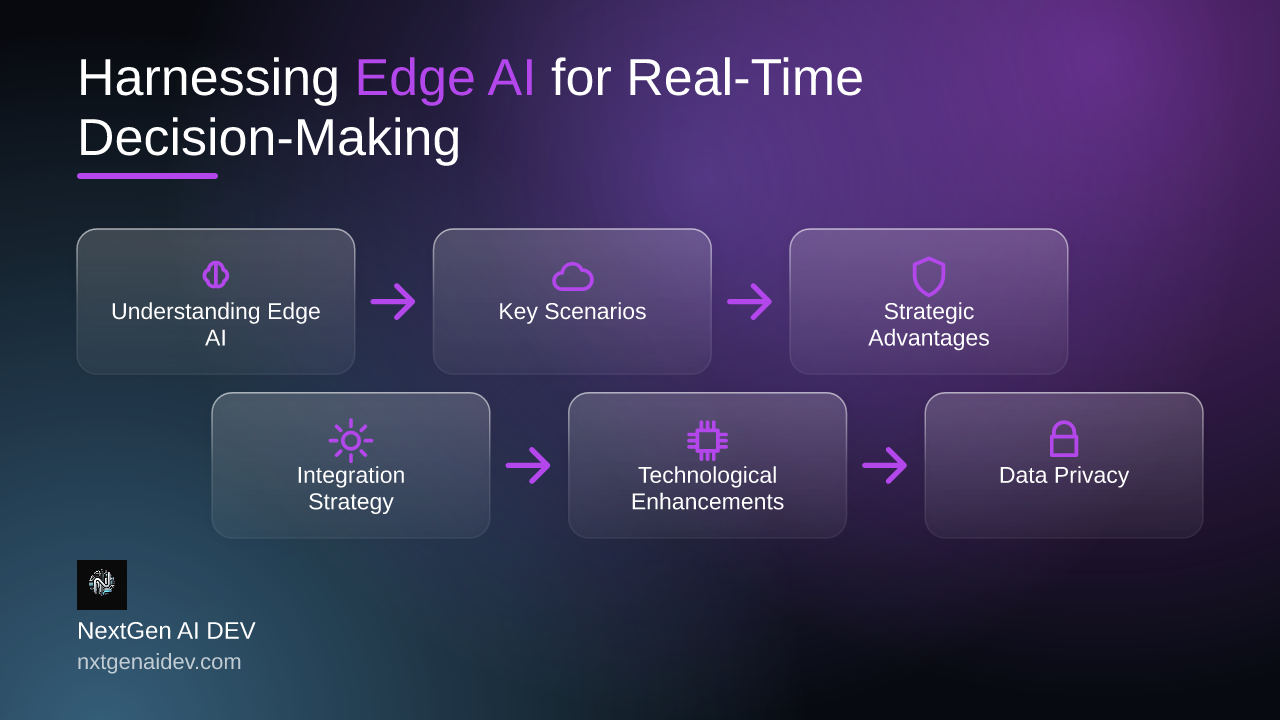
Understanding Edge AI in the Context of Emerging Technologies
What is Edge AI?
Edge AI, a rapidly evolving domain within the tech landscape, refers to the deployment of artificial intelligence at or near the source of data generation, rather than relying solely on centralized cloud servers. This approach not only minimizes latency but also enhances the responsiveness of AI applications, making real-time decision-making possible for a myriad of use cases. By processing data on local edge devices, businesses benefit from improved speed, reduced bandwidth usage, and heightened privacy, all of which are critical in today's data-driven environment.
Centralized AI consolidates data processing in remote data centers, creating a chain of dependencies which can hinder the speed of decision-making. In contrast, Edge AI leverages local data processing, streamlining operations and empowering teams to act swiftly based on immediate insights. This distinction is significant for sectors such as healthcare, manufacturing, and logistics, where milliseconds can make all the difference.
The Role of Emerging Technologies in Business
Emerging technologies, including Internet of Things (IoT), 5G connectivity, and advanced analytics, are key enablers of Edge AI, enhancing its capabilities and deployment across various industries. By creating a synergistic environment where devices can communicate and collaborate, businesses can optimize operations and elevate customer experiences.
For instance, IoT devices can generate vast amounts of data that, when processed locally via Edge AI, can lead to faster decision-making and proactive measures. The integration of these technologies fosters not just efficiency, but innovation, allowing businesses to adapt to changing market conditions and consumer behaviors seamlessly.
Identifying Key Real-Time Decision-Making Scenarios
High-Impact Use Cases for Edge AI
Edge AI is transforming how businesses operate by providing a lens into real-time decision-making scenarios. Industries such as automotive, where autonomous vehicles rely heavily on immediate data analysis, are prime examples of Edge AI's potential. Similarly, sectors like retail and smart manufacturing use real-time analytics to monitor inventory levels, enhance customer experiences, and streamline operations.
In agriculture, Edge AI is being utilized for precision farming, where real-time data on soil conditions and crop health can significantly influence yield outcomes. According to a report by McKinsey, early adopters of Edge AI in agriculture have reported increases in crop yields of up to 20% due to better decision-making capabilities.
Prioritizing ROI-Focused Scenarios
When assessing potential ROI from Edge AI implementations, it's crucial to identify scenarios that promise the most significant financial impact. Businesses should evaluate the cost savings associated with reduced latency, bandwidth usage, and the ability to leverage insights for operational adjustments.
Success stories vary across sectors; in healthcare, predictive analytics powered by Edge AI not only improve patient care but also reduce operational costs. A notable instance involves a healthcare provider that integrated Edge AI for real-time patient monitoring, resulting in a 30% decrease in emergency room visits.
To quantify ROI effectively, organizations can employ metrics such as cost savings, efficiency improvements, and enhanced customer satisfaction rates, providing a holistic view of Edge AI’s impacts.
Strategic Advantages for Early Adopters
Gaining Competitive Edge
Companies adopting Edge AI earlier have often gained substantial competitive advantages over their peers. This technology enables them to respond rapidly to market changes and customer demands, positioning them as leaders in innovation and customer service. A recent case study showed that a logistics company implemented Edge AI for real-time tracking, resulting in a 15% reduction in delivery times, thus enhancing customer satisfaction and operational efficiency.
This agility acts not just as a differentiator but also as a compelling factor in customer retention. Businesses can cultivate a reputation for reliability and responsiveness, crucial factors in today's competitive markets.
Leveraging Insights for Growth
Furthermore, organizations can leverage insights gained from Edge AI for strategic growth. By adopting a data-driven culture, companies harness analytics for continuous improvement in products and services.
A tech startup focusing on smart home devices utilized Edge AI to gather user behavior data, enabling them to develop features that directly addressed customer needs. Consequently, they experienced a 40% growth in user engagement within just three months, illustrating how actionable insights can fuel business expansion.
Integrating Edge AI into Your Digital Transformation Strategy
Organizational Changes Needed
To successfully implement Edge AI, organizations must embrace significant cultural and operational shifts. This includes fostering a collaborative environment that prioritizes data-driven decision-making. Employees should be trained to utilize the tools and data available, ensuring successful integration across departments.
Building cross-functional teams can facilitate a smoother transition into Edge AI strategies, combining technical expertise and domain knowledge to create effective solutions tailored to specific business needs.
Supporting Infrastructure for Edge AI
The technological infrastructure supporting Edge AI is equally critical. Businesses must invest in devices capable of real-time data processing, robust security frameworks, and networking technologies that facilitate seamless data exchange.
For example, a retail chain upgraded its in-store sensors to support Edge AI, dramatically improving inventory management and customer insights while reducing costs associated with stock shortages or overages. This strategic alignment with Edge AI not only modernized operations but also directly contributed to enhanced customer experiences.
Technological Advancements Enhancing Edge AI
AI Model Compression Techniques
AI model compression techniques are at the forefront of optimizing Edge AI applications. These methods reduce the size and complexity of AI models, enabling them to run efficiently on edge devices without sacrificing accuracy. This efficiency is paramount for enterprises deploying numerous edge devices, where computational resources can often be limited.
Federated Learning and Neuromorphic Chips
Federated learning plays a significant role in Edge AI by enhancing both security and efficiency. This decentralized approach to machine learning allows multiple devices to learn collaboratively without sharing sensitive data. Companies can improve their AI models while maintaining data privacy, a crucial aspect given today’s stringent regulations.
Neuromorphic chips further revolutionize the landscape of real-time processing by mimicking the functioning of the human brain. This technology allows edge devices to process information more intuitively and responsively, contributing to advancements in applications such as autonomous vehicles and smart home gadgets.
Ensuring Data Privacy and Security with Edge AI
Challenges in Regulated Industries
While Edge AI presents promising benefits, it also brings forth challenges regarding data privacy and security, especially in regulated industries like healthcare and finance. Organizations must navigate complex regulatory landscapes while ensuring compliance with data protection laws.
Best Practices for Data Handling
To safeguard data on edge devices, businesses should establish stringent best practices, including encryption, regular audits, and comprehensive user training. Adopting a proactive approach to data handling not only mitigates risks but also fosters a culture of trust among customers.
Implementing frameworks that promote continuous monitoring of data access and usage can further reinforce security measures, giving stakeholders peace of mind as they harness the power of Edge AI.
Overcoming Challenges in Scaling Edge AI Solutions
Addressing Common Obstacles
Scaling Edge AI solutions is not without its hurdles. Common challenges include managing device interoperability, ensuring data quality, and aligning cross-functional teams with innovative goals. Addressing these obstacles involves a strategic approach that prioritizes collaboration and standardization.
Scalability Strategies
To facilitate smoother scaling, organizations can invest in modular solutions that allow for incremental growth. Establishing clear governance frameworks and employing scalable technologies can enable businesses to expand their Edge AI capabilities without overwhelming existing systems.
Additionally, utilizing cloud resources for backup and support helps maintain performance levels while transitioning to a more robust Edge AI architecture.
The convergence of Edge AI with emerging technologies presents tremendous opportunities for businesses willing to adapt. As organizations continue to explore the capacities of real-time decision-making, the potential applications are vast.
What specific real-time decision-making scenarios do you envision benefiting most from Edge AI in your industry?
💬 Join the conversation — share your take in the comments and tell us what you’d add.