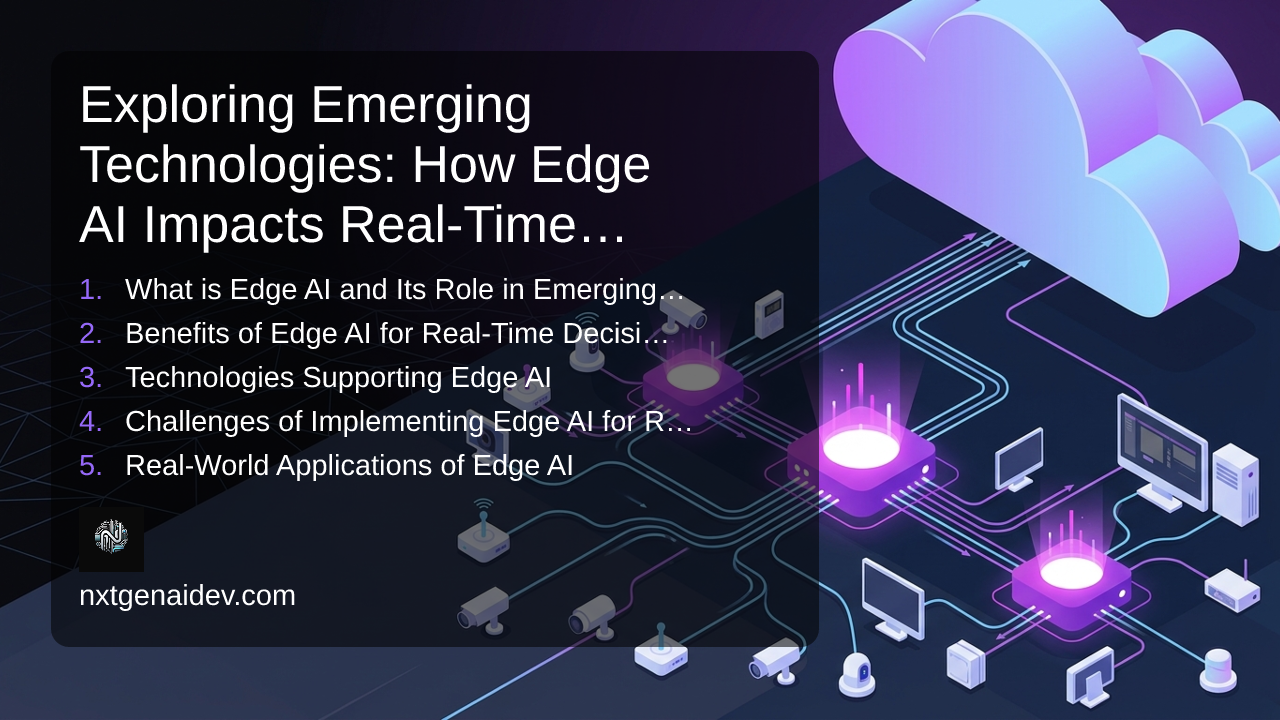
Exploring Emerging Technologies: How Edge AI Impacts Real-Time Decision Making
Explore how emerging technologies like Edge AI enhance real-time decision making for businesses. Stay ahead with actionable insights.
What is Edge AI and Its Role in Emerging Technologies?
The rise of Edge AI marks a transformative shift in how businesses approach data processing and decision-making. By enabling intelligent data handling at the source, organizations are poised to accelerate their responsiveness to real-time situations.
Definition of Edge AI
Edge AI refers to the deployment of artificial intelligence algorithms on devices located at the edge of the network, closer to where data is generated. Instead of relying solely on centralized cloud servers to process data, Edge AI processes information locally. This means decisions can be made instantly, facilitating quicker responses and actions.
How Edge AI Differs from Cloud AI
While Cloud AI handles substantial data processing remotely, it presents challenges, particularly concerning latency. The time taken to send data to the cloud and receive insights can hinder operations that require rapid decision-making. In contrast, Edge AI minimizes latency by processing data right at the source, significantly enhancing the speed and efficiency of decision-making processes.
Benefits of Edge AI for Real-Time Decision Making
As organizations explore the potential of Edge AI, several key benefits emerge that directly impact real-time decision-making.
Reduced Latency and Real-Time Analytics
One of the most significant advantages of Edge AI is the reduction in latency, allowing organizations to harness real-time analytics. For instance, in autonomous vehicles, real-time data processing is crucial for immediate responses to environmental changes. By processing data locally, vehicles can react to obstacles far more swiftly than systems reliant on cloud computing.
Enhanced Data Privacy and Security
Data privacy concerns are paramount, especially in industries like healthcare and finance. Edge AI enhances data security by keeping sensitive information closer to its place of origin and minimizing data transmission to external servers. This localized approach significantly reduces the risk of data breaches and fosters confidence in data handling practices.
Cost Optimization in Data Processing
Adopting Edge AI can also lead to cost savings. Processing at the edge reduces the need for extensive cloud storage and the associated costs of data transport. For example, retailers leveraging Edge AI for inventory management can make prompt decisions about stock levels while avoiding expensive cloud data transfers.
Technologies Supporting Edge AI
Numerous supporting technologies enable Edge AI to function effectively, leading to a smarter, more connected ecosystem.
The Role of 5G in Edge AI
5G technology plays a pivotal role in enhancing Edge AI applications. The increased bandwidth and reduced latency offered by 5G networks can facilitate rapid data transfer, enabling real-time communication between devices. As applications increasingly rely on vast data streams, the implementation of 5G networks will be vital for seamless Edge AI operations.
Federated Learning for Decentralized Processing
Federated learning is another emerging technology that supports Edge AI by allowing models to learn from decentralized data. This method enables devices to improve their machine learning models without sending raw data to a central server. Practically, this can mean that smartphones can develop personalized user experiences while ensuring that private data remains local.
Challenges of Implementing Edge AI for Real-Time Decision Making
Despite the promising benefits, organizations face several challenges in integrating Edge AI solutions effectively.
Scalability Issues
When scaling Edge AI solutions, organizations often encounter various hurdles. Implementing Edge devices across numerous locations requires significant investment and resources. Moreover, ensuring that these devices work seamlessly together can be a labyrinth of integration challenges that can bog down progress.
Complex Deployment Scenarios
The deployment of Edge AI can also be complex due to the diversity of devices and platforms involved. Organizations must navigate various operating systems, hardware capabilities, and network protocols to ensure efficient integration. For instance, deploying Edge AI in a smart factory may involve multiple types of machinery, each requiring customized AI solutions to fully leverage their data.
Real-World Applications of Edge AI
Understanding how Edge AI plays out in real-world scenarios can provide insightful examples of its capabilities.
Use Cases in Healthcare
In healthcare, Edge AI has shown exceptional promise. For example, medical devices equipped with Edge AI can analyze patient data on-site, resulting in quicker diagnostics. Consider a scenario where a patient’s vital signs are continuously monitored by wearable tech; Edge AI can process this data immediately, alerting healthcare professionals to significant changes faster than traditional data processing would allow.
Manufacturing and IoT Applications
In the manufacturing sector, Edge AI enhances operational efficiencies by processing data from IoT devices on-site. A factory could use Edge AI to monitor machinery performance in real-time, predicting maintenance needs before they result in expensive downtime. This proactive approach allows for a more seamless production process, improving overall productivity.
Future Trends in Edge AI and Emerging Technologies
Looking ahead, it's essential to explore the developments shaping the future of Edge AI.
Predictions for Market Growth
The Edge AI market is projected to grow substantially by 2025. As businesses increasingly realize the advantages of local data processing, the adoption of Edge AI solutions will expand across various sectors, creating a more connected and responsive digital ecosystem.
Impact of Evolving Regulatory Standards
As Edge AI becomes more prevalent, regulatory standards will also evolve. Organizations will need to navigate compliance with data privacy regulations, potentially affecting how they implement Edge AI solutions. This dynamic environment will require businesses to stay informed and adapt their strategies as new regulations emerge.
What has been your experience with implementing edge technologies in your organization? Have you faced any specific challenges or achieved significant benefits? Share your insights below!
💬 Join the conversation — share your take in the comments and tell us what you’d add.