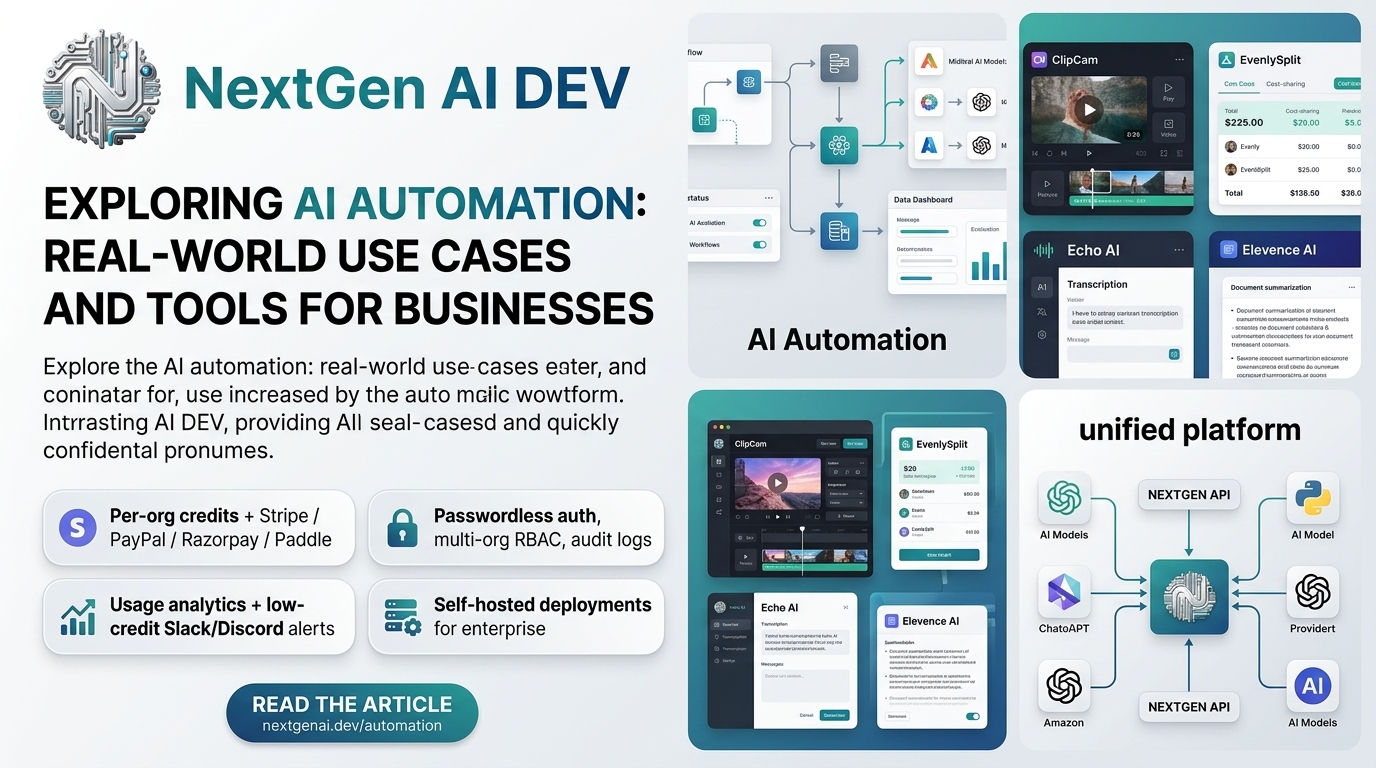
Exploring AI Automation: Real-World Use Cases and Tools for Businesses
Discover how AI automation improves efficiency and drives results. Explore tools & real-world use cases to streamline your business.
Introduction to AI Automation in Business
Imagine a world where mundane tasks are handled seamlessly by machines, allowing human talent to focus on creativity and strategy. This is the transformative power of AI automation, a technology that has become essential in modern business processes. Defined as the use of artificial intelligence to handle repetitive tasks, AI automation not only improves efficiency but also enhances overall decision-making within organizations.
As businesses increasingly lean towards hyperautomation, which integrates processes, people, and technology, the implications are profound. Hyperautomation enables companies to automate complex processes in conjunction with AI, leading to greater agility and responsiveness in the market.
Real-World Applications of AI Automation
Enhancing Customer Service with AI
One of the most visible applications of AI automation is in customer service. Chatbots and virtual assistants, powered by natural language processing, have revolutionized how businesses interact with customers. For instance, many companies have reported a significant reduction in response times and an increase in customer satisfaction ratings after implementing AI solutions.
A notable case is a major airline that utilized an AI chatbot to manage flight-related queries, resulting in a 50% decrease in customer wait times and a noticeable uplift in customer loyalty ratings. These solutions not only handle multiple inquiries simultaneously but also provide personalized experiences, making them invaluable tools in customer-centric strategies.
Optimizing Supply Chains through Automation
The complexity of supply chains cannot be overstated, and AI automation plays a critical role in optimizing these intricate systems. For example, AI-driven tools can analyze vast amounts of data to forecast demand and manage inventory levels, providing companies with a competitive edge.
In a industry-specific case, a global retail giant applied AI algorithms to optimize logistics and inventory management, which resulted in a 30% decrease in excess stock and a marked improvement in delivery times. Such advancements showcase how businesses can achieve greater efficiency and responsiveness through automation.
AI in Workforce Management
AI is not just changing customer-facing aspects of business; it's also reshaping how companies manage internal resources. Automated tools for employee scheduling and performance tracking have simplified workforce management significantly.
Consider a healthcare provider that integrated AI for staff scheduling. By analyzing patient demand and staff availability, the AI tool dynamically adjusted schedules, resulting in a 20% improvement in workforce efficiency while maintaining high-quality patient care.
Key AI Automation Tools for Businesses
Low-Code/No-Code Automation Platforms
The rise of low-code/no-code platforms has empowered businesses to leverage AI automation without requiring extensive technical knowledge. These platforms allow users to create automated workflows through intuitive interfaces, facilitating quicker implementation of automation strategies.
Popular platforms like Zapier and Microsoft Power Automate provide businesses the tools to automate everything from data entry to complex multi-step processes, enabling non-technical users to create solutions that drive productivity.
AI-Powered Workflow Orchestration Tools
As organizations become more complex, the need for orchestration tools to enhance end-to-end workflows grows. These AI-powered tools centralize various automation technologies, providing a cohesive environment that improves visibility and control over processes.
For instance, companies using tools such as MuleSoft or Camunda can streamline communication between departments, reduce bottlenecks, and create an efficient chain reaction for task completion, laying the foundation for a more integrated operational framework.
AI Solutions for Industry-Specific Needs
Different industries face specific challenges, and tailored AI solutions have emerged to address these needs effectively. From underwriting in finance to patient management in healthcare, businesses can choose from a wide array of AI tools designed to fit their unique operational requirements.
For example, specialized AI analytics tools in retail provide insights into consumer behavior, allowing companies to personalize marketing strategies and enhance customer engagement significantly.
Understanding Hyperautomation with AI and RPA
Hyperautomation combines AI with Robotic Process Automation (RPA), creating a formidable approach to business efficiency. By integrating these technologies, organizations can streamline processes, reduce human error, and improve accuracy.
Real-world examples highlight this synergy. One financial institution implemented hyperautomation to manage their compliance processes, resulting in a 40% reduction in processing time and a remarkable decrease in regulatory errors. Such integrations underscore the potential of hyperautomation to revolutionize traditional workflows.
Challenges and Considerations in Implementing AI Automation
Data Privacy and Security Concerns
While AI automation promises efficiency, it also raises valid concerns regarding data privacy and security. Organizations must take measures to safeguard sensitive information, especially when implementing AI technologies that process vast amounts of data.
Establishing robust data governance frameworks and employing advanced cybersecurity protocols is essential to mitigate risks associated with data breaches and privacy violations.
Change Management and Workforce Training
Transitioning to AI automation is not merely a technical challenge; it requires careful change management and workforce training. As AI systems take over routine tasks, businesses must focus on upskilling employees to work alongside these technologies effectively.
Organizations that invest in comprehensive training programs can ensure their workforce is well-versed in utilizing AI tools, leading to smoother transitions and enhanced employee morale.
Cost Implications of AI Adoption
Implementing AI automation tools necessitates a thorough cost-benefit analysis. While the initial investment may seem daunting, the long-term savings through increased efficiencies and reduced labor costs often justify the expenditure.
Firms need to assess their unique circumstances and determine which AI automation tools will deliver the highest ROI based on their operational goals and industry practices.
The Future of AI Automation in Business
As we look ahead, the evolution of AI automation tools appears promising. Predictions indicate accelerated advancements in machine learning algorithms, resulting in more sophisticated and capable automation solutions.
Emerging trends such as the rise of AI-driven analytics and real-time process monitoring are paving the way for organizations to harness insights like never before, fueling innovation and strategic planning.
Exploring AI automation and its real-world applications highlights an untapped potential for enhancing efficiency and driving growth in business. Are you ready to leverage AI automation to optimize your operations? Discover how you can implement it in your business today!