
Exploring Agentic AI: Transforming Business with AI Agents
Discover how AI agents revolutionize decision-making in business. Unlock efficiency and innovation today!
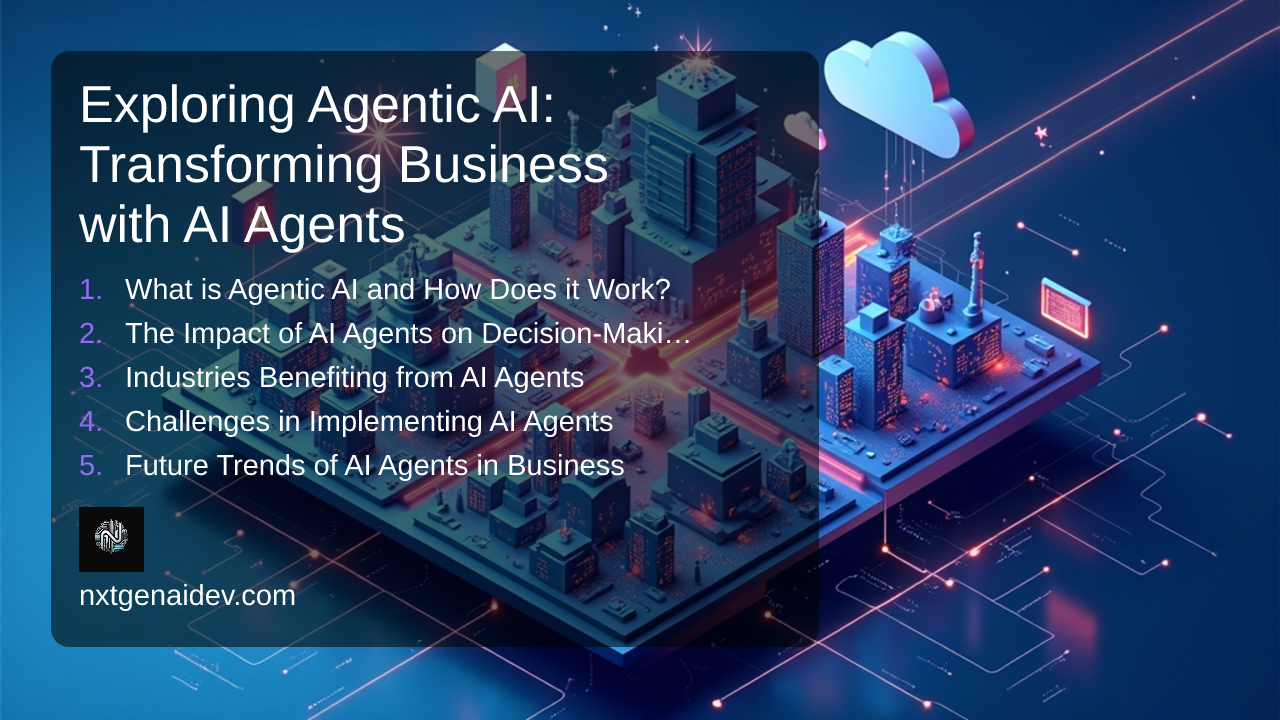
Exploring Agentic AI: Transforming Business with AI Agents
Imagine a world where decisions are made in the blink of an eye, backed by data and devoid of human bias. This is not a distant fantasy; it's the power of agentic AI. As businesses face an ever-increasing amount of information, AI agents are emerging as indispensable allies in navigating complex landscapes and making swift, informed decisions.
What is Agentic AI and How Does it Work?
Agentic AI refers to a type of artificial intelligence that operates autonomously, executing tasks without requiring human intervention. This autonomy is a key characteristic, enabling AI to function as proactive agents in various business processes. The core technologies driving agentic AI include:
Machine Learning: Allows AI to learn from data and improve its performance over time.
Natural Language Processing (NLP): Empowers AI to understand and generate human language, facilitating seamless communication.
Automation Technologies: Enables AI agents to carry out repetitive tasks, accelerating workflow efficiency.
Together, these technologies allow agentic AI to analyze vast datasets, recognize patterns, and make decisions that would take humans considerably longer, shifting the dynamics of numerous industries.
The Impact of AI Agents on Decision-Making
Real-time Data Processing
The speed at which AI agents can process real-time data is transformative. Traditional decision-making often relies on historical data analysis, which can lag behind current trends. In contrast, AI agents ingest information continuously, generating insights almost instantaneously. This capability:
Enhances the accuracy of predictions and decision-making processes.
Minimizes the risk of human error by removing subjective biases from the equation.
Enhancing Strategic Choices
AI agents don’t just assist in making decisions; they also act as strategic partners. For instance, businesses can use AI to simulate various scenarios based on different data inputs, helping them choose the most advantageous path forward. By identifying potential opportunities and risks, AI agents enhance strategy formulation, proving invaluable in dynamic business environments.
Industries Benefiting from AI Agents
Finance and Investments
The finance sector leads the charge in AI agent adoption, particularly in areas like algorithmic trading and risk management. For instance, AI algorithms can analyze market trends and execute trades at lightning speed, often resulting in improved returns on investment. Additionally, AI agents assist financial analysts by flagging unusual transaction patterns, vastly improving fraud detection rates.
Healthcare Innovations
In healthcare, AI agents revolutionize diagnostics and patient management. These agents can process patient data to detect anomalies that may go unnoticed by human eyes. For instance, AI has been utilized to identify early signs of diseases in imaging studies, leading to quicker interventions. Moreover, AI systems help manage appointment schedules and patient follow-ups, significantly enhancing operational efficiency.
Manufacturing Efficiency
The manufacturing industry is leveraging AI-driven workflows to streamline operations. AI agents monitor production lines in real-time, detecting inefficiencies and suggesting modifications. Companies employing AI for predictive maintenance can foresee equipment failures and address them proactively, thus minimizing downtime and increasing productivity.
Challenges in Implementing AI Agents
Ethical Considerations
As AI agents become more autonomous, ethical concerns arise. Questions about accountability in decision-making, data privacy, and potential job displacement are increasingly pertinent. Addressing these concerns requires a framework that prioritizes transparency in AI operations and equitable treatment of all stakeholders.
Integration with Existing Systems
Transitioning to agentic AI often presents integration challenges with legacy systems. Businesses need to ensure that new AI technologies function seamlessly with established infrastructure. Strategies for smooth implementation include:
Conducting comprehensive audits of current systems to identify compatibility issues.
Phased rollouts of AI systems, allowing teams to adapt gradually.
Adequate training and change management plans can also help mitigate risks during this transition.
Future Trends of AI Agents in Business
Automation of Complex Workflows
Looking ahead to 2028 and beyond, the trend toward automation will intensify, with AI agents taking on increasingly complex tasks. Once viewed merely as tools, AI is expected to evolve into collaborators that actively contribute to strategic planning and operational frameworks.
AI as Active Business Partners
The paradigm is shifting toward considering AI agents not just as support systems but as integral business partners. This change is anticipated to yield substantial improvements in cost efficiencies and productivity, allowing businesses to focus on innovation instead of routine processes.
Case Studies of Successful AI Agent Deployments
Many organizations are reaping the benefits of AI agents. For example, a leading insurance company successfully implemented an AI-driven claims processing system, reducing claim processing time from weeks to days. Quantitative benefits included a 30% increase in customer satisfaction ratings and a significant reduction in operational costs.
These successes offer essential lessons in understanding AI’s transformative potential. Effective communication about the role of AI agents and clear definitions of their functions are crucial for stakeholder buy-in and overall success.
Getting Started with AI Agents
Choosing the Right Tools
For organizations looking to integrate AI agents, selecting the right tools is paramount. Businesses should evaluate platforms based on:
Scalability
Ease of integration
Support and community resources
Developing an AI Strategy
To build an effective AI strategy, consider a step-by-step approach:
Define Objectives: Establish what you aim to achieve with AI.
Assess Readiness: Evaluate your current capabilities and identify any skill gaps.
Pilot Programs: Start with small-scale trials to fine-tune deployments.
Measure Outcomes: Continuously assess performance metrics to drive improvements.
For ongoing learning, various online resources and courses are available to help deepen your understanding of AI technologies and their implementation.
AI agents are changing the game for decision-making processes across industries. Their ability to process data in real-time and act autonomously presents a powerful opportunity for mounting challenges and shaping future strategies.
How have you seen AI agents change decision-making processes in your industry?
💬 Join the conversation — share your take in the comments and tell us what you’d add.