Enhancing Business Capacity with Self-Hosted Deployments for Enterprises
Unlock your enterprise’s potential with self-hosted deployments. Discover benefits and tips for optimizing your business operations today!
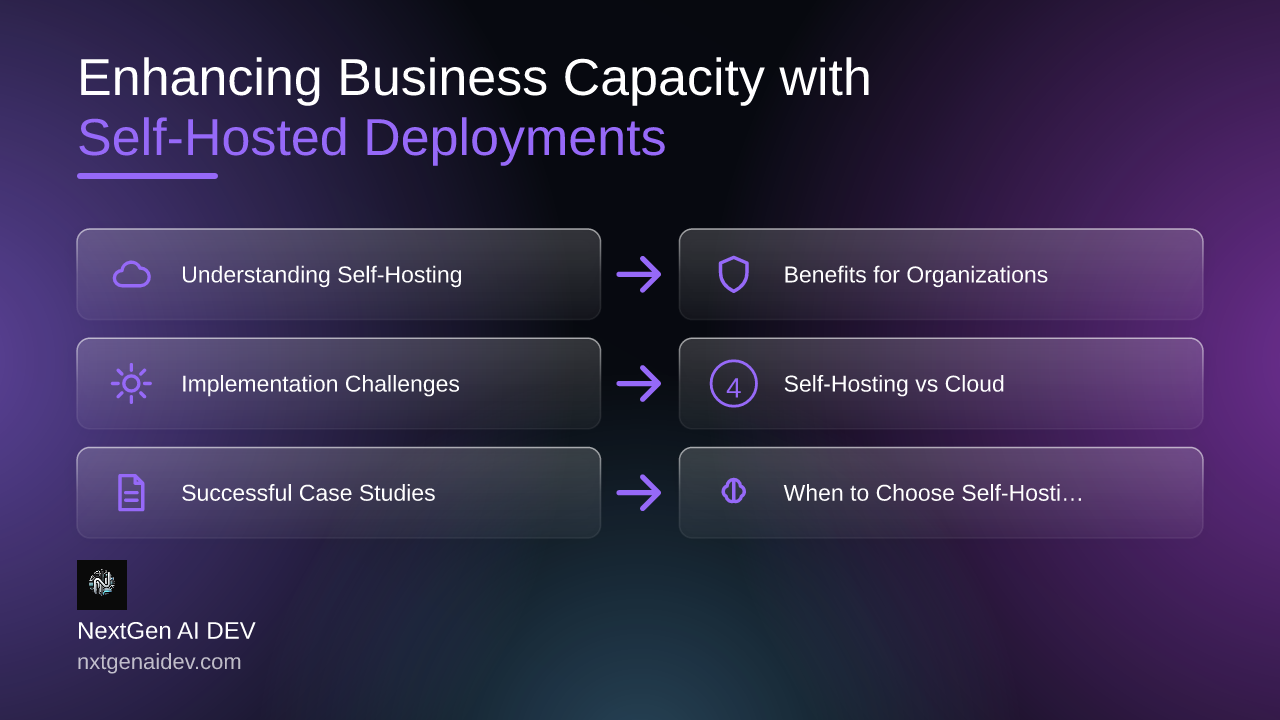
Enhancing Business Capacity with Self-Hosted Deployments for Enterprises
Unlocking the full potential of enterprise operations is often a matter of choosing the right deployment strategy. Self-hosted deployments, especially those facilitated by advanced platforms like NextGen AI DEV, are becoming essential for enterprises aiming for security, compliance, and unparalleled control over their data.
Understanding Self-Hosted Deployments for Enterprises
What Defines a Self-Hosted Deployment?
Self-hosted deployments refer to the practice of hosting software on an enterprise’s own infrastructure, rather than relying on third-party cloud providers. This deployment model emphasizes the autonomy of organizations, allowing them to manage software solutions internally. In the context of NextGen AI DEV, this means enterprises can utilize powerful AI-driven tools without sacrificing security or control.
Key Characteristics of Self-Hosting
Several characteristics set self-hosting apart from traditional cloud solutions. Data sovereignty becomes a top priority, as organizations maintain control over their data, complying with legal requirements and internal policies. Flexibility allows IT leaders to tailor the deployment to specific operational needs, while control ensures that sensitive information remains within the organization's purview. NextGen AI DEV specifically enhances these attributes through features like multi-org RBAC (Role-Based Access Control), providing granular permission levels for different teams and users.
Benefits of Self-Hosting for Large Organizations
Enhanced Security and Compliance
Self-hosting elevates security to new heights. By implementing solutions from NextGen AI DEV, enterprises can leverage cutting-edge security features. With passwordless authentication and comprehensive audit logs, organizations can easily monitor access and maintain compliance—especially crucial for industries with strict regulatory demands. Furthermore, self-hosting means data stays in-house, dramatically reducing the risks associated with cloud breaches.
Customization and Scalability
The architecture of NextGen AI DEV allows extensive customization options, enabling IT teams to adapt the platform according to their specific goals. Whether it's deploying models for various use cases or integrating proprietary systems, self-hosting facilitates a tailored experience that aligns with business objectives. Additionally, scalability is seamless; enterprises can expand resources as needed without the traditional constraints of cloud providers.
Optimized Cost Management
Cost efficiency is another significant benefit. While cloud-hosted solutions often involve recurring fees and unexpected costs, self-hosting can lead to predictable expenditure models. Conducting a cost analysis reveals that over time, organizations investing in self-hosted deployments from NextGen AI DEV frequently find savings through reduced licensing fees and tailored resource management.
Challenges of Implementing Self-Hosted Deployments
Technical Expertise Requirements
Implementing self-hosting is not without its challenges. A critical requirement is specialized technical expertise. IT teams must be well-versed in managing and optimizing the deployment. NextGen AI DEV’s self-hosted environment alleviates some of this with comprehensive documentation and initial support to help teams get up to speed quickly.
Maintenance and Support Considerations
Ongoing maintenance can be a heavy lift for enterprises, demanding consistent updates and troubleshooting. Organizations must be prepared to allocate resources effectively to ensure the deployment remains functional and secure. With NextGen AI DEV’s unique features, enterprises can utilize usage analytics to monitor performance and receive alerts for low credits through integrated Slack or Discord channels. This proactive approach minimizes downtime and keeps operations running smoothly.
Integrating with Existing Infrastructure
Successfully integrating self-hosted deployments with existing infrastructure can be challenging. However, frameworks provided by NextGen AI DEV facilitate smoother transitions. Utilizing APIs and comprehensive integration guides, IT teams can connect the AI solutions with current systems seamlessly, promoting operational continuity.
Self-Hosted Deployments vs. Cloud Solutions
Performance Comparisons
When it comes to performance, self-hosted deployments often outshine cloud solutions. By running software on dedicated hardware, enterprises can optimize for speed and responsiveness. NextGen AI DEV enables this high-performance environment by allowing businesses to deploy AI models that meet their requirements directly on their infrastructure, free from the constraints of shared resources typical in cloud setups.
Data Control and Accessibility
Self-hosting provides organizations with unmatched data control. Unlike cloud services where data is often stored offsite, self-hosting with NextGen AI DEV allows enterprises to maintain control over data access and management. This capability ensures compliance with regulations and organizational policies, as sensitive information remains local.
Scalability and Customization
Customizing a self-hosted environment can lead to more tailored solutions than typically offered in more generalized cloud services. NextGen AI DEV enables enterprises to scale deployments rapidly without the limitations imposed by third-party vendors. Organizations can expand functionalities as needed, embedding AI tools that add value directly to their business workflow.
Case Studies: Successful Self-Hosted Deployments
Enterprise Data Sovereignty and Compliance
Consider the case of a large multinational company that transitioned to a self-hosted deployment with NextGen AI DEV. The organization faced issues regarding data residency and compliance with local regulations. After implementing a self-hosted version of AI-enhanced tools, they observed improved oversight and management of sensitive data, allowing them to meet compliance standards more effectively.
Use Cases in AI Integration
Another impressive case involves a tech company leveraging NextGen AI DEV for AI integration into their existing workflow. By self-hosting the AI tools, they enhanced their operational efficiency and achieved a significant increase in productivity, allowing them to explore new avenues in AI development without the constraints of a cloud-hosted model.
When is Self-Hosting the Preferred Solution?
Evaluating Business Needs
Self-hosting should be considered when an organization has substantial data security needs, requires compliance with specific regulations, or aims to maximize control over its technology stack. Enterprises must evaluate their specific needs, identifying gaps in their current solutions that self-hosting could fill effectively.
Identifying Suitable Scenarios
Key scenarios where self-hosting becomes advantageous include industries dealing with highly sensitive data, such as finance, healthcare, or government sectors. In these cases, the enhanced security, compliance, and customization capabilities afforded by NextGen AI DEV's self-hosted deployments make them an ideal solution.
Discover how NextGen AI DEV can enhance your enterprise's operations through self-hosted deployments—explore our solutions today!