Engineering Resilient AI Customer Support: LLM Integration
AI Customer Support that scales faster, improves response quality, and keeps costs in check. Learn the best practices and get started.
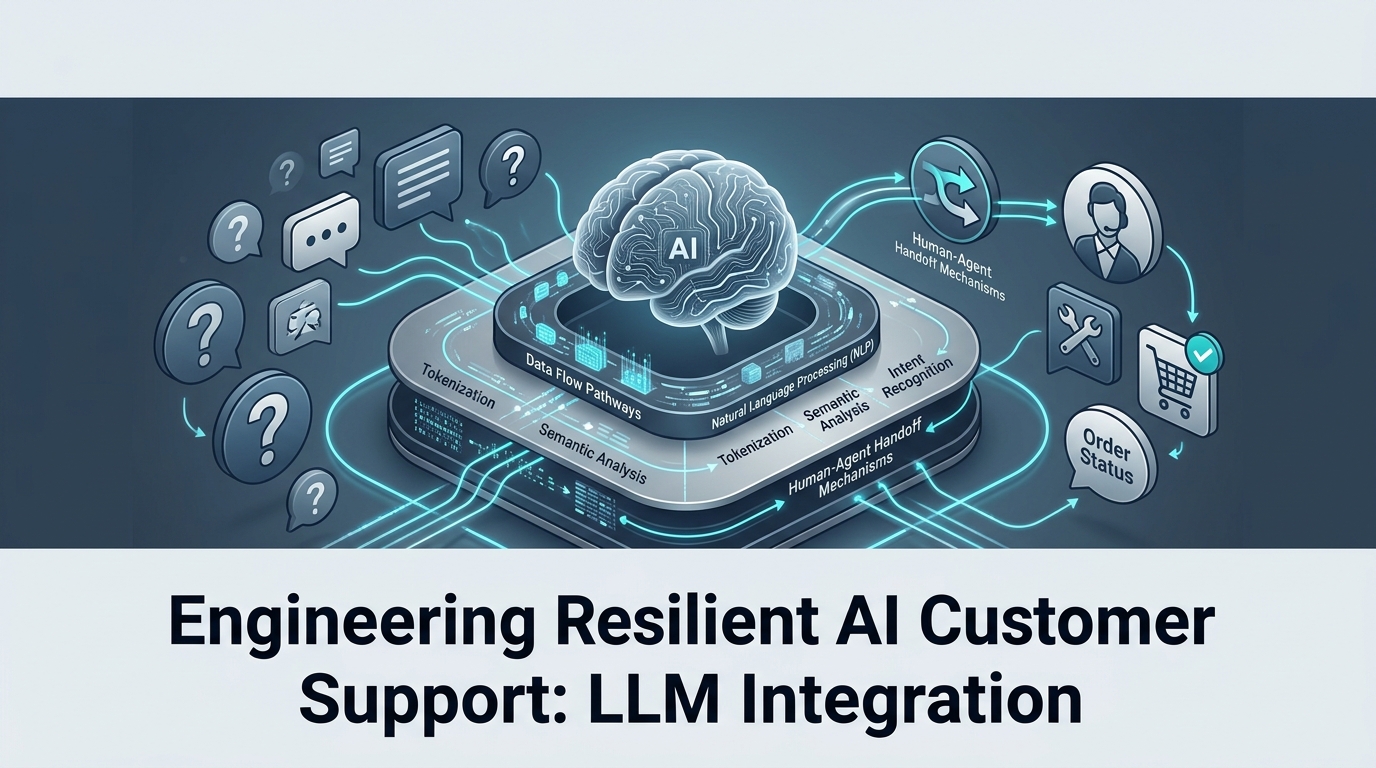
Customer support is often a company's frontline, shaping brand perception and customer loyalty. Yet, traditional models, heavily reliant on human agents, buckle under the weight of increasing scale and complexity, leading to long wait times, inconsistent answers, and sky-high operational costs. The promise of AI Customer Support offers a compelling alternative, enabling 24/7 availability, instant responses, and the ability to handle a massive volume of inquiries. However, simply automating interactions isn't enough; true success hinges on engineering resilient AI customer support systems that can navigate ambiguity, maintain accuracy, and seamlessly transition to human agents when necessary.
Resilience in this context means your AI system isn't just about answering questions; it's about reliably solving problems without breaking down, hallucinating, or frustrating customers. It’s about building a robust digital assistant that can gracefully handle unexpected failures, consistently deliver accurate information, and ensure a smooth, context-preserving handoff to a human agent when an issue exceeds its capabilities. This isn't just about efficiency; it's about safeguarding customer trust and ensuring a positive brand experience, even when facing complex or sensitive interactions.
Foundational Architecture: Building for Stability and Safety
The bedrock of any resilient AI customer support system lies in its foundational architecture. This involves not just integrating powerful Large Language Models (LLMs) but also surrounding them with robust guardrails and reliable data sources to ensure consistent, safe, and accurate performance.
Grounding LLMs with Knowledge Bases and Policy
One of the primary challenges with LLMs is their propensity for "hallucinations"—generating plausible but factually incorrect information. To combat this, LLMs must be "grounded" in reliable, current, and company-specific knowledge. This is achieved through a Retrieval-Augmented Generation (RAG) approach, where the LLM first retrieves relevant information from a curated knowledge base before generating a response.
Key knowledge sources include:
FAQs and Help Articles: Standardized answers to common questions.
Product Manuals and Documentation: Detailed information about features, troubleshooting, and usage.
Internal Policies and Procedures: Crucial for sensitive topics like billing, refunds, compliance, account changes, and cancellations. These explicitly define permissible actions and responses. For example, a policy might state: "An LLM should never directly process a refund greater than $50 without human approval, regardless of sentiment analysis."
CRM Data and User Profiles: Contextual information about the specific customer and their history.
Structuring these knowledge bases is critical. Use clear hierarchies, version control, and consistent tagging. When an LLM receives a query, it should first search these sources for the most relevant information, then use that information to formulate its answer, rather than relying solely on its pre-trained general knowledge. This drastically reduces the likelihood of incorrect or outdated responses. For sensitive topics, explicit policy content acts as a hard boundary, ensuring the AI adheres to strict rules, even if a user attempts to "prompt engineer" around them.
Designing Explicit Escalation Paths and Context-Preserving Handoffs
No AI, however advanced, can handle every customer query. Building resilience means acknowledging these limitations and designing clear, explicit escalation paths to human agents. The goal is not just to escalate, but to do so intelligently, preserving context so the customer doesn't have to repeat themselves.
Escalation logic should be multi-faceted, considering:
Confidence Scores: If the LLM's confidence in its answer is below a certain threshold (e.g., 70%), it should escalate.
Sentiment Analysis: Highly negative or frustrated sentiment can trigger an escalation, indicating a need for human empathy.
Policy Risk Signals: If the conversation touches on sensitive topics (e.g., legal, compliance, fraud) or actions with high financial implications, it should flag for human review.
Unresolved Intent: If the AI repeatedly fails to understand the user's intent or provide a satisfactory answer after a few turns.
Specific Keywords/Phrases: Certain words ("speak to a manager," "cancel my account") can immediately trigger a handoff.
When a handoff occurs, the system must seamlessly transfer all relevant information to the human agent. This includes:
Full Conversation Transcript: The entire chat history.
AI-Generated Summary: A concise summary of the customer's issue and the AI's attempts to resolve it. This is often generated by a separate LLM call specifically for summarization.
Identified Intent and Key Entities: What was the customer trying to do, and what product/order/account were they referring to?
Reason for Escalation: Why did the AI decide it couldn't handle the query? (e.g., "Low confidence," "Sensitive topic," "Requested agent").
Relevant Customer Data: Order IDs, account status, previous interactions pulled from CRM.
Example of a context summary for an agent:
**Customer:** John Doe, ID #12345
**Issue:** Inquiry about recent charge of $79.99 for "Premium Subscription." Claims not to have subscribed.
**AI Action:** Provided link to subscription management page, explained typical billing cycles.
**Reason for Escalation:** Customer stated, "I still don't understand, this isn't right, I need to speak to someone." (Negative sentiment, expressed desire for human interaction).
**Next Step:** Agent to review subscription history and clarify charges.
This comprehensive handoff prevents customer frustration and allows the agent to pick up the conversation immediately without requiring the customer to re-explain their situation, significantly improving the customer experience.
Integrating LLMs with Workflow Automation for Action-Taking AI
The true power of resilient AI customer support extends beyond merely answering questions to actually taking action. Integrating LLMs with workflow automation transforms them from conversational interfaces into proactive problem-solvers. This requires careful design to ensure safety and prevent unintended consequences.
Safe Tool Use and Guardrails for Automated Actions
Enabling LLMs to execute actions—like resetting passwords, updating addresses, or checking order status—involves connecting them to backend systems via APIs. This "tool use" capability is incredibly powerful but demands stringent guardrails.
Key considerations for safe tool use:
Idempotency: Crucial for any automated action. An operation should produce the same result whether executed once or multiple times. For instance, a password reset API call should only reset the password once, even if the system accidentally attempts to call it twice. This prevents issues like double billing or multiple duplicate actions.
Human Approval Gates: For high-risk actions (e.g., initiating a large refund, changing sensitive account information, processing a cancellation that incurs fees), human review and approval must be mandatory. The AI can prepare the action, but a human agent confirms before execution.
Validation and Verification: Before an AI-initiated action is executed, validate the inputs. Does the order ID exist? Is the new address valid? After execution, verify the action was successful. For example, if the AI processes a password reset, immediately check if the user can log in with the temporary password.
Strict Access Control: LLMs should only have access to the specific APIs and data they need to perform their designated tasks. Implement granular permissions.
Circuit Breakers: Implement mechanisms to automatically disable or limit AI actions if a high rate of errors or failures is detected, preventing widespread issues.
Consider an example for a password reset:
User Request: "I need to reset my password."
LLM Intent: Detects "password reset" intent.
Entity Extraction: Extracts user's email/username.
Verification: Asks security questions or sends a verification code.
Tool Call (Guarded): Calls
resetPasswordAPI(user_id, token).Validation: Checks API response for success.
Confirmation: Informs user of success, e.g., "Your password has been reset. Please check your email for instructions." If the API call fails or times out, it triggers an escalation or retry.
Prioritizing Use Cases: Starting Small, Scaling Smart
The temptation to automate everything at once is strong, but a resilient strategy dictates a more measured approach. Start with high-volume, low-complexity, and low-risk use cases to build confidence and refine your systems.
Good Starter Use Cases:
Password Resets: High frequency, clearly defined steps, generally low risk (especially with verification).
Order Status Checks: Retrieval of information only, no modifications.
FAQ Retrieval: Direct answers from a knowledge base.
Basic Account Information Updates: e.g., updating a shipping address (with validation and potential human approval for sensitive changes).
Appointment Scheduling: Direct API calls to a booking system (with confirmation steps).
Strategy for Piloting and Scaling:
Narrow Pilot: Begin by deploying the AI for a very specific set of intents (e.g., only password resets) or for a particular channel (e.g., web chat only, not phone). You might even pilot with a specific customer segment or internal teams first.
Prove Stable Quality: Before expanding, rigorously measure the AI's performance on the pilot use cases. Focus on resolution rates, accuracy, and CSAT. Ensure the system consistently meets predefined quality thresholds.
Iterative Expansion: Once stability is proven for initial use cases, gradually expand to more complex or slightly riskier actions, always maintaining guardrails and monitoring.
This iterative approach allows you to learn from real-world interactions, refine your LLM prompts, improve your knowledge base, and strengthen your automation workflows in a controlled environment, reducing the risk of widespread failures or negative customer experiences.
Continuous Improvement: Testing, Evaluation, and Feedback Loops
Building resilient AI customer support is not a one-time project; it's a continuous journey of improvement. Systems must be constantly monitored, evaluated, and refined based on real-world performance and evolving customer needs.
Beyond Containment: Measuring Outcome-Oriented Success
Traditional AI support metrics often focus on "containment"—how many interactions the AI handled without human intervention. While important, this doesn't tell the full story of resolution quality. A truly resilient system prioritizes outcome-oriented metrics:
Resolution Rate: The percentage of issues fully resolved by the AI without escalation or repeat contact.
First Contact Resolution (FCR): The percentage of customer issues resolved on the first interaction (by AI or human after handoff).
Customer Satisfaction (CSAT) / Net Promoter Score (NPS): Directly measure customer sentiment towards the AI interaction.
Repeat Contact Rate: How often do customers contact support again for the same issue after an AI interaction? A high rate indicates poor resolution.
Cost Per Resolution: The overall cost savings achieved by the AI (operational efficiency).
Escalation Quality Metrics: When a handoff occurs, how well-prepared was the human agent? Was the context sufficient?
Auditability and Decision Logging: For every interaction, the system should log the LLM's prompts, responses, confidence scores, tool calls, and reasons for any escalation. This creates an auditable trail, allowing teams to understand why the AI made certain decisions and diagnose failures. For example, if an AI incorrectly routes a billing inquiry to technical support, the logs should clearly show the misinterpretation of intent or the low confidence score that led to the wrong decision.
Feedback Loops: The continuous review of unresolved or poorly handled conversations is paramount.
Identify Failures: Regularly review escalated conversations, low-CSAT interactions, or instances of repeat contact.
Categorize Issues: Classify the root cause of AI failures (e.g., knowledge gap, prompt misunderstanding, policy violation, hallucination, tool execution error).
Implement Fixes:
Content Update: If a knowledge gap, add or update the relevant article in the knowledge base.
Policy Refinement: If a policy wasn't followed, clarify the policy, refine the LLM's grounding mechanism, or adjust prompt instructions.
Prompt Engineering: If the LLM misunderstood, refine the system prompt or few-shot examples.
Automation Rule Adjustment: If an action failed, improve the tool's error handling or validation steps.
Red-Teaming, A/B Testing, and Regression Prevention
To ensure ongoing resilience, proactive testing and validation are essential.
Red-Teaming: Actively try to "break" your AI system. This involves a dedicated team (or even external experts) attempting to:
Generate harmful, biased, or inappropriate content.
Circumvent security protocols or policy guardrails.
Force hallucinations or reveal sensitive information.
Identify vulnerabilities in prompt injection or data leakage. The findings from red-teaming exercises are invaluable for strengthening defenses and improving safety mechanisms.
A/B Testing: Experiment with different LLM models, prompt strategies, knowledge base versions, or automation rules. Deploy two versions simultaneously to a subset of users and measure key outcome metrics. This data-driven approach allows you to objectively determine which changes lead to real improvements.
Regression Prevention: As new features are added or existing ones modified, there's a risk of breaking previously working functionality. Implement automated regression test suites that run regularly. These tests should cover critical paths, common user queries, and known edge cases, ensuring that updates don't introduce unexpected behaviors or reduce the system's overall quality and resilience. Monitor key metrics post-deployment for any sudden drops that might indicate a regression.
Navigating Ethical Considerations and Compliance
Deploying AI customer support, especially with advanced LLMs, introduces a host of ethical and compliance considerations that must be addressed proactively to maintain trust and avoid legal pitfalls.
Data Privacy and Security: LLMs process vast amounts of data, including potentially sensitive customer information. Robust data governance, anonymization techniques, and stringent security protocols (encryption, access controls) are non-negotiable. Ensure that PII (Personally Identifiable Information) is handled in accordance with best practices and never used to fine-tune public models. Companies must implement secure ingestion, processing, and storage of all customer data interacting with the AI. (See our guide on secure data handling)
Bias: LLMs are trained on enormous datasets that reflect existing societal biases. This can manifest in biased responses, unfair treatment of certain customer segments, or discriminatory outcomes. Mitigation strategies include:
Careful Data Curation: Ensure the knowledge bases used for grounding are diverse and unbiased.
Prompt Engineering: Design prompts that encourage neutrality and fairness.
Bias Detection Tools: Implement tools to monitor for biased outputs in real-time or during post-interaction analysis.
Regular Audits: Continuously review AI interactions for evidence of bias.
Compliance with Regulations: Adhere to relevant data protection and privacy regulations such as GDPR (General Data Protection Regulation) in Europe, CCPA (California Consumer Privacy Act) in the US, HIPAA for healthcare data, and other industry-specific compliance requirements. This includes obtaining consent for data usage, providing users with rights to access or delete their data, and reporting breaches.
Transparency with Customers: It is crucial to be transparent when customers are interacting with an AI. Clearly state that they are communicating with an automated system. Provide easy and explicit pathways to escalate to a human agent at any point in the conversation. This builds trust and avoids frustration, ensuring customers feel respected and in control of their interaction. (Learn more about our AI transparency principles)
Engineering resilient AI customer support with LLM integration is a strategic endeavor that demands a holistic approach—from robust architecture and safe automation to continuous improvement and unwavering ethical commitment. It's about building a system that not only automates tasks but also safeguards customer trust and delivers consistent, high-quality service, even in the face of complexity.
Given the rapid evolution of AI, what unexpected challenges have you faced when trying to make your AI customer support systems truly resilient, and how did you overcome them?
💬 Join the conversation — share your take in the comments and tell us what you’d add.