Boost Engineering Productivity with AI Coding Assistants
Discover how AI coding assistants boost productivity and streamline your workflow. Explore the future of coding efficiency now.
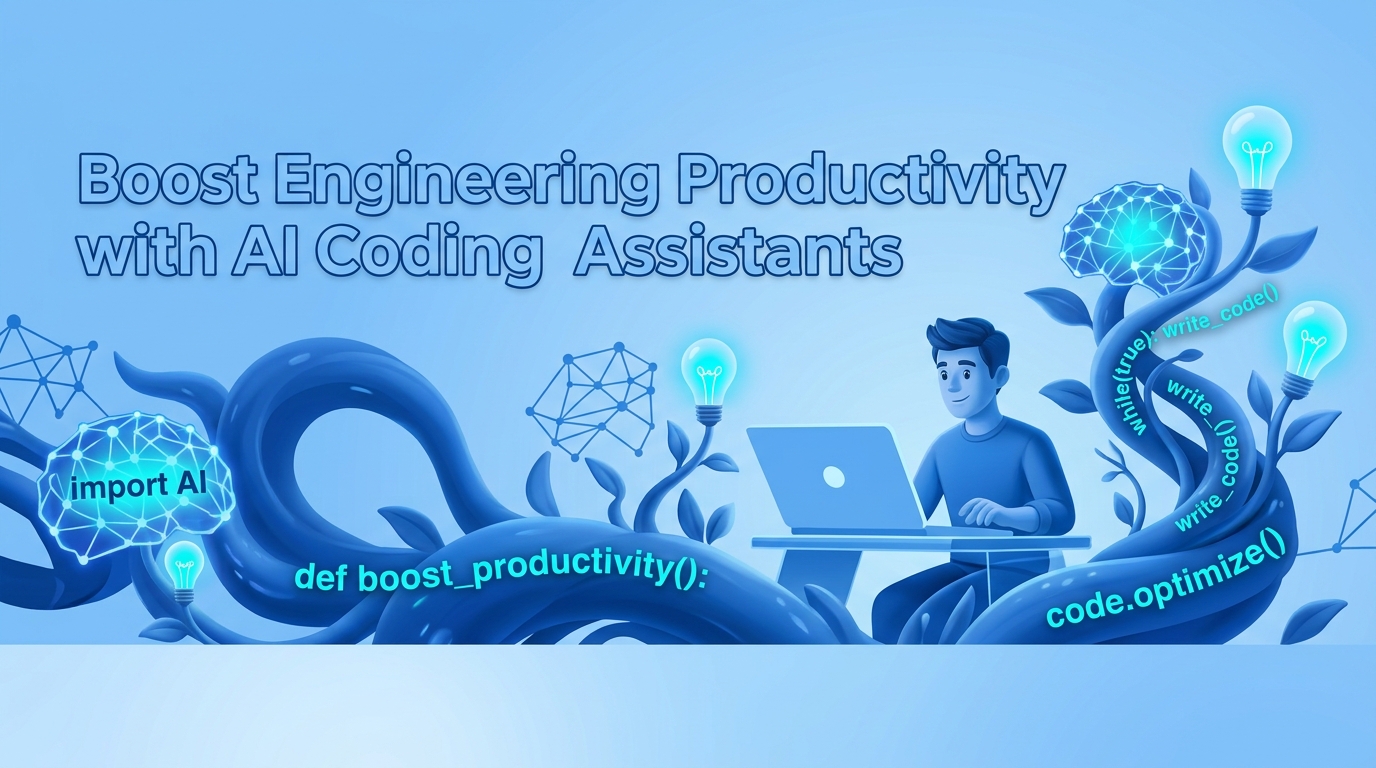
Imagine writing a complex API endpoint, meticulously crafting boilerplate, database interactions, and error handling, only to realize a significant chunk of it could have been generated in seconds. This isn't a futuristic fantasy; it's the present reality with advanced AI coding assistants, tools that are rapidly redefining the landscape of software development and significantly boosting engineering productivity. Moving far beyond simple autocompletion, these intelligent partners are transforming how developers write, debug, and maintain code, unlocking unprecedented levels of efficiency and innovation.
The Evolution of AI Coding Assistants: Beyond Basic Autocomplete
For years, developers have relied on Integrated Development Environments (IDEs) for basic autocompletion, suggesting keywords or function names based on simple string matching. Modern AI coding assistants, however, represent a paradigm shift. These are intelligent tools powered by sophisticated large language models (LLMs) that don't just complete syntax; they interpret context, understand intent, and generate coherent, functional code.
The core difference lies in their underlying intelligence. Traditional IDE autocomplete operates on static, rule-based suggestions – if you type sys., it might suggest stdout or stderr based on available methods. In contrast, modern AI-driven generation, exemplified by tools like GitHub Copilot, leverages LLMs trained on vast datasets of code and natural language. This allows them to:
Predict next lines of code: Not just the next word, but entire logical blocks.
Generate full functions or classes: Given a descriptive comment or function signature, the AI can often produce the entire implementation.
Refactor code intelligently: Suggesting improvements to existing code for readability, efficiency, or adherence to best practices.
Answer context-aware questions: Provide explanations or solutions based on a broader understanding of the codebase and programming paradigms.
Consider the difference: a traditional IDE might suggest console.log() if you start typing console.. An AI coding assistant, given the comment // Log user data, might generate:
// Log user data
const userData = { name: "Alice", id: "123" };
console.log("User data logged:", userData);
This leap from static, keyword-based suggestions to dynamic, context-aware code generation is what truly sets modern AI coding assistants apart, empowering developers to focus on higher-level problem-solving rather than rote syntax.
Unlocking New Levels of Engineering Productivity
The impact of AI coding assistants on developer productivity is profound and multifaceted. They aren't just speeding up typing; they're fundamentally altering the development workflow.
One of the most immediate benefits is the acceleration of development cycles through rapid boilerplate generation. Developers often spend significant time writing repetitive, foundational code for common tasks like creating a full CRUD (Create, Read, Update, Delete) endpoint skeleton, defining data models, or generating test stubs. An AI assistant can generate this infrastructure in moments, freeing developers to focus on the unique business logic.
For example, asking an AI to "create a new user model with name, email, and password fields, including validation" could yield a fully-formed data model and associated methods, rather than manually typing out each field and validator.
AI also plays a crucial role in debugging and error detection. While human developers remain essential for complex logical issues, AI can suggest fixes for common syntax errors, identify potential runtime issues, or even flag subtle logical flaws before execution. By analyzing code patterns, it can often point out inconsistencies or common anti-patterns that might lead to bugs down the line. This proactive identification significantly reduces the time spent in the debug-test-fix cycle.
Furthermore, these assistants are invaluable for learning new APIs or frameworks. When encountering an unfamiliar library, framework, or even a legacy codebase, developers can prompt the AI for instant, context-relevant code examples and explanations. Instead of sifting through extensive documentation, one can simply ask: "How do I make an API call using fetch with async/await and error handling?" and receive a ready-to-use snippet.
async function fetchData(url) {
  try {
    const response = await fetch(url);
    if (!response.ok) {
      throw new Error(`HTTP error! status: ${response.status}`);
    }
    const data = await response.json();
    console.log(data);
    return data;
  } catch (error) {
    console.error("Fetch error:", error);
    // Handle error appropriately
    throw error;
  }
}
This capability significantly flattens the learning curve.
Finally, AI contributes to improved code quality and consistency. By suggesting refactoring options, enforcing style guides (e.g., linting-like suggestions), and identifying anti-patterns, AI can help maintain a higher standard across a codebase. This leads to more maintainable, readable, and robust software. Common anecdotal reports, often backed by early studies, indicate that developers experience 20-40% faster task completion for routine coding tasks when leveraging AI coding assistants, primarily due to reduced context switching and mental overhead.
Advanced Capabilities: More Than Just Code Generation
Beyond generating simple snippets, the newest generation of AI coding assistants offers sophisticated features that integrate deeply into the development process. These tools gain a comprehensive contextual understanding across entire repositories, not just the file currently being edited. This enables them to provide suggestions that respect project-wide architecture, design patterns, and existing conventions, leading to more cohesive and less fragmented code.
One powerful advanced capability is multi-file refactoring. Imagine renaming a variable or changing a function signature that is used across dozens of files. Manually doing this is tedious and error-prone. An AI assistant can automatically propagate these changes across related components, ensuring consistency and preventing breakage throughout the entire codebase.
For testing, AI can be a game-changer. An assistant can generate a comprehensive set of unit tests for a given function or class, including various edge cases and assertions. For example, if you have a calculateDiscount function:
// Given this function:
function calculateDiscount(price, discountPercentage) {
  if (discountPercentage < 0 || discountPercentage > 100) {
    throw new Error("Discount percentage must be between 0 and 100.");
  }
  return price * (1 - discountPercentage / 100);
}

// An AI might generate tests like:
describe('calculateDiscount', () => {
  test('should apply a valid discount', () => {
    expect(calculateDiscount(100, 10)).toBe(90);
  });

  test('should handle zero discount', () => {
    expect(calculateDiscount(50, 0)).toBe(50);
  });

  test('should handle 100% discount', () => {
    expect(calculateDiscount(200, 100)).toBe(0);
  });

  test('should throw error for negative discount', () => {
    expect(() => calculateDiscount(100, -5)).toThrow("Discount percentage must be between 0 and 100.");
  });

  test('should throw error for discount over 100%', () => {
    expect(() => calculateDiscount(100, 105)).toThrow("Discount percentage must be between 0 and 100.");
  });
});
This dramatically speeds up test development and improves test coverage.
AI can also automatically generate documentation for existing code or explain complex functions in natural language. By analyzing function signatures, comments, and the code logic itself, it can produce readable docstrings or markdown explanations, crucial for onboarding new team members or maintaining long-term projects. Features like semantic search within codebases go beyond simple keyword matching, allowing developers to find relevant code snippets based on their intent, such as "find functions that handle user authentication" rather than just searching for "auth."
Finally, some advanced AI assistants are beginning to integrate with CI/CD pipelines for automated preliminary code reviews and style checks, catching potential issues even before a human reviewer sees the pull request.
Navigating the Landscape: Choosing the Right AI Coding Assistant
The market for AI coding assistants is growing rapidly, offering a diverse range of tools. Choosing the right one depends on your specific needs, team size, and security requirements.
When evaluating options, consider these key features:
Language Support: Does it support the programming languages and frameworks your team uses?
Seamless IDE Integration: How well does it integrate with your preferred IDE (VS Code, JetBrains products, etc.)? Smooth integration minimizes friction.
Context Window Size: A larger context window allows the AI to understand more of your surrounding code, leading to more accurate and relevant suggestions.
Specific Security Features: Look for features like IP filtering, private network support, and data encryption.
Let's briefly compare some popular tools:
GitHub Copilot: Excellent for boilerplate, single-file code completion, and general suggestions across many languages. It's broadly accessible and widely adopted.
Claude Code (Anthropic's LLM): Often praised for its ability to handle complex logic and multi-turn conversations, making it valuable for more involved coding challenges or architectural discussions.
JetBrains AI Assistant: Deeply integrated into JetBrains' suite of IDEs (IntelliJ IDEA, PyCharm, etc.), leveraging the IDE's rich understanding of the codebase for highly relevant suggestions and actions like refactoring or commit message generation.
Google Gemini Code Assist: A newer contender, often marketed for enterprise-grade solutions, focusing on comprehensive codebase understanding and security for large organizations.
Pricing models vary from individual subscriptions (e.g., Copilot Pro) to enterprise licenses that include administrative controls, audit logs, and compliance features. For larger organizations, enterprise features like fine-grained access control, usage analytics, and the ability to configure the AI to adhere to internal style guides are critical considerations.
Crucially, data privacy and security must be paramount. Many cloud-based AI solutions transmit code to external servers for processing, which can be a concern for proprietary or sensitive code. You must understand how your data is used, whether it's retained, and if it's used for model training. Some solutions offer local-first AI processing or options for private cloud deployments to mitigate these risks, providing a trade-off between convenience and absolute data sovereignty. Always review the vendor's data handling policies and security certifications carefully.
Best Practices for Maximizing AI Assistant Effectiveness
AI coding assistants are powerful, but they are tools, not replacements for human intelligence. Maximizing their effectiveness requires a thoughtful approach and adherence to best practices.
The most important principle is maintaining the "human in the loop." Always critically evaluate AI-generated code. Does it make sense? Is it efficient? Does it introduce any security vulnerabilities? Does it align with your project's coding standards and architectural patterns? Developers should treat AI suggestions as intelligent drafts, not gospel. A quick review can prevent subtle bugs or inefficiencies from making it into production.
Well-written natural language prompts, comments, and docstrings within your code significantly improve the AI's understanding and output accuracy. The more context you provide, the better the AI can tailor its suggestions. For example, instead of just typing // Create user, provide a more descriptive comment: // Create a new user with a unique ID, hashed password, and default role "member". This guidance helps the AI generate more precise and relevant code.
Breaking down complex tasks into smaller, manageable prompts also guides the AI more effectively. Instead of asking for an entire application, prompt for one function at a time, or one class, then integrate them. This iterative approach allows you to refine the AI's output at each step, achieving desired outcomes more reliably.
AI assistants are fantastic learning tools. Leverage them to explore new programming paradigms, understand unfamiliar libraries, or decipher legacy codebases. Ask the AI to explain a complex function or to provide an example of how to use a specific method you're struggling with.
Finally, integrate AI tools thoughtfully into existing team workflows. This includes establishing clear guidelines for reviewing AI-generated code and encouraging peer education on effective usage. Share tips and tricks within your team on how to craft better prompts or identify common AI-generated pitfalls. Treating AI assistants as collaborative partners, rather than magic black boxes, fosters a more productive and skilled team.
Addressing Challenges: Risks, Limitations, and Ethical Considerations
While AI coding assistants offer immense benefits, it's crucial to acknowledge their challenges, limitations, and ethical considerations. These tools are still evolving and come with inherent risks.
One of the most common issues is AI-generated errors. While generally good, AI can produce code with subtle bugs like off-by-one errors, inefficient algorithms, or even potential security flaws (e.g., generating code vulnerable to SQL injection if not carefully prompted and reviewed). For instance, a function designed to sanitize user input might inadvertently leave a loophole if the AI's training data included less-than-perfect sanitization examples. Developers must be vigilant in identifying and correcting these issues.
Intellectual property concerns are a significant debate. AI models are trained on vast amounts of public code, including open-source projects. There's a risk that AI might generate code resembling existing proprietary or open-source projects without proper attribution or licensing compliance. While vendors like GitHub Copilot have implemented features to check for such matches, the legal landscape is still developing. Organizations need clear policies regarding AI-generated code and potential IP conflicts.
There's also the risk of over-reliance on AI potentially leading to a degradation of fundamental coding skills and problem-solving abilities. If developers consistently rely on AI to generate basic solutions, they might lose proficiency in crafting elegant solutions from first principles or debugging complex, unfamiliar problems. This necessitates a balance between leveraging AI for speed and actively maintaining core development skills.
Biases present in AI training data can inadvertently be reflected in generated code. If the training data contains patterns from suboptimal or biased code, the AI might perpetuate those patterns, leading to less inclusive, less efficient, or even unfair code outputs. This calls for responsible AI development and deployment, with continuous auditing for bias.
Data privacy and security risks are paramount. Exposing sensitive or proprietary code to external AI models (especially cloud-based ones) means that your intellectual property is being processed by a third party. Understanding their data retention policies, security protocols, and whether your code can be used to further train their models is critical. For highly sensitive projects, local-first or air-gapped AI solutions might be the only viable options.
Finally, there's an ongoing debate about the long-term impact of AI on overall code quality, maintainability, and the evolving roles of human developers. While AI can improve initial quality, poorly reviewed AI-generated code might lead to technical debt. The roles of developers are shifting towards architecture, system design, prompt engineering, and critical review, emphasizing higher-order thinking over rote coding.
What specific project or task has an AI coding assistant helped you complete faster or more accurately, and what was the most surprising benefit you experienced?
💬 Join the conversation — share your take in the comments and tell us what you’d add.