Building Scalable Knowledge Bases for Enterprise AI: Beyond Vector Stores
Knowledge Bases for enterprise AI need more than vector stores. Learn how to design scalable, secure, and searchable systems that power better retrieval.
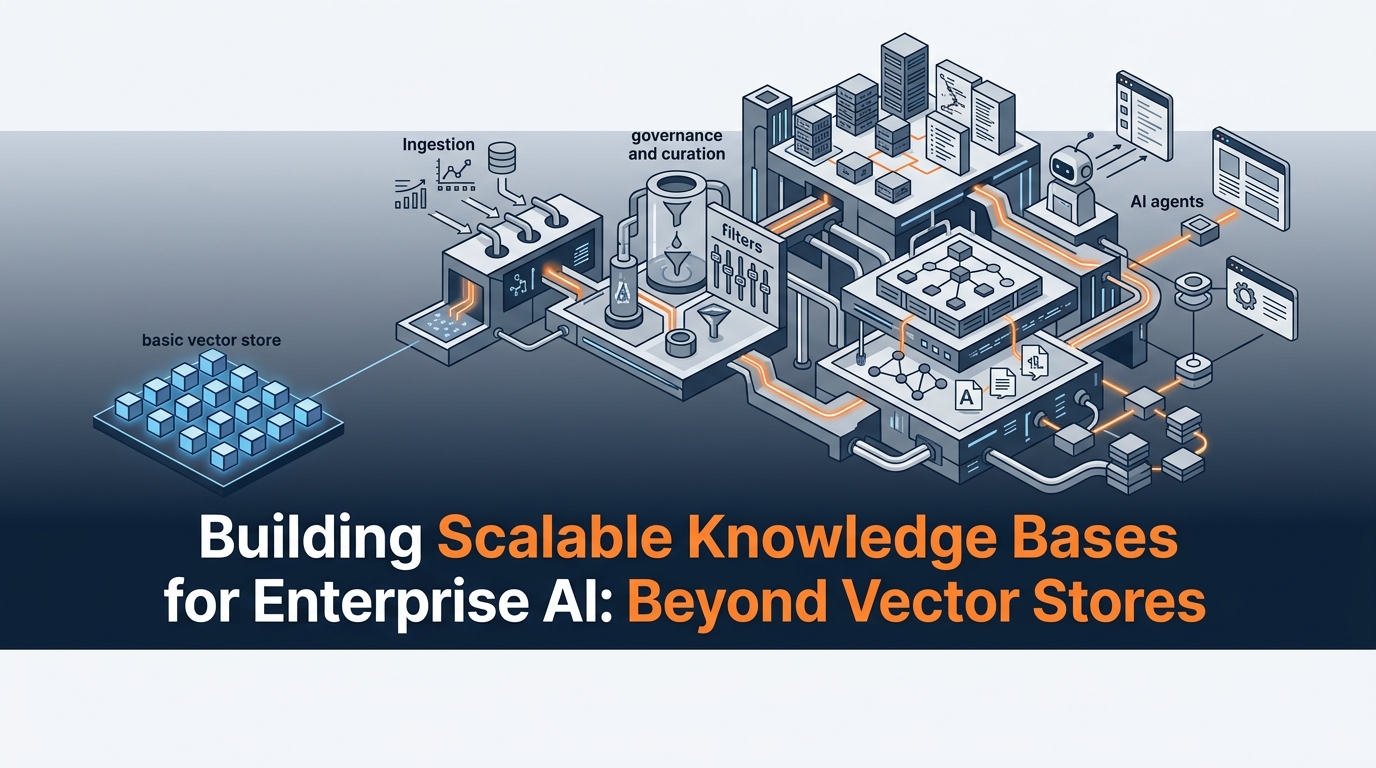
The promise of enterprise AI is undeniable: intelligent agents that can answer complex questions, automate tedious tasks, and unlock insights from vast troves of proprietary data. Yet, realizing this vision hinges on a foundation far more sophisticated than simply embedding documents and running similarity searches. For organizations truly committed to leveraging AI at scale, building scalable knowledge bases for enterprise AI demands moving beyond basic vector stores to a comprehensive, governed, and dynamic architecture.
It's not enough to just store information; enterprises need to ensure that their AI systems access accurate, timely, and contextually rich knowledge, all while adhering to stringent compliance and security protocols. This isn't an incremental improvement; it's a fundamental shift in how we conceive of and construct the data backbones powering our next generation of intelligent applications.
The Evolution of Knowledge Bases for Enterprise AI
The journey to effective enterprise AI often begins with an exploration of retrieval-augmented generation (RAG) strategies. At the heart of many RAG implementations lies a data store, but the nature of that store is crucial.
What Differentiates a Knowledge Base from a Vector Store?
Think of a vector store as a highly specialized library for numerical representations (embeddings) of text or other data. Its primary function is to store these embeddings and efficiently retrieve similar ones based on a query's embedding. It excels at finding conceptually similar pieces of information very quickly. If you ask it "Show me documents related to renewable energy policies," it will use the embedded meaning of your query to find documents with similar embedded meanings.
A knowledge base, particularly in an enterprise AI context, is a holistic, multi-layered system that may contain one or more vector stores as a component. It encompasses:
Ingestion & Processing: Mechanisms to bring in data from diverse sources (documents, databases, APIs) in various formats, clean it, chunk it, and transform it.
Indexing & Retrieval: Beyond just vector indexing, this includes keyword indexes, graph databases, and structured data indexing.
Semantic Layers: Business glossaries, ontologies, and relationships that provide explicit meaning and context to the raw data.
Governance & Access Control: Rules, policies, and integrations to ensure data quality, freshness, and secure access based on user permissions.
Evaluation & Monitoring: Tools to continuously assess the quality of the knowledge and its impact on AI performance.
A vector store is essentially a powerful search index for semantic similarity. A knowledge base is the entire information management ecosystem that feeds, governs, and leverages that index, alongside other capabilities, to deliver trustworthy answers.
Why Enterprises Need 'Beyond Vector Stores' Architectures
Relying solely on vector stores for production-grade enterprise AI applications quickly reveals their limitations:
Precision Issues & Lack of Explicit Context: While vector search is great for semantic similarity, it can struggle with highly specific factual queries or when exact matches are required. It doesn't inherently understand the relationship between entities or the business rules governing data. For example, a pure vector search might struggle to differentiate between "employee performance review" and "employee benefit review" if the embeddings are too close, or fail to find a specific policy document if the query uses slightly different phrasing from the embedded text.
No Semantic Meaning or Business Logic: Vector stores don't store explicit meaning. They don't know that "Q1 earnings" relates to "financial reports" or that "senior management" is a specific role hierarchy. This missing semantic layer makes it hard for AI to reason over business-specific concepts or follow complex rules.
Freshness Challenges: Without an intelligent ingestion pipeline, vector stores become static. If your company's policies change daily, a purely static vector store quickly becomes outdated, leading to AI hallucinations based on stale information.
No Inherent Access Control or Governance: Vector stores themselves typically lack native capabilities to manage document-level permissions or enforce data governance policies. This is a non-starter for sensitive enterprise data, where different users require different access levels.
Multi-Modal Complexity: Enterprise data isn't just text. It includes structured data, images, videos, and complex relationships. Pure vector stores are often optimized for a single modality (like text embeddings), making it challenging to integrate and query diverse data types cohesively.
The shift towards "beyond vector stores" means adopting managed RAG platforms that abstract away the underlying vector storage and provide the full suite of ingestion, governance, retrieval, and semantic capabilities. This allows enterprises to build AI applications that are accurate, secure, and truly aligned with their business logic.
Core Architecture for Scalable Enterprise Knowledge Bases
A robust knowledge base for enterprise AI is not a monolithic application but a well-orchestrated system of interconnected layers. Each layer plays a critical role in transforming raw data into reliable, queryable knowledge.
Key Layers of a Production-Ready Knowledge Base
Imagine a data flow from your source systems through to an AI agent:
Ingestion & Processing Layer:
Purpose: To bring raw data from disparate sources (documents, databases, APIs, streaming feeds) into the knowledge base, clean it, enrich it, and prepare it for indexing.
Components: Connectors (e.g., SharePoint, Confluence, Salesforce, database CDC tools), parsers (for PDFs, Word docs), chunking algorithms, entity extractors, data quality checks, PII redaction, embedding generation.
Output: Cleaned, chunked, enriched data with associated metadata.
Indexing & Storage Layer:
Purpose: To store the processed data and its various indexes (sparse, dense, graph) in a highly retrievable format.
Components: Vector stores (for dense embeddings), keyword search engines (e.g., Elasticsearch, Solr), graph databases (for relationships), traditional relational/NoSQL databases (for structured metadata).
Output: Indexed data ready for efficient retrieval.
Retrieval & Ranking Layer:
Purpose: To receive a user query, execute various search strategies, and select the most relevant chunks of information.
Components: Query parser, hybrid retrieval orchestrator (combining keyword, vector, graph), reranking models, query expansion modules.
Output: A ranked list of highly relevant content snippets or full documents.
Semantic Layer:
Purpose: To provide a unified, business-centric view of the data, defining concepts, relationships, and hierarchies. It acts as a bridge between raw data and business understanding.
Components: Ontology management tools, knowledge graphs, business glossaries, schema mappings.
Output: Contextualized understanding that enriches retrieval and AI reasoning.
Access Control & Governance Layer:
Purpose: To enforce security policies, manage permissions, and ensure data quality, freshness, and compliance.
Components: Integration with enterprise IAM (Identity and Access Management) systems, data quality dashboards, freshness monitors, auditing tools.
Output: Secure, compliant, and up-to-date knowledge.
Evaluation & Monitoring Layer:
Purpose: To continuously assess the performance, accuracy, and impact of the knowledge base and the AI systems it powers.
Components: A/B testing frameworks, human feedback loops, custom metrics (grounding, citation accuracy), performance dashboards, anomaly detection.
Output: Insights for continuous improvement and operational oversight.
This layered approach ensures that each aspect of managing enterprise knowledge is handled by dedicated components, allowing for modularity, scalability, and maintainability.
Intelligent Ingestion: Keeping Knowledge Fresh and Governed
The best retrieval system is only as good as the data it has. For enterprise AI, knowledge freshness and robust governance during ingestion are paramount.
Strategies for Real-time and Event-driven Ingestion
Stale data leads to incorrect AI answers and eroded trust. Enterprises must move beyond periodic batch updates for critical information.
Event-Driven Architectures: For real-time synchronization, adopt event-driven ingestion. When a change occurs in a source system (e.g., a new policy document is approved, a customer record is updated in a CRM), an event is triggered.
Example: Using Apache Kafka or a similar message queue, a "document_updated" event could be published whenever a file is saved in SharePoint. A knowledge base ingestion service subscribes to this topic, immediately processes the updated document, re-chunks it, re-embeds it, and updates the relevant indexes.
Change Data Capture (CDC): For databases, CDC tools can monitor transaction logs and stream changes (inserts, updates, deletes) in near real-time to the ingestion pipeline, ensuring database-backed knowledge is always current.
Incremental Updates and Versioning: Instead of re-ingesting entire datasets, focus on incremental updates.
Document Versioning: Maintain historical versions of documents. This is crucial for auditing, rollback capabilities, and understanding how knowledge has evolved. Each chunk should ideally carry a version identifier.
Delta Processing: Identify only the changed portions of documents or data records and process only those deltas. This reduces computational load and speeds up updates.
Freshness Monitoring, Staleness Detection, and Automated Re-ingestion
Even with event-driven systems, mechanisms are needed to verify freshness and trigger corrective actions.
Freshness Metrics: Attach
last_updatedtimestamps to every document and even individual chunks. Monitor these timestamps.Thresholds: Define acceptable staleness thresholds for different types of content (e.g., "financial reports must be no more than 1 hour old," "HR policies no more than 24 hours old").
Staleness Detection: Implement automated checks that periodically scan the knowledge base for content exceeding its freshness threshold.
Example: A daily scheduled job might query the metadata store for all documents with
last_updatedolder than 24 hours and belonging to the "critical policy" category.
Automated Re-ingestion: When staleness is detected, trigger an automated re-ingestion workflow for the identified content. This can involve fetching the latest version from the source system, reprocessing it, and updating the indexes.
Knowledge Drift Detection: Over time, the meaning or context of knowledge can drift even if the content itself doesn't change. This is harder to detect but can involve monitoring query patterns, user feedback, and periodically re-evaluating embeddings for semantic shifts.
Metadata Contracts and Schema Governance
Metadata is the unsung hero of a scalable knowledge base. It unlocks powerful filtering, context, and access control.
Metadata Contracts: Define strict schemas for metadata that must accompany every ingested piece of content. This includes:
source_system: e.g., "SharePoint HR," "Salesforce CRM"owner: The department or individual responsible for the content.sensitivity_level: "Public," "Internal," "Confidential," "Restricted."entity_tags: Automatically extracted entities like "product_name," "region," "employee_group."last_reviewed_date: Important for compliance and ensuring content validity.document_type: "Policy," "Procedure," "FAQ," "Legal_brief."Practical Example (JSON Metadata):
{
  "id": "doc_hr_00123",
  "title": "Remote Work Policy V2.1",
  "source_system": "SharePoint HR",
  "owner": "HR Department",
  "sensitivity_level": "Internal",
  "entity_tags": ["remote work", "policy", "HR", "employees"],
  "last_updated": "2023-10-26T10:30:00Z",
  "effective_date": "2023-11-01T00:00:00Z",
  "access_groups": ["hr_staff", "all_employees"]
}
Schema Governance: Establish a centralized schema registry and validation process. All ingestion pipelines must conform to these defined metadata schemas. This ensures consistency, which is critical for accurate retrieval and filtering.
Normalized Contexts: By standardizing metadata fields and values, you create a "normalized context" that allows the AI to understand and reason over diverse data sources as a unified whole. This helps prevent ambiguity and improves the quality of AI grounding.
Advanced Retrieval: Hybrid, Reranking, and Permission-Aware
Retrieval is where the knowledge base truly shines. Moving beyond basic similarity search vastly improves relevance and trustworthiness.
The Power of Hybrid Retrieval
Pure vector search has its limitations. The solution often lies in combining multiple retrieval methods.
Combining Retrieval Methods:
Keyword Search (Sparse Vectors): Traditional lexical search, excellent for exact matches, proper nouns, and specific terminology. Fast and robust for known entities.
Vector Search (Dense Embeddings): Semantic search, great for conceptual understanding, synonyms, and finding documents even if they don't contain exact keywords.
Graph-Based Retrieval: Leverages knowledge graphs to retrieve facts or documents based on relationships between entities (e.g., "show me all employees reporting to John Doe" or "documents related to projects funded by the R&D department").
Scenarios Where Hybrid Search Excels:
Specific + Conceptual Queries: A query like "What is the latest policy on remote work for employees in the engineering department?" benefits from:
Keyword search for "latest policy" and "engineering department" (exact terms).
Vector search for "remote work" (semantic similarity).
Metadata filtering for
document_type:policyandaccess_groups:engineering.
Low-Resource Domains: Where high-quality embeddings are hard to generate due to limited data, keyword search provides a strong baseline.
Retrieving Specific Data Points: If an AI needs to find a specific financial figure, keyword search often outperforms vector search for precision.
Weighting and Combining Results: After retrieving candidates from each method, a sophisticated strategy is needed to merge and score them. This can involve:
Reciprocal Rank Fusion (RRF): A method to combine multiple ranked lists into a single, robust ranked list.
Learned Re-ranking: Using a machine learning model to assign final scores based on features from all retrieval methods.
Optimizing Relevance with Reranking
Initial retrieval often returns many potentially relevant documents. Reranking refines this list to present only the most pertinent information to the AI.
How Reranking Works: A reranker model takes the initial set of retrieved document chunks (typically 50-100) and the original query, then re-scores them for relevance. It considers the query and document together in a more nuanced way than initial retrieval.
Reranking Approaches:
Cross-Encoders: These transformer models (e.g., BERT, RoBERTa) take the query and a document chunk as a pair and output a single relevance score. They are powerful but computationally more intensive, making them suitable for re-ranking a smaller, already filtered set.
Fine-tuned Models: Domain-specific rerankers trained on relevance judgments (query-document pairs labeled as relevant or not relevant) from your own enterprise data will perform best.
Role of User Feedback: Incorporate implicit (click-through rates, time spent on results) and explicit (thumbs up/down buttons) user feedback to continuously improve reranking models. A well-designed feedback loop is crucial for adapting to evolving user needs and data.
Implementing Permission-Aware Retrieval
Security is non-negotiable for enterprise knowledge. AI systems must respect existing access controls.
Document-Level Access Permissions: Every document or chunk should have associated access control lists (ACLs) or permission metadata (e.g.,
access_groups,owner_id).Integration with Enterprise IAM: Integrate the knowledge base's access control layer directly with your organization's Identity and Access Management (IAM) system (e.g., Active Directory, Okta, Azure AD). When a user queries, their identity and associated roles/groups are passed to the retrieval system.
Strategies for Filtering Results:
Pre-Retrieval Filtering: During the query, the system dynamically generates a filter based on the user's permissions. Only documents matching both the query and the user's permissions are retrieved from the index.
Example Query:
search(query="latest HR policy", filter="access_groups contains ('employee_id_123_groups') AND sensitivity_level <= 'internal'")
Post-Retrieval Filtering: Retrieve potential results, then filter them before passing them to the AI agent. This can be less efficient but provides an extra layer of security.
Challenges: Ensuring performant filtering over millions of documents and managing complex permission hierarchies requires careful indexing and system design.
The Governed Semantic Layer: Ensuring Business Correctness
Beyond just finding information, enterprise AI needs to understand it in a business context. This is where the semantic layer becomes indispensable.
Building a Unified Semantic View of Enterprise Data
Data in an enterprise is often siloed and inconsistent. A semantic layer bridges these gaps.
Definition: A semantic layer defines business terms, hierarchies, relationships, and domain knowledge in a standardized way. It’s a map that connects raw data elements to their meaning in the business world.
Role in Standardizing Concepts: For example, "customer" might mean one thing in the CRM system (an account) and another in the ERP (a billing entity). The semantic layer defines "customer" unambiguously, linking these disparate data points under a single, governed definition.
Reducing Ambiguity and Improving AI Grounding: By providing explicit definitions and relationships, the semantic layer helps AI agents:
Understand the nuances of domain-specific language.
Resolve ambiguous terms (e.g., "revenue" vs. "net revenue").
Connect facts from different documents that refer to the same underlying concept.
Practical Example: A knowledge graph where nodes represent entities (e.g., "Product X," "Q1 Earnings," "CEO Jane Doe") and edges represent relationships (e.g., "Product X contributes_to Q1 Earnings," "CEO Jane Doe leads R&D Department"). This explicit structure makes it easier for AI to trace information and answer complex relational queries.
Enhancing Trust and Reducing Hallucinations
A strong semantic layer directly combats common AI shortcomings like hallucination and lack of trustworthiness.
"Source of Truth" for AI: The semantic layer becomes the canonical reference for business concepts and rules. When an AI generates an answer, it can ground its response not just in retrieved documents, but also in the validated relationships and definitions from the semantic layer.
AI Reasoning Over Business Rules: It enables AI to reason over business-specific terms and rules. If the semantic layer defines "high-value customer" based on specific criteria (e.g.,
annual_spend > $100k), the AI can use this definition directly, rather than trying to infer it from raw text.Verifiable Citations and Answer Grounding: By linking semantic concepts to their source documents and specific chunks, the AI can provide verifiable citations for its answers. This dramatically increases user trust. If the AI states "Product X's Q1 earnings were $5M," it can point directly to the relevant line in the Q1 Financial Report.
Evaluating the Quality and Impact of Your Knowledge Base
Building a sophisticated knowledge base is an ongoing effort. Continuous evaluation is essential to ensure it delivers value and meets business objectives.
Moving Beyond Simple Retrieval Metrics
Traditional metrics like precision and recall are useful for individual retrieval components, but they don't tell the whole story for enterprise AI.
Limitations of Precision/Recall: While crucial, they measure how well you retrieve relevant documents, not how well the AI answers using those documents, or if the answer is factually correct from a business standpoint.
Introducing New Metrics:
Grounding Quality: Does the AI's answer directly derive from the retrieved documents? Are all claims supported by evidence from the knowledge base?
Citation Accuracy: Are the citations provided by the AI correct and genuinely support the specific claims made?
Adherence to Business Rules: Does the AI's answer align with defined business logic and constraints from the semantic layer?
Coherence & Readability: Is the AI's answer well-structured, easy to understand, and free of grammatical errors?
Completeness: Does the AI's answer fully address the user's query?
Human-in-the-Loop Evaluation: For subjective quality, there's no substitute for human review.
Annotation Pipelines: Set up processes where human annotators review a sample of AI-generated answers, scoring them against the new metrics. This feedback is invaluable for fine-tuning models and identifying systemic issues.
User Feedback: Directly solicit feedback from end-users on the helpfulness and accuracy of AI answers.
Measuring Business Correctness and Trust
Ultimately, a knowledge base's success is measured by its impact on the business.
Defining Business Correctness: This goes beyond factual accuracy. An answer is "business correct" if it adheres to internal policies, regulatory requirements, and strategic objectives. For example, an AI answering a legal question must not only be factually accurate but also reflect the company's specific legal stance.
Methods for Measuring User Trust and Satisfaction:
Surveys & Interviews: Directly ask users about their confidence in AI answers and their overall satisfaction.
Usage Analytics: Monitor how users interact with AI outputs (e.g., do they follow up with human agents less often? Do they complete tasks faster?).
A/B Testing: Test different knowledge base configurations or AI models against each other to see which leads to higher user satisfaction or better business outcomes.
Establishing Operational Thresholds: Define clear, measurable thresholds for acceptable performance.
Example: "95% of AI answers regarding HR policies must be business-correct and have verifiable citations."
These thresholds provide targets for improvement and alert teams when the knowledge base or AI system deviates from desired performance.
Building a truly scalable and effective knowledge base for enterprise AI is a complex, multi-faceted undertaking. It requires a strategic vision that looks beyond simplistic data storage and embraces a holistic architecture focused on intelligent ingestion, advanced retrieval, robust governance, and continuous evaluation. By investing in these foundational layers, organizations can unlock the full potential of their proprietary data, empowering AI agents to deliver trusted, accurate, and business-critical insights at an unprecedented scale.
In your experience, what is the single biggest challenge you've faced when trying to scale an enterprise knowledge base beyond a basic vector store for production AI, and how did you (or would you) address it?
💬 Join the conversation — share your take in the comments and tell us what you’d add.