
Building Real-Time Speech-to-Speech AI Systems: An Engineering Deep Dive
Speech-to-Speech AI engineering deep dive with practical architecture guidance to build faster, more natural voice experiences. Read now.
Imagine a world where your spoken words instantly transform into another language, delivered in a voice that feels naturally yours, or where a virtual assistant understands and responds with no perceptible delay, just like a human. This isn't science fiction; it's the promise of real-time Speech-to-Speech AI systems, an engineering feat that demands precision, speed, and an intimate understanding of human conversation. Building these systems is a deep dive into the fascinating intersection of AI research and practical, low-latency systems design.
The Real-Time Challenge of Speech-to-Speech AI
Speech-to-Speech (STS) AI refers to the direct conversion of spoken input into spoken output, bypassing the intermediate text representation often found in more traditional voice AI pipelines. The goal is to create truly natural, fluid interactions where the AI can listen, process, and respond in real-time, making the distinction between human and machine almost imperceptible.
The Latency Imperative
For conversational AI, the latency imperative is paramount. Humans expect near-instantaneous responses in dialogue. A delay of even a few hundred milliseconds can feel unnatural, disruptive, and lead to user frustration. This means every component in a real-time Speech-to-Speech system must operate with ultra-low latency, minimizing processing time from the moment a word is spoken until a response is heard.
Beyond Simple Transcription and Synthesis
While traditional Speech-to-Text (STT) and Text-to-Speech (TTS) systems handle transcription and voice generation, respectively, real-time STS goes significantly further. It requires synchronous processing, sophisticated turn-taking mechanisms to manage who speaks when, and robust barge-in detection to allow users to interrupt the AI mid-sentence, just as they would a human. The complexity escalates dramatically compared to offline processing, where delays are tolerable. In real-time, the system must continuously anticipate, process, and react, mimicking the dynamic flow of human dialogue.
Architectural Choices: Cascaded vs. Native Speech-to-Speech
When architecting real-time Speech-to-Speech AI systems, engineers face a fundamental choice: a cascaded approach or a more integrated, native end-to-end model. Each has distinct advantages and trade-offs.
The STT-LLM-TTS Pipeline
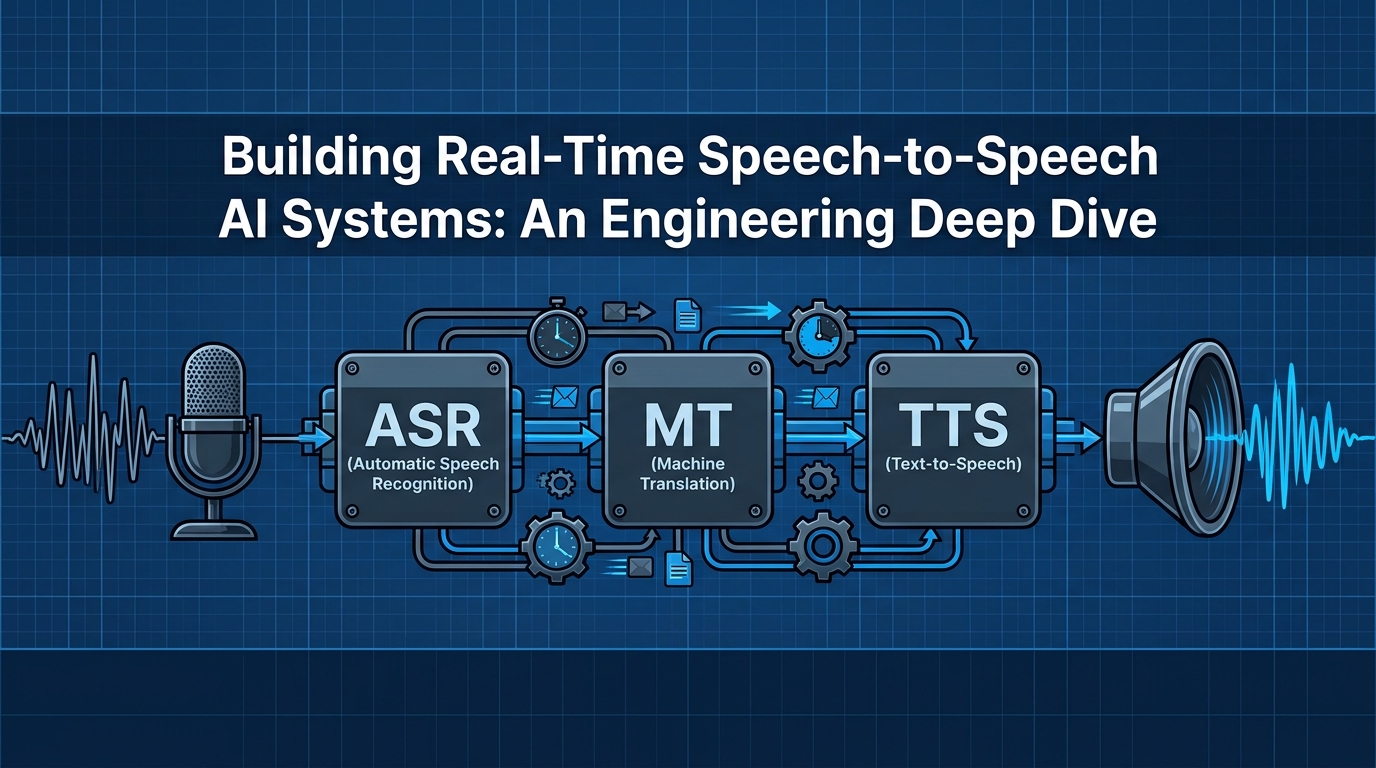
The most common approach for building conversational AI is a cascaded STT-LLM-TTS pipeline. This system breaks the problem into three sequential stages:
Speech-to-Text (STT): Converts the user's spoken input into text.
Large Language Model (LLM): Processes the text input, generates a textual response, and performs any necessary reasoning or knowledge retrieval.
Text-to-Speech (TTS): Synthesizes the LLM's text response into spoken audio.
The data flow is strictly sequential: audio → text → text → audio. This modularity offers significant benefits in terms of development, debugging, and the ability to leverage best-in-class models for each component. However, the cumulative latency of each stage, plus network transit times, can quickly add up, posing a challenge for ultra-low latency requirements.
Advantages of End-to-End Native STS
Native Speech-to-Speech models aim for a more direct spoken input to spoken output conversion, often with a single neural network or a tightly integrated architecture. These models learn to map directly from audio features to generated speech, potentially bypassing explicit text transcription and synthesis steps.
The primary advantage of native STS is its potential for reduced cumulative latency. By integrating the processing, it can avoid the overhead of converting between modalities and the potential delays introduced by separate model inferences. This approach is particularly powerful for tasks like direct voice translation or highly expressive voice cloning, where the nuances of the original speech (intonation, emotion) can be more directly carried through to the output.
When to Choose Which Architecture
The choice between cascaded and native STS architectures depends heavily on the specific application's requirements for latency, complexity, and auditability.
Cascaded STT-LLM-TTS Systems are often preferred when:
Complex Reasoning is Required: LLMs excel at understanding complex queries, performing reasoning, and retrieving specific information, which is critical for virtual assistants, customer support bots, and expert systems.
Strict Factual Accuracy and Auditability are Essential: The intermediate text representation provides a crucial audit trail. It's easier to apply content moderation filters, fact-checking mechanisms, and human oversight to text output before it's spoken. This is vital for enterprise applications where reliability and compliance are paramount.
Modularity and Flexibility are Valued: Individual components can be swapped, updated, or fine-tuned independently. Different STT models can be used for various languages, or specialized LLMs for specific domains.
Voice Cloning or Expressivity is Secondary: While advanced TTS models offer highly natural voices, the primary focus is on conveying information clearly.
End-to-End Native STS Models shine when:
Ultra-Low Latency is the Absolute Priority: For applications where every millisecond counts, such as real-time language interpretation or highly responsive interactive games, the reduced latency of an integrated model can be a game-changer.
Expressive Voice Cloning or Emotion Transfer is Key: By maintaining a direct audio-to-audio path, native STS can better preserve and transfer paralinguistic features, resulting in more natural and emotionally resonant synthetic speech.
Direct Translation or Voice Style Transfer is the Primary Goal: For tasks where the semantic content is less complex than the way it's spoken, native STS can offer a more elegant solution.
For enterprise readiness, the cascaded approach often provides more robust guardrails and easier integration with existing knowledge bases and compliance frameworks. Native STS models, while promising for latency, can present a "black box" challenge for auditability and ensuring factual accuracy, often requiring additional validation layers.
Engineering for Minimal Latency and Seamless Interaction
Achieving sub-200ms latency in real-time Speech-to-Speech AI is not just about fast models; it's about meticulously optimizing every stage of the data pipeline.
Optimizing the Streaming Pipeline
Efficient handling of audio streams is critical. Rather than waiting for an entire utterance, systems must process audio in small, continuous chunks.
Chunking Strategies: Audio input should be segmented into small, fixed-size chunks (e.g., 20ms or 30ms) for continuous processing. This allows early inference of partial hypotheses.
Look-Ahead Buffers: While processing a current chunk, the system can pre-fetch or begin processing the subsequent chunk, minimizing idle time.
Pipelining: Overlapping the compute of different stages (e.g., while the STT model processes chunk
N, the LLM can begin processing the text from chunkN-1, and the TTS can synthesize audio from chunkN-2). This parallelization is key to reducing perceived latency.
# Conceptual example of streaming audio processing
def process_audio_stream(audio_iterator, stt_model, llm_model, tts_model):
    stt_buffer = []
    llm_buffer = []

    for audio_chunk in audio_iterator:
        # STT processes the current audio chunk
        partial_text = stt_model.transcribe_streaming(audio_chunk)
        stt_buffer.append(partial_text)

        # Once a complete utterance or a significant partial is formed
        if is_utterance_ready(stt_buffer):
            full_text = combine_stt_buffer(stt_buffer)
            response_text = llm_model.generate_response(full_text)
            llm_buffer.append(response_text)

            # As LLM generates, TTS can start synthesizing
            if is_tts_ready(llm_buffer):
                synthesized_audio_chunk = tts_model.synthesize_streaming(llm_buffer.pop(0))
                yield synthesized_audio_chunk
                stt_buffer.clear() # Reset for next turn
    # Handle any remaining buffer content
Managing Partial Hypotheses and Endpointing
The ability to act on incomplete information is central to real-time interaction.
Partial Hypotheses: STT models provide "partial hypotheses"—transcriptions that are updated as more audio comes in. Intelligent systems can start generating LLM responses based on these partials, refining or re-generating as the transcription stabilizes.
Voice Activity Detection (VAD): VAD precisely identifies when speech begins and ends, differentiating it from silence or background noise. Accurate VAD is crucial for segmenting utterances and determining turn-taking.
Sophisticated Endpointing: Beyond simple silence detection, advanced endpointing uses prosodic cues (intonation, rhythm), semantic completeness, and even contextual understanding to predict when a speaker has finished their thought, allowing the AI to respond promptly without waiting for a long pause. This avoids awkward silences.
Defining and Measuring Real-Time KPIs
To ensure real-time performance, key metrics must be rigorously defined and continuously monitored:
Time-to-First-Audio (TTFA): The duration from the end of the user's utterance to the first audible sound of the AI's response. This is a critical measure of perceived responsiveness.
End-to-End Latency (E2E Latency): The total time from the start of the user's utterance to the completion of the AI's response. While important, TTFA often dominates the user's subjective experience.
Barge-in Detection Delay: The time from when a user starts speaking over the AI to when the AI detects the interruption and stops its current output.
Interruptibility Latency: The time from a user's barge-in to the start of the AI's processing of the new user input.
For a truly real-time conversational agent, especially in voice interfaces like virtual assistants or call center agents, the target for human-perceptible delay is generally under 200 milliseconds for TTFA. Any longer, and users start to notice and perceive the AI as slow or unresponsive.
Mechanisms for Jitter Control and Packet Loss Compensation
Network instability is a harsh reality for live audio.
Jitter Buffers: Implement buffers to smooth out variations in packet arrival times (jitter), ensuring a continuous audio stream for processing.
Packet Loss Concealment (PLC): Utilize algorithms to intelligently "fill in" missing audio packets, often by predicting missing samples based on surrounding data, to prevent audible glitches and maintain conversational flow. This is crucial for maintaining audio quality and system robustness.
Mastering Conversational Dynamics: Turn-Taking and Barge-in
Natural conversation is a dance of turn-taking and graceful interruptions. For real-time STS, replicating this requires sophisticated engineering.
Intelligent Turn-Taking Mechanisms
Simply waiting for silence isn't enough. AI needs to predict when a user is finished speaking and when it's appropriate to respond.
Silence Detection & VAD: While fundamental, simple silence detection is prone to errors in noisy environments or with hesitant speakers.
End-of-Utterance (EOU) Prediction: Models trained on prosody (pitch, rhythm, volume changes), grammatical completeness, and semantic cues can predict an EOU before a long silence occurs. For example, a sudden drop in pitch or a grammatically complete sentence strongly signals an end.
Contextual Cues: The system can also use semantic understanding. If a user asks a question, the AI knows to prepare a response. If the user says "Okay, thanks," it might be a signal to conclude the interaction.
Detecting and Responding to Barge-in
One of the most challenging aspects of real-time conversational AI is robust barge-in detection—the ability for a user to interrupt the AI's speech and for the AI to gracefully handle it.
Cross-Talk Detection: The system must differentiate between simultaneous speech (barge-in) and background noise, often using advanced signal processing techniques or dedicated neural networks that can identify multiple active speakers.
Interruptible Models: TTS models should be designed to be interruptible, meaning they can stop generating audio immediately upon receiving a barge-in signal, rather than completing their current phrase.
Low-Latency Keyword Spotting: For critical commands or "stop" phrases, a highly optimized, low-latency keyword spotter running continuously can provide an immediate interrupt signal, even during AI speech.
The User Experience of Interruption
Gracefully handling an interruption is paramount to a natural user experience.
Truncate Current Output: Upon barge-in detection, the AI must immediately stop its current speech generation. Playing even a fraction of a second of unnecessary audio after an interruption creates an unnatural, robotic feel.
Seamless Transition: The system should then quickly process the new user input, transitioning smoothly to a response. This means the STT component must be able to immediately switch from listening for a new turn to processing the barge-in speech as the start of a new turn.
Minimizing Audible Interruption: If the AI is mid-sentence when interrupted, it should ideally not audibly cut itself off abruptly. More advanced systems might try to fade out quickly or even complete the current word if possible without introducing too much delay, although direct truncation is often the more reliable and faster approach.
Building Robust and Reliable Production Systems
Bringing real-time Speech-to-Speech AI to production means confronting the messy realities of the real world and ensuring not just speed, but also reliability, accuracy, and ethical operation.
Handling Real-World Audio Variability
Live audio environments are far from pristine. Production systems must cope with:
Diverse Accents and Dialects: Models need extensive training data covering a wide range of linguistic variations to maintain high transcription accuracy.
Varying Background Noise Levels: From bustling call centers to quiet homes, noise impacts VAD and STT accuracy. Techniques include noise suppression algorithms, robust STT models trained on noisy data, and dynamic noise estimation.
Code-Switching: In multilingual environments, users may seamlessly switch between languages mid-sentence. Models capable of recognizing and processing multiple languages concurrently are essential. This often requires language identification modules or truly multilingual end-to-end models.
Ensuring Factual Accuracy and Guardrails
While speed is critical, accuracy and safety cannot be compromised, especially in enterprise applications.
Content Moderation: Implement text-based content moderation filters on the LLM's output before it reaches the TTS stage. This prevents the AI from generating inappropriate, offensive, or harmful speech.
Factual Grounding (RAG): For knowledge-intensive tasks, integrate Retrieval Augmented Generation (RAG) techniques. This ensures the LLM's responses are grounded in verified, up-to-date information, rather than relying solely on its pre-trained knowledge, which can be outdated or inaccurate.
Auditability Features: Comprehensive logging of all interactions (audio, STT transcriptions, LLM prompts/responses, TTS output metadata) is crucial for debugging, performance analysis, and compliance. Tracing tools that allow following a single interaction through the entire pipeline are invaluable.
A Framework for Production Evaluation
Systematic evaluation is essential for maintaining and improving production quality.
Live Audio Performance Metrics: Beyond traditional offline metrics (e.g., Word Error Rate for STT), focus on live metrics:
VAD False Positive/Negative Rates: Misclassifying speech as silence or vice versa severely impacts turn-taking.
Barge-in False Positive/Negative Rates: Incorrectly detecting a barge-in or failing to detect one creates jarring experiences.
Latency Distribution: Monitor the distribution of TTFA and E2E latencies, not just averages, to identify outliers.
Throughput & Concurrency: How many simultaneous conversations can the system handle while maintaining latency targets?
Subjective Quality Assessments: Human evaluators are indispensable. They can assess the naturalness of the conversation, the appropriateness of responses, the gracefulness of interruptions, and the overall user experience under different real-world conditions (e.g., noisy backgrounds, fast talkers). A/B testing with different model versions or pipeline optimizations can provide valuable insights.
Cost Optimization in Real-Time Speech-to-Speech AI
The computational demands of real-time Speech-to-Speech AI can be substantial, making cost optimization a key engineering challenge.
Understanding Audio-Token Compute Costs
Unlike purely text-based LLM applications, real-time STS involves processing raw audio, which is inherently more compute-intensive than text tokens.
Sampling Rate and Bandwidth: High-fidelity audio (e.g., 16kHz or 24kHz) means more samples per second, directly increasing the amount of data that needs to be processed by STT and generated by TTS.
Continuous Processing: Real-time streaming requires models to be "always on" or rapidly activated, consuming resources even during periods of silence or low activity.
Multi-Modal Inference: Each stage (STT, LLM, TTS) often involves separate, computationally intensive neural network inferences, all happening in a tightly coupled, low-latency loop.
Scaling and Resource Allocation
Efficient resource management is critical to control costs.
GPU Sizing and Utilization: Selecting the right GPU instance types (e.g., balancing memory, core count, and cost) and ensuring high GPU utilization through efficient batching of incoming requests are paramount.
Model Quantization: Reducing the precision of model weights (e.g., from FP32 to FP16 or INT8) can significantly reduce memory footprint and increase inference speed with minimal impact on accuracy, leading to lower compute costs.
Optimization for Streaming Concurrency: Design the inference servers to handle many concurrent audio streams efficiently. This often involves specialized streaming inference frameworks that can manage state across chunks for multiple users on the same GPU.
Dynamic Scaling: Implement robust auto-scaling rules based on real-time load metrics to ensure enough resources are available during peak times without over-provisioning during off-peak hours.
Quality vs. Throughput Trade-offs
Engineers must constantly evaluate the balance between the desired quality of the AI's responses and the system's throughput capacity within a given compute budget.
Model Complexity: Larger, more sophisticated STT, LLM, or TTS models generally offer higher accuracy and naturalness but come with greater computational costs and latency.
Inference Speed: Aggressive optimization techniques (e.g., pruning, distillation) can speed up inference at the potential cost of a slight degradation in quality.
Batching Strategies: While larger batch sizes can increase GPU utilization, they can also introduce latency, especially in a real-time streaming context where individual user requests need fast responses. Careful balancing is required.
Monitoring and optimizing cost per interaction is an ongoing process. This involves tracking compute usage (GPU hours, CPU cycles), network egress, and API costs against the number of successful user interactions. Identifying bottlenecks and continuously refining the architecture and model choices are key to building economically viable real-time Speech-to-Speech AI systems.
What is the most unexpected engineering challenge you've encountered when building real-time voice AI, and how did your team address it?
💬 Join the conversation — share your take in the comments and tell us what you’d add.