Building Advanced AI Search: Beyond Keyword Matching with Semantic Understanding
Unlock the power of AI Search to build advanced experiences that go beyond keywords. Discover semantic understanding and revolutionize your search today!
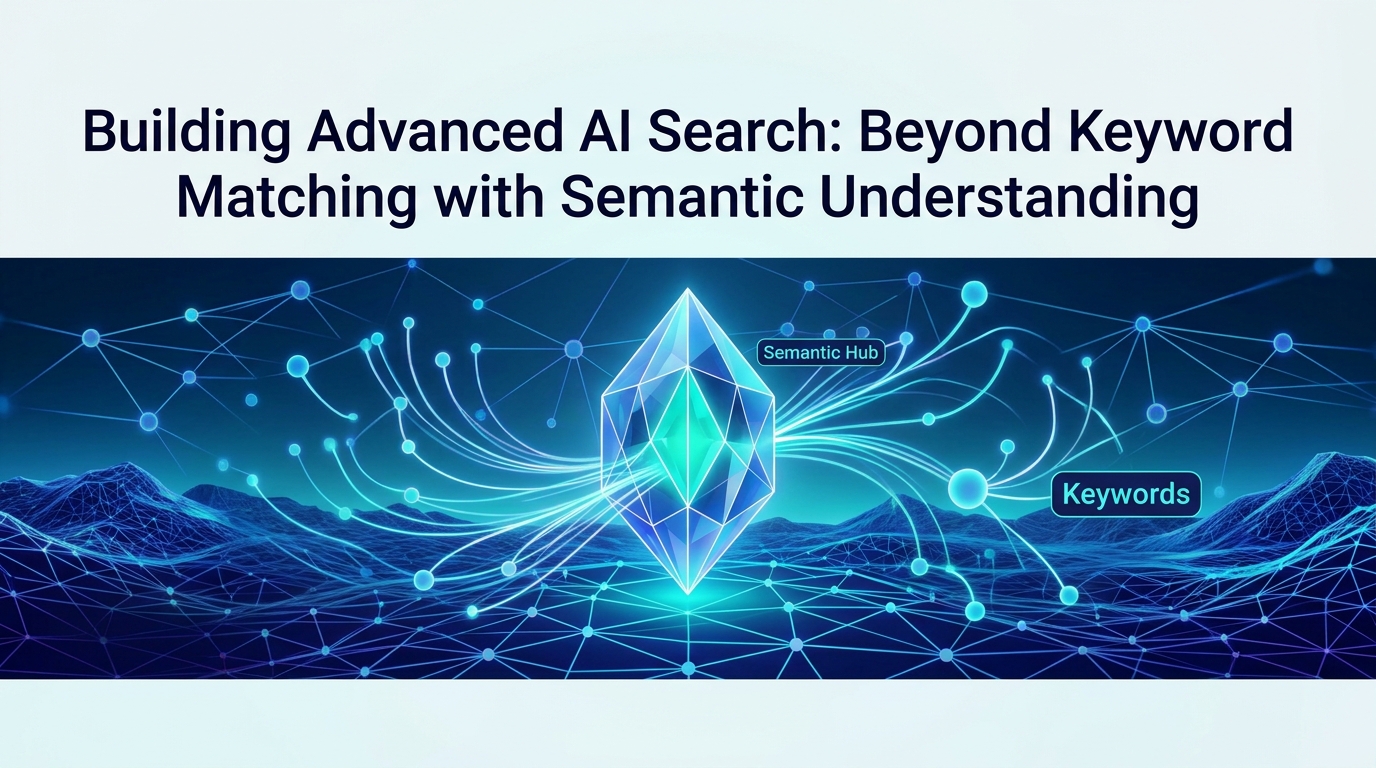
The days of typing precise keywords into a search bar and hoping for a direct match are rapidly fading. Users now expect search engines to understand their intent, interpret nuanced language, and deliver relevant results even when their query doesn't perfectly align with the content's exact wording. Building advanced AI search systems is no longer a luxury, but a necessity for any platform aiming to provide a truly intuitive and efficient user experience.
The Evolution of Search: Why Keywords Aren't Enough Anymore
For decades, traditional search engines relied heavily on a keyword-matching paradigm. You type a word, the system looks for documents containing that exact word (or close variations based on basic stemming rules), and then ranks them according to factors like frequency and location. While revolutionary for its time, this approach suffers from inherent limitations:
Exact Matching Pitfalls: A query like "how to fix a leaky faucet" might miss an article titled "plumbing repair guide for dripping taps." The system focuses on lexical tokens, not underlying meaning.
Synonym Blindness: It struggles with synonyms. "Best smartphone for photography" might completely overlook content discussing "top camera phones."
Contextual Ignorance: Without understanding context, polysemous words (words with multiple meanings, like "bank" for a financial institution or a river's edge) lead to irrelevant results. A search for "Java" could yield results about coffee, an island, or a programming language, depending on which keywords happen to be more prevalent.
Zero-Result Frustration: If a user's exact phrasing isn't present, even if the concept is, they get nothing.
User expectations have dramatically shifted. We're accustomed to interacting with voice assistants and sophisticated web search engines that interpret natural language processing (NLP) and intent-based queries with impressive accuracy. We expect systems to grasp the concept we're searching for, not just the words. This demand for deeper comprehension is why AI search, which moves beyond simple lexical matches to comprehend meaning and context, has become indispensable.
What is AI Search? Semantic Understanding at its Core
At its heart, AI search refers to systems that leverage artificial intelligence (AI), machine learning (ML), and natural language processing (NLP) to interpret both the user's query intent and the meaning embedded within documents. Unlike traditional methods, it doesn't just look for words; it endeavors to understand what those words mean in context.
Differentiating AI Search from Traditional Keyword Search
Consider the simple distinction with a few concrete examples:
When traditional keyword search queries like "affordable housing San Francisco" might only return documents explicitly containing those three terms, an AI search system understands that "cheap apartments SF" or "low-cost living Bay Area" convey the same core intent and can surface relevant information.
How Semantic Search Works: From Words to Vectors
The magic behind AI search's ability to grasp meaning lies in semantic search, powered by vector embeddings. Instead of treating words as isolated tokens, semantic search transforms both queries and documents into dense numerical representations called embeddings. Think of these embeddings as coordinates in a high-dimensional space where meaning dictates proximity:
Embeddings as Dense Vector Representations: An embedding model (often a deep neural network like a Transformer) takes a piece of text (a word, sentence, or even an entire document) and converts it into a fixed-size array of numbers – a vector. Crucially, texts with similar meanings will have vectors that are numerically "close" to each other in this abstract space, while unrelated texts will be far apart.
# Conceptual example: not runnable code
from sentence_transformers import SentenceTransformer

model = SentenceTransformer('all-MiniLM-L6-v2')
query_vector = model.encode("best wireless headphones for running")
doc_vector = model.encode("top Bluetooth earphones for exercise")

# query_vector and doc_vector would be numerically close
# representing their semantic similarity.
Shared Vector Space: Both your search queries and your entire corpus of documents (or chunks of them) are processed by the same embedding model, placing them into a shared vector space. This ensures that a query's meaning can be directly compared to a document's meaning.
Similarity Search: Once everything is vectorized, finding relevant documents becomes a mathematical problem of measuring distance. Algorithms like cosine similarity calculate the angle between vectors. A smaller angle (cosine similarity closer to 1) indicates higher semantic similarity, meaning the query and document convey similar ideas. The search system then retrieves the
kclosest document vectors to the query vector.
This process transcends mere word matching, allowing the search system to understand the concepts and relationships expressed in natural language, even if the exact words are different.
Architectural Components of a Modern AI Search System
Building a robust AI search system involves orchestrating several sophisticated components. It’s not just about one AI model; it’s a pipeline.
Vector Embeddings: The Foundation of Semantic Retrieval
The choice and management of vector embeddings are paramount:
Embedding Models: Diverse models exist, each with strengths.
Sentence Transformers (e.g.,
all-MiniLM-L6-v2,mpnet-base-v2): Excellent for generating fixed-size sentence or short paragraph embeddings, offering a balance of performance and speed. Ideal for semantic search where the primary goal is to find semantically similar text.Custom Models: For highly specialized domains, training or fine-tuning models on your specific dataset can yield superior relevance, capturing domain-specific jargon and nuances.
Large Language Models (LLMs) like OpenAI's
text-embedding-ada-002: Offer powerful, general-purpose embeddings, though they can be more expensive and slower for large-scale real-time indexing.
Generating and Storing Embeddings: For a large document corpus, this is a significant undertaking. Documents must be pre-processed (cleaned, chunked if necessary) and then passed through the chosen embedding model. These generated vectors, often hundreds or thousands of dimensions long, must be efficiently stored.
Vector Databases: Traditional databases are not optimized for high-dimensional vector similarity search. Specialized vector databases (e.g., Pinecone, Weaviate, Milvus, Qdrant) are essential. They implement Approximate Nearest Neighbor (ANN) algorithms (like HNSW or FAISS) to perform similarity searches over millions or billions of vectors in milliseconds, making real-time semantic search feasible. They also handle indexing, scaling, and managing the vector lifecycle.
Hybrid Search: Combining Lexical and Semantic Power
While semantic search offers incredible conceptual understanding, it's not a silver bullet. Rare entity names, exact product codes, or very specific phrases are often best handled by traditional keyword methods. This is where hybrid search shines: it combines the strengths of both lexical (keyword) and semantic retrieval.
Lexical Search (e.g., BM25): This component uses techniques like TF-IDF or BM25 (Best Match 25) over an inverted index (typically managed by systems like Elasticsearch or Lucene). It excels at:
Exact Matches: Quickly finding documents with the precise keywords.
Rare Terms and Named Entities: Locating specific product names, IDs, or proper nouns that might not have strong semantic neighbors in a vector space.
Known Entities: When users know exactly what they're looking for.
Semantic Search: This component, powered by vector embeddings and vector databases, provides:
Synonym and Polysemy Handling: Understanding varied phrasing.
Contextual Understanding: Grasping the intent behind a query.
Conceptual Matches: Finding documents that discuss similar ideas, even if different vocabulary is used.
Combining Results: The challenge is effectively merging the ranked lists from both lexical and semantic stages. A popular strategy is Reciprocal Rank Fusion (RRF). RRF takes the ranked lists from multiple sources (e.g., lexical BM25 and semantic vector search) and combines them into a single, unified ranked list, giving higher weight to documents that appear high in multiple lists. This balances the strengths of both approaches, improving both recall (finding more relevant documents) and precision (ensuring top results are highly relevant).
Reranking for Enhanced Relevance
After initial retrieval (often a hybrid approach), a powerful reranking step further refines the results. The goal of reranking is to take the top N candidates (e.g., 50-100 documents) from the initial retrieval and reorder them based on a deeper, more computationally intensive analysis of their relevance to the query.
More Powerful Models: Reranking often employs larger, more sophisticated NLP models (e.g., cross-encoders like
msmarco-MiniLM-L-6-v2or even fine-tuned LLMs). Unlike bi-encoder embedding models used for initial retrieval (where query and document are embedded independently), cross-encoders process the query and document together. This allows them to model deep, nuanced interactions between the two, leading to highly accurate relevance scores.Contextual Signals: Rerankers can consider factors beyond just semantic similarity, such as:
Query-document interaction: How specific terms in the query relate to specific parts of the document.
Contextual clues: E.g., if a document mentions a highly authoritative source, or if a user has previously interacted positively with similar content.
Diversity: Promoting a diversity of topics in the top results, even if some are slightly less relevant individually, to provide a broader context.
Implementing Advanced AI Search: Practical Steps
Transforming theoretical components into a working system requires careful execution.
Data Preparation and Indexing
The quality of your search experience starts with your data.
Document Chunking: Large documents (e.g., long articles, PDFs) often contain multiple topics. Embedding an entire document can dilute its meaning. Chunking involves breaking documents into smaller, semantically coherent segments (e.g., paragraphs, sections, or even overlapping windows of text). Each chunk is then embedded and indexed independently, ensuring that the semantic search focuses on specific, relevant passages.
Strategy: Fixed-size chunks with overlap, or intelligent chunking based on document structure (headings, paragraphs).
Handling Metadata: Beyond the content itself, metadata (author, date, tags, categories, access permissions, product attributes) is crucial.
Filtering and Faceting: Metadata enables users to refine searches (e.g., "articles published last month," "products by brand X").
Access Control: Integrating user permissions with metadata allows filtering results to only show documents a user is authorized to see. This is critical for enterprise search.
Indexing Process:
Lexical Index: Your raw text content, often with some preprocessing (tokenization, stemming), is indexed into an inverted index database (e.g., Elasticsearch). This allows for fast keyword lookup.
Vector Index: Each document chunk's embedding vector is stored in a vector database, along with a reference back to the original document or chunk ID and its relevant metadata.
Query Processing and Retrieval Workflow
The journey from a user typing a query to receiving results involves a precise sequence of operations:
Query Expansion (for Lexical Search): Before hitting the lexical index, the raw user query can be enhanced.
Synonym Mapping: "Smartphone" -> "mobile phone."
Acronym Expansion: "LLM" -> "Large Language Model."
Intent Detection: Analyzing the query to categorize it (e.g., "informational," "navigational," "transactional") and potentially route it to specialized handlers.
Generating Query Embeddings (for Semantic Search): The user's query is passed through the same embedding model used for document chunking, generating a query vector.
End-to-End Workflow:
Lexical Retrieval: The expanded query hits the lexical index (e.g., Elasticsearch) to retrieve an initial set of keyword-matching documents.
Semantic Retrieval: The query vector is used in the vector database to find the top
K_semanticsemantically similar document chunks.Hybrid Combination: The results from both lexical and semantic retrieval are combined using a method like Reciprocal Rank Fusion (RRF) to generate a unified list of candidate documents.
Reranking: This combined list (e.g., top 100) is then fed into a more powerful cross-encoder reranker, which deeply analyzes each candidate against the original query, reordering them for optimal relevance.
Result Presentation: The final, reranked list of documents (or answers generated from them) is presented to the user.
Beyond Retrieval: Context, Personalization, and Generative AI
Advanced AI search goes beyond simply finding relevant documents; it aims to deliver tailored, direct answers.
Incorporating Contextual Signals
Search relevance can be significantly enhanced by understanding the user and their current situation:
User History: Past queries, clicked results, viewed documents, and purchase history provide strong signals. A user who frequently searches for "Python programming" will likely prefer programming-related results for a generic "Python" query.
Location and Device: A search for "restaurants near me" benefits directly from location data. Device type might influence presentation (mobile vs. desktop).
Implicit Feedback: Clicks, dwell time on results, scrolling behavior, and even lack of clicks (indicating dissatisfaction) can be used to refine relevance models over time.
Personalized Embeddings: More advanced systems can create or adapt embeddings specifically for individual users or user segments, allowing for truly tailored results based on their unique preferences or needs (e.g., through collaborative filtering techniques).
RAG and LLMs for Answer Generation
Retrieval-Augmented Generation (RAG) is a powerful paradigm that combines AI search with the generative capabilities of Large Language Models (LLMs) to provide direct answers instead of just document links.
RAG Mechanism:
Retrieval: The AI search system first retrieves a small set of highly relevant document chunks (e.g., 3-5 top chunks) in response to a user's query. This is where the advanced AI search system described earlier is crucial.
Augmentation: These retrieved chunks are then provided as "context" to an LLM, along with the original user query.
Generation: The LLM uses this context to synthesize a concise, factual, and coherent answer directly from the retrieved information.
# Conceptual RAG prompt
prompt = f"""
Based on the following context, please answer the question:

Context:
{retrieved_document_chunk_1}
{retrieved_document_chunk_2}
{retrieved_document_chunk_3}

Question: {user_query}

Answer:
"""
# LLM then generates the answer based on this prompt.
Generating Concise, Factual Answers: RAG allows for direct answers without requiring the user to sift through documents. For example, a query "What are the symptoms of a migraine?" can yield a direct summary generated from medical documents, rather than just links to articles.
Mitigating Hallucination and Ensuring Factual Accuracy: This is paramount.
Grounding: By strictly instructing the LLM to "only answer based on the provided context" and "state if the answer is not in the context," RAG significantly reduces hallucination (making up facts).
Source Citation: For transparency and verifiability, generated answers should ideally cite the specific document or chunk from which the information was extracted.
Confidence Scores: The retrieval and reranking models can provide confidence scores for retrieved documents, which can then be used to inform the LLM about the reliability of its context.
Evaluating and Optimizing Your AI Search Experience
Implementing AI search is an iterative process. Measurement and continuous improvement are key.
Metrics for Success: Beyond Click-Through Rates
Traditional metrics like click-through rates (CTR) are a start but don't tell the whole story for AI search.
Relevance Judgments: The gold standard. Human annotators assess pairs of queries and documents (or generated answers) to determine their true relevance. This creates a "ground truth" dataset essential for training and evaluating models.
Offline Evaluation Metrics: These are calculated against your ground truth dataset:
Precision@k: Of the top
kresults, how many are relevant?Recall@k: Of all truly relevant documents, how many did we retrieve in the top
k?Mean Reciprocal Rank (MRR): For a set of queries, what is the average reciprocal rank of the first relevant document found? (1/rank, so 1 for rank 1, 0.5 for rank 2, etc.) Higher MRR means relevant results appear earlier.
Normalized Discounted Cumulative Gain (NDCG): A more sophisticated metric that accounts for the graded relevance of documents (e.g., highly relevant, somewhat relevant, not relevant) and discounts relevance at lower ranks.
Online A/B Tests: The ultimate test. Deploying different search algorithms or model versions to separate user groups and measuring real-world performance:
User engagement (clicks, time on page, conversions).
Task completion rates (e.g., did the user find what they needed?).
Abandonment rates.
Continuous Improvement and Feedback Loops
AI search systems thrive on feedback.
Implicit User Feedback:
Clicks and Dwell Time: Strong signals of relevance.
Query Reformulation: If a user rephrases a query multiple times, the initial results were likely poor.
"No Results" Pages: A clear indicator of failure.
Explicit User Feedback:
"Was this helpful?" buttons.
Thumb-up/down ratings for results or generated answers.
Direct user surveys or feedback forms.
Model Retraining and Re-indexing:
Periodically retrain your embedding and reranking models using newly annotated data or updated implicit feedback.
As your content corpus changes, new documents need to be embedded and indexed into the vector database. Existing embeddings might need to be refreshed if the models are updated.
Operational Metrics: Monitor system health:
Latency: How fast do search results return?
Throughput: How many queries per second can the system handle?
Cost Efficiency: Optimize infrastructure and model choices to manage operational expenses.
Navigating Challenges in Enterprise AI Search
Implementing AI search in an enterprise environment brings unique complexities.
Data Governance, Security, and Access Control
These are paramount in any corporate setting:
Data Privacy and Compliance: Ensuring that sensitive information is handled according to regulations like GDPR, HIPAA, or CCPA. This often means masking or redacting certain data before indexing and ensuring data locality.
Fine-Grained Access Controls: Not all users should see all documents. The search system must integrate with existing identity and access management (IAM) systems to filter results based on a user's permissions, roles, or attributes. This means indexing document access metadata alongside content embeddings and applying filters at retrieval time.
Multilingual and Cross-Lingual Search
Global enterprises need to support diverse languages:
Multilingual Embeddings: Use models trained on multiple languages (e.g., multilingual Sentence Transformers like
paraphrase-multilingual-mpnet-base-v2). These models map similar concepts across different languages to nearby points in the vector space, allowing a query in one language to retrieve documents in another, or to search across a mixed-language corpus.Translation Services: For less common languages or very high precision requirements, query or document content can be translated using machine translation services before embedding or indexing.
Cross-Lingual Query Understanding: The challenge here is ensuring that the semantic intent of a query in one language is accurately understood and matched to documents in another, without losing nuance.
Real-time Updates and Freshness
Information in enterprise systems is constantly changing, requiring fresh search results:
Maintaining Data Freshness: For dynamic datasets (e.g., e-commerce product catalogs, news feeds, internal documentation), search indexes must be updated frequently.
Incremental Indexing: Instead of rebuilding the entire index, strategies focus on only updating or adding new/changed documents.
When a document is updated, its old vector and lexical entries are removed, and new ones are added.
Vector databases are designed to handle these updates efficiently.
Near Real-Time Updates: By combining streaming data pipelines (e.g., Kafka) with incremental indexing, you can achieve updates within seconds or minutes, ensuring users always find the most current information.
Building advanced AI search capabilities is a journey that demands a deep understanding of NLP, machine learning, and robust system architecture. By moving beyond simple keyword matching to embrace semantic understanding, hybrid retrieval, and generative AI, organizations can unlock unprecedented levels of user satisfaction and information access.
What specific challenge have you faced when trying to move beyond keyword search, and what solutions did you find most effective?
💬 Join the conversation — share your take in the comments and tell us what you’d add.