
Build Scalable Voice AI Applications with React Native and Node.js
Create impactful Voice AI applications with React Native and Node.js. Learn practical strategies and boost your development today!
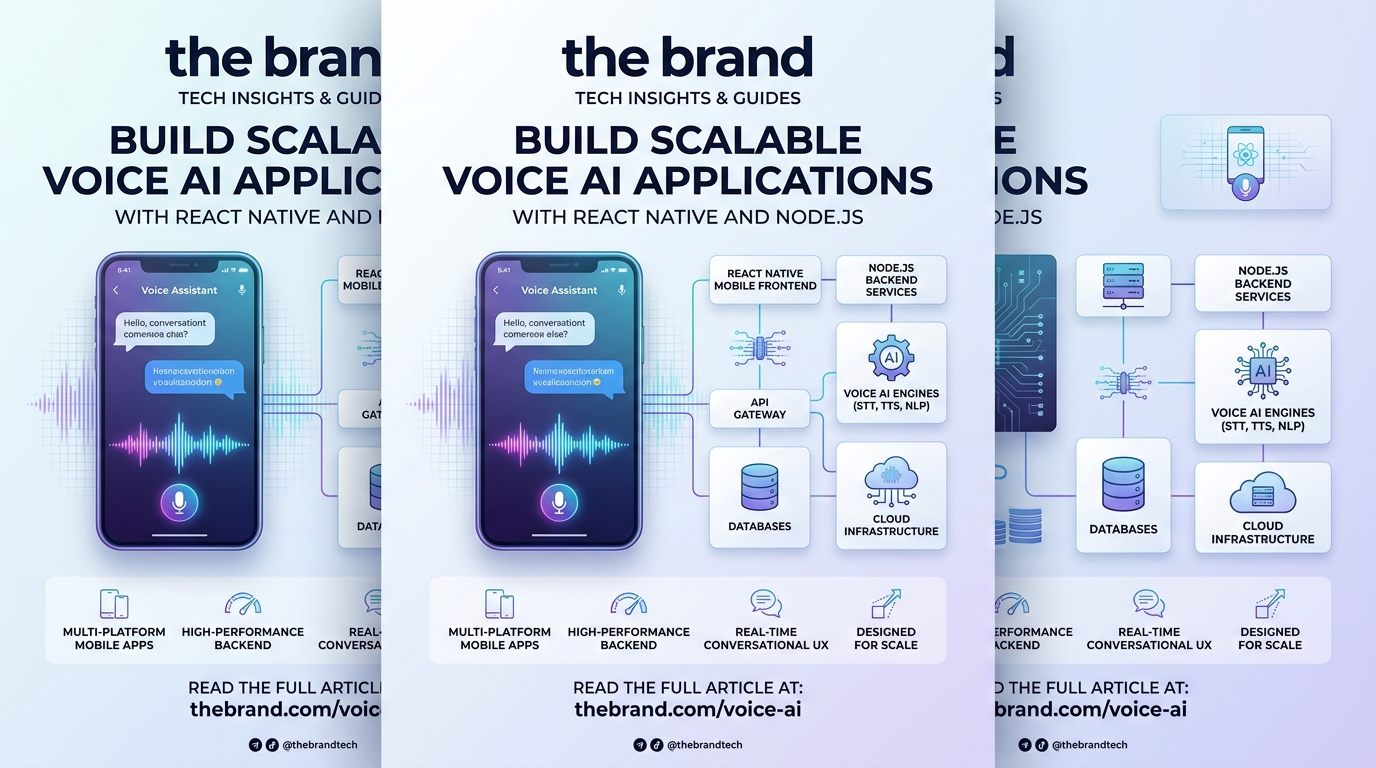
Build Scalable Voice AI Applications with React Native and Node.js
Have you ever wished for a seamless interface where technology acknowledges your voice commands like a proficient assistant? Voice AI applications are swiftly becoming the backbone of modern interactions in various industries, allowing for intuitive customer engagements and streamlined operations. In this post, we’ll dive deep into how you can build scalable Voice AI applications using React Native and Node.js, two powerful tools for developers.
Understanding Voice AI Applications
What is a Voice AI Application?
Voice AI applications leverage artificial intelligence technology to interact with users through voice commands. These systems understand, process, and respond to spoken inputs, making the user experience more engaging and efficient. Key components of voice AI include speech recognition, natural language understanding (NLU), and speech synthesis. By combining these elements, developers can create applications that not only respond to queries but also learn and adapt from user interactions, ultimately enhancing user satisfaction.
Common Use Cases for Voice AI
Voice AI applications have found their niche across various sectors. Here are some common use cases:
Customer Service: Automating responses to FAQs or routing calls to the right department enhances efficiency.
Healthcare: Voice-enabled applications assist patients in scheduling appointments or checking symptoms with ease.
E-commerce: Users can place orders or inquire about products simply by speaking.
Home Automation: Smart speakers and apps allow users to control household devices through voice commands.
These applications demonstrate how voice AI can transform user interactions, forging a more immersive experience.
Differences Between Voice AI and Traditional Call Automation
While traditional call automation relies heavily on pre-recorded messages and touch-tone menus, voice AI offers a more dynamic and interactive experience. Unlike press-1-for-this or press-2-for-that options, voice AI can understand context and nuances in spoken language. This ability allows for personalized interactions that can resolve queries much quicker. With voice AI, businesses can provide a more satisfying and effective customer experience.
Choosing the Right Technology Stack
React Native for Mobile Client Development
When developing mobile applications that integrate voice AI functionalities, React Native stands out as an excellent choice. It allows developers to write for both iOS and Android platforms simultaneously, reducing development time and cost. The framework supports a myriad of libraries specifically designed for voice recognition and AI integration, ensuring that developers can efficiently create feature-rich applications.
Node.js for Real-time Orchestration
Real-time communication is pivotal in voice AI applications. Node.js excels in this area due to its non-blocking architecture, which is ideal for handling concurrent connections. This means that users can experience minimal latency when interacting with voice features. Furthermore, Node.js's vast ecosystem of frameworks and modules facilitates easy integrations, enabling developers to build and scale their applications without significant hassles.
API-led Voice Architecture Using Cloud AI APIs
To harness the power of voice recognition, leveraging cloud AI APIs is essential. Services like Google Cloud Speech-to-Text or Amazon Transcribe provide robust, reliable speech recognition capabilities. By utilizing an API-led architecture, developers can easily integrate these services into their applications, ensuring high accuracy and responsiveness.
Designing Your Voice AI Application
Hybrid AI Deployment
A hybrid AI deployment that combines on-device and cloud resources offers numerous advantages. It ensures that basic functionalities function offline, resulting in faster response times during standard tasks. Moreover, cloud capabilities can handle complex queries, giving applications the power of large-scale processing. This approach balances performance and scalability effectively.
Handling Accented Speech and Terminology
A major challenge in voice AI is ensuring comprehension across different accents and terminologies. Implementing neural networks trained on diverse datasets can significantly improve accuracy. Voice AI applications should be designed to learn from user interactions, tuning themselves to better understand regional variations and unique vocabulary. This adaptability enhances user experience and builds trust in the system.
Integrating On-device AI with React Native
For optimal performance, integration of on-device AI models within React Native applications is crucial. Developers can utilize frameworks like TensorFlow Lite or ONNX, allowing for lightweight models that run efficiently on mobile devices. This integration not only enhances responsiveness but also provides users with an uninterrupted experience.
Building Scalable Solutions
Load Balancing Techniques for Voice AI
To ensure smooth operation as your application scales, implementing load balancing techniques is essential. Techniques such as round-robin distribution or resource-based allocation can optimize traffic across servers, preventing overload. By effectively managing requests, developers can maintain a high-quality user experience even during peak times.
Managing Scalability in High-Traffic Situations
Adopting microservices architecture can facilitate scalability in high-traffic scenarios. By decoupling services, developers can independently scale each component of the application according to demand. This modular approach allows for greater flexibility and easier maintenance, ensuring that your application can grow effortlessly.
Practical Considerations
Choosing a Speech-to-Text Model
When selecting a speech-to-text model, consider factors such as accuracy, latency, and compatibility with your technology stack. Open-source models, cloud-based solutions, and proprietary software each offer different advantages. Evaluating the specific needs of your application will guide you toward the best choice.
Ensuring Real-time Responsiveness
Node.js’s concurrency model plays a vital role in ensuring real-time responsiveness for voice applications. By managing multiple requests concurrently, developers can ensure quicker response times, which is especially critical in voice interactions where users expect minimal lag. Regular performance testing and optimization are necessary to keep your application responsive under varying conditions.
Case Studies and Success Stories
Exploring successful implementations of voice AI applications offers valuable insights. Companies like Domino's Pizza have revolutionized ordering with voice applications, demonstrating significant efficiency upgrades while enhancing customer satisfaction. By analyzing these success stories, you can glean best practices and lessons that can be implemented in your projects, ensuring you don’t reinvent the wheel.
Conclusion
Building scalable voice AI applications with React Native and Node.js is not just a trend; it's a necessity for businesses aiming to innovate and enhance user experiences. By understanding the technology stack, designing effectively, and addressing the challenges associated with voice interactions, you can create a cutting-edge application that stands out in today’s market.
Start building your scalable Voice AI application today, leveraging the power of React Native and Node.js!