Unlock Advanced Anthropic Models with NextGen AI DEV's Unified API
Access powerful Anthropic AI models through NextGen AI DEV's single API. Elevate your generative AI projects with ease and scale. Learn how to integrate today!
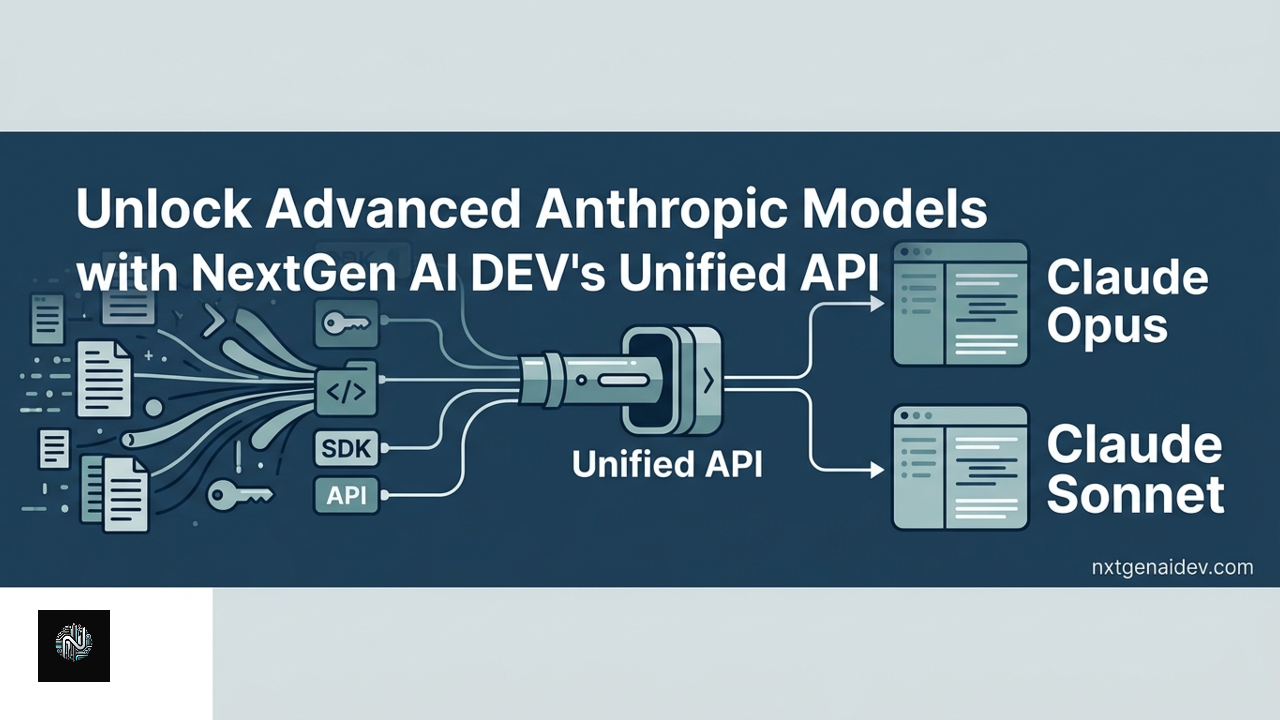
Integrating powerful large language models (LLMs) into applications often comes with a hidden complexity tax: juggling multiple SDKs, managing diverse API keys, and adapting to ever-evolving endpoint variations. For developers and product managers aiming to leverage cutting-edge Anthropic models like Claude Opus or Sonnet, these integration hurdles can significantly slow down innovation. This is where NextGen AI DEV's unified API emerges as a game-changer, simplifying access and supercharging your AI development workflow, allowing you to unlock advanced Anthropic capabilities with unprecedented ease and control.
Integrating Anthropic's Claude: The NextGen AI DEV Advantage
Directly integrating Anthropic's Claude models, while powerful, introduces several operational and development challenges. You're tasked with managing distinct API keys for each provider, understanding their specific request/response formats, and staying updated with their unique SDK versions. This fragmented approach can quickly become a significant overhead, particularly when your application needs to interact with multiple LLM providers or switch between them.
NextGen AI DEV eliminates this complexity by offering a single API key and a unified endpoint to access a wide array of LLMs, including the full suite of Anthropic models. Whether you need the advanced reasoning of Claude Opus, the speed of Claude Sonnet, or the cost-efficiency of Claude Haiku, a single, consistent API call is all it takes. This means less time spent on boilerplate integration code and more time focused on building innovative features.
Simplify Your Integration Workflow
Imagine a world where you don't need to rewrite significant portions of your code every time a new Anthropic model is released or when you decide to experiment with a different provider. NextGen AI DEV abstracts away the underlying complexities. It acts as an intelligent proxy, taking your standardized request and translating it into Anthropic's native format before sending it on its way. The response is then converted back into a familiar, often OpenAI-compatible, schema, ensuring a consistent development experience across all models and providers.
For instance, directly integrating with Anthropic might involve specific libraries, authentication methods, and message object structures unique to their API. With NextGen AI DEV, you interact with a single, well-documented endpoint, abstracting these differences. This not only simplifies initial integration but also dramatically reduces maintenance efforts, allowing your team to focus on core product logic rather than API plumbing.
Seamless Protocol Abstraction for Anthropic
One of NextGen AI DEV's core strengths is its ability to seamlessly convert Anthropic's native request and response formats into a standardized schema. This is particularly beneficial for developers already familiar with the OpenAI API structure, as NextGen AI DEV can present Anthropic models in a way that feels instantly familiar.
Consider a typical chat completion request. Instead of diving into Anthropic's specific SDK to instantiate a client and craft a request object, you can simply make a POST request to NextGen AI DEV's unified endpoint, specifying the desired Anthropic model using our consistent naming convention.
Example: Switching from Direct Anthropic to NextGen AI DEV
Let's say you're currently making a direct call to Anthropic's Claude for a chat completion:
# Direct Anthropic SDK example (conceptual)
from anthropic import Anthropic

client = Anthropic(api_key="YOUR_ANTHROPIC_API_KEY")

message = client.messages.create(
    model="claude-opus-20240229",
    max_tokens=1024,
    messages=[
        {"role": "user", "content": "Explain quantum entanglement simply."}
    ]
)
print(message.content)
With NextGen AI DEV, the transition is remarkably straightforward. You'll use your NextGen AI DEV API key and specify the model with our standardized identifier, like anthropic:claude-opus-20240229:
# NextGen AI DEV unified API example (conceptual)
import requests
import json

NEXTGEN_API_KEY = "YOUR_NEXTGEN_AI_DEV_API_KEY"
UNIFIED_ENDPOINT = "https://api.nxtgenaidev.com/v1/chat/completions" # Example endpoint

headers = {
    "Authorization": f"Bearer {NEXTGEN_API_KEY}",
    "Content-Type": "application/json"
}

data = {
    "model": "anthropic:claude-opus-20240229", # Our standardized model ID for Claude Opus
    "messages": [
        {"role": "user", "content": "Explain quantum entanglement simply."}
    ],
    "max_tokens": 1024
}

response = requests.post(UNIFIED_ENDPOINT, headers=headers, data=json.dumps(data))
print(response.json()['choices'][0]['message']['content'])
This minimal code change demonstrates the power of NextGen AI DEV's abstraction. You're no longer tied to a specific provider's SDK or API structure, gaining flexibility without sacrificing functionality.
Build with Freedom: A Multi-Provider Strategy for Anthropic
Relying on a single LLM provider, even one as powerful as Anthropic, carries inherent risks, including potential vendor lock-in, service disruptions, or fluctuating pricing. A strategic multi-provider approach offers resilience, cost optimization, and the flexibility to always use the best model for any given task. NextGen AI DEV is purpose-built to facilitate this strategy, making it simple to incorporate Anthropic models alongside others.
Strategic Vendor Diversification with Claude
By using NextGen AI DEV as your central gateway, you inherently avoid vendor lock-in. Your application integrates with our unified API, not directly with Anthropic's. This means that if you ever need to pivot or add another LLM provider—be it OpenAI, Google, or Together AI—the changes required in your application code are minimal. You simply adjust the model parameter in your request.
This level of abstraction provides unparalleled agility. You can experiment with different models, switch providers based on performance benchmarks, cost-effectiveness, or feature availability, all without refactoring your core application logic. Your choice of underlying LLM becomes a configuration decision, not a major development project.
Intelligent Routing and Fallback Chains
NextGen AI DEV empowers developers with intelligent routing capabilities, allowing you to direct requests to Anthropic models based on custom logic. You might route specific types of queries to Claude Opus for its superior reasoning, or to Claude Sonnet for faster responses where latency is critical. This routing can be configured based on factors such as:
Cost: Prioritize the most cost-effective Anthropic model for less critical tasks.
Performance: Route high-priority requests to the fastest available model.
Availability: Ensure service continuity by routing away from an overloaded or unavailable provider.
Custom Logic: Define rules based on user segments, prompt characteristics, or application states.
Beyond proactive routing, NextGen AI DEV enables robust fallback chains. Imagine a scenario where Anthropic's Claude service experiences a temporary outage. Instead of your application failing, NextGen AI DEV can be configured to automatically reroute the request to another provider's model, such as GPT-4 from OpenAI. This seamless failover mechanism ensures your application remains operational, maintaining a high level of reliability and user experience even when individual providers face issues.
A fallback chain might look like this:
Attempt
anthropic:claude-opus-20240229.If unavailable or fails, fallback to
openai:gpt-4-turbo.If
gpt-4-turboalso fails, fallback totogether:mistralai/Mixtral-8x7B-Instruct-v0.1.
This layered approach guarantees maximum uptime and flexibility.
A/B Testing Anthropic vs. Other Models
Making data-driven decisions about which LLM performs best for your specific use cases is crucial. NextGen AI DEV simplifies the process of A/B testing Anthropic's Claude models against other LLMs directly through its unified endpoint. You can configure experiments to send a percentage of requests to anthropic:claude-sonnet-20240229 and another percentage to openai:gpt-3.5-turbo, for example, all while collecting performance metrics and output quality assessments.
This capability allows you to:
Compare Response Quality: Objectively evaluate which model generates more accurate, relevant, or creative responses for your prompts.
Analyze Latency and Throughput: Understand the real-world performance characteristics of different models under your specific load.
Optimize Costs: Identify the most cost-effective model that still meets your quality requirements.
Inform Model Selection: Make informed decisions about which LLMs to use for different features or user segments based on empirical data rather than speculation.
Product managers can leverage these insights to strategically deploy Anthropic models where they provide the most value, ensuring optimal resource allocation and superior product outcomes.
Unleash Advanced Claude Capabilities for Complex Workflows
Anthropic's Claude models are renowned for their exceptional capabilities, particularly in areas like long context understanding and structured output. NextGen AI DEV ensures that you can fully leverage these advanced features within your applications without being bogged down by integration specifics.
Leveraging Anthropic's Long Context Windows
One of Anthropic's standout strengths is its support for incredibly long context windows, allowing models like Claude to process and reason over vast amounts of text. This capability opens doors for highly sophisticated applications that require deep understanding and analysis of lengthy documents or complex conversations.
NextGen AI DEV fully supports these extended context windows for Anthropic models. You can send large input payloads, confident that our platform will handle the translation and delivery to Claude, enabling powerful use cases such as:
Comprehensive Document Summarization: Summarize entire legal briefs, research papers, or financial reports, extracting key insights and condensing vast information.
Detailed Analysis and Review: Conduct in-depth analysis of codebases, customer feedback logs, or medical records, identifying patterns, anomalies, and critical information.
Complex RAG Applications: Build Retrieval-Augmented Generation (RAG) systems that can reference extensive internal knowledge bases, providing highly accurate and contextually rich responses. For instance, a customer support agent powered by Claude via NextGen AI DEV could instantly pull information from hundreds of pages of product manuals to answer obscure user questions.
Structured Outputs and Tool Use with NextGen AI DEV
For building reliable, production-grade AI applications, deterministic and structured outputs are paramount. Anthropic's models support generating outputs in specific formats, such as JSON, and also offer advanced tool use (often referred to as function calling) capabilities. NextGen AI DEV facilitates the seamless use of these features.
Our unified API allows you to easily specify your desired output format (e.g., "JSON mode") when invoking an Anthropic model. This ensures that the model's response adheres to a predictable structure, making it much simpler to parse and integrate into your downstream application logic. This is critical for tasks like:
Data Extraction: Reliably extract entities (names, dates, locations), sentiments, or key facts from unstructured text into a structured format for database storage or further processing.
API Integration: Generate API call parameters or code snippets that directly interface with other services based on user prompts.
Similarly, Anthropic's tool use functionality enables models to interact with external tools or APIs, extending their capabilities beyond pure text generation. With NextGen AI DEV, you can define the available tools and their schemas, allowing Claude to intelligently decide when and how to invoke them based on the conversation context. This is the cornerstone for building sophisticated AI agents that can perform actions like:
Booking Appointments: A calendar tool could be exposed to Claude, allowing it to schedule meetings.
Fetching Real-time Data: A weather API tool could be used to retrieve current conditions.
Database Queries: Claude could interpret a natural language query and use a tool to fetch specific data from your database.
NextGen AI DEV handles the intricacies of passing tool definitions and parsing tool calls, making it straightforward to build powerful, interactive AI agents.
Advanced Use Cases for Product Managers
Product managers are always looking for ways to accelerate feature development and deliver cutting-edge AI experiences. By leveraging Anthropic's advanced capabilities through NextGen AI DEV, they can:
Develop Sophisticated Agents Faster: Build intelligent assistants that can process complex user requests, retrieve information from various sources, and perform multi-step actions, all while maintaining long-term conversational context. Think of advanced chatbots for customer support, personal assistants, or automated research agents.
Automate Content Generation: Power automated content creation pipelines for marketing copy, technical documentation, or internal communications, leveraging Claude's nuanced understanding and generation capabilities, especially with long-form inputs.
Streamline Complex Workflow Automation: Automate business processes that involve understanding unstructured data, making decisions based on extensive context, and integrating with other systems. Examples include automated claims processing, legal document review, or dynamic report generation.
The unified API and abstraction layers provided by NextGen AI DEV dramatically reduce the engineering effort required to bring these advanced Anthropic-powered features to market, allowing product teams to iterate faster and deliver more impactful solutions.
Operational Excellence: Manage Anthropic Usage at Scale
Scaling AI applications in an enterprise environment demands robust operational controls, clear cost visibility, and stringent security measures. NextGen AI DEV provides the comprehensive toolkit needed to manage Anthropic model usage efficiently, securely, and transparently at any scale.
Granular Cost Tracking and Analytics
Understanding and controlling costs is paramount for any large-scale AI deployment. NextGen AI DEV offers detailed, real-time cost tracking specifically for your Anthropic model usage, breaking down expenses across different projects, teams, or even individual users. This granular visibility allows you to:
Allocate Costs Accurately: Pinpoint exactly where your Anthropic spending is going, facilitating chargebacks to specific departments or initiatives.
Optimize Budgeting: Identify high-cost areas and make informed decisions about model selection or usage patterns to stay within budget.
Analyze Usage Patterns: Gain insights into which Anthropic models are most frequently used, at what times, and for which types of tasks, helping you fine-tune your resource allocation.
Our platform supports per-organization billing through various payment gateways including Stripe, PayPal, Razorpay, and Paddle, simplifying financial management. Furthermore, our shared credits system allows enterprises to pool credits and distribute them across multiple teams or projects, ensuring seamless access to Anthropic models while maintaining centralized financial control.
Robust Access Control and Security
Security and compliance are non-negotiable in enterprise AI. NextGen AI DEV implements multi-organization Role-Based Access Control (RBAC), ensuring that only authorized individuals and teams have access to specific Anthropic models and configurations. This means:
Fine-Grained Permissions: Define roles and assign permissions to control who can deploy, configure, and monitor Anthropic model usage.
Segregated Access: Isolate projects and teams into their own organizational units, preventing unauthorized cross-access to data and models.
Audit Logs: Every action performed within the NextGen AI DEV platform is meticulously logged, providing a complete audit trail for compliance, security reviews, and troubleshooting. These logs offer transparency into how Anthropic models are being accessed and utilized across your organization.
By centralizing access through NextGen AI DEV, you enhance your security posture, reduce the risk of unauthorized API key exposure, and simplify compliance with industry regulations.
Proactive Monitoring and Alerts
Preventing unexpected interruptions and managing credit consumption are critical for maintaining service continuity. NextGen AI DEV provides comprehensive usage analytics and proactive alerting mechanisms specifically tailored for your Anthropic consumption.
Real-time Dashboards: Monitor your Anthropic model usage, latency, error rates, and costs through intuitive dashboards.
Custom Low-Credit Alerts: Configure custom alerts (e.g., delivered via Slack or Discord) to notify relevant teams when your shared credit balance for Anthropic usage falls below a defined threshold. This proactive notification system prevents service disruptions due to depleted credits, ensuring your AI applications run smoothly.
Performance Metrics: Track key performance indicators (KPIs) for Anthropic models, allowing you to identify potential issues before they impact end-users.
These operational tools ensure that you can manage your Anthropic deployments with confidence, predictability, and efficiency, even at the most demanding enterprise scales.
Self-Hosted Control: Anthropic Deployments Your Way
For organizations with stringent security policies, specific compliance requirements, or a mandate for complete data sovereignty, a fully managed SaaS solution may not always be the optimal choice. NextGen AI DEV understands this need and offers powerful options for self-hosted or on-premise deployments, providing unparalleled control over your Anthropic model access.
Architecting for On-Premise Anthropic Access
NextGen AI DEV can be deployed within your own infrastructure, acting as a private, self-hosted LLM gateway. This architecture ensures that all traffic to Anthropic models (and other providers) flows through your controlled environment, rather than a third-party managed service.
Typical architectural patterns for deploying NextGen AI DEV in a self-hosted environment include:
Kubernetes Deployments: Leveraging container orchestration for scalability, resilience, and easy management.
Private Cloud Instances: Deploying on dedicated VMs within your AWS, Azure, or Google Cloud private networks.
On-Premise Servers: For organizations with physical data centers, NextGen AI DEV can run directly on your hardware.
In these setups, NextGen AI DEV acts as a secure, local proxy, routing requests to Anthropic's cloud-based APIs while keeping your data and control plane within your trusted perimeter. This ensures private access to Anthropic models, reducing exposure and enhancing security.
Enhanced Security and Compliance Benefits
Self-hosting NextGen AI DEV for your Anthropic model access brings significant security and compliance advantages:
Data Sovereignty: By keeping the gateway within your infrastructure, sensitive data processed by the LLM (if it passes through the gateway before anonymization) remains within your defined geographical boundaries and control. This is crucial for compliance with data residency requirements.
Meeting Strict Compliance: Achieve compliance with rigorous industry regulations such as GDPR (General Data Protection Regulation), HIPAA (Health Insurance Portability and Accountability Act), SOC 2, and others. Self-hosting provides the necessary controls and auditability to meet these standards.
Custom Security Layers: Implement your organization's specific network security policies, firewalls, intrusion detection systems, and threat intelligence directly around your NextGen AI DEV instance.
Reduced Attack Surface: Minimize the exposure of your API keys and internal data by confining the LLM gateway within your existing secure network.
While a fully managed SaaS solution offers convenience and reduces operational overhead, self-hosting NextGen AI DEV provides maximum control, customization, and security. The choice depends on your organization's specific needs for compliance, security, and resource availability for operational management. NextGen AI DEV offers the flexibility to choose the deployment model that best suits you.
Beyond Anthropic: A World of Models in One API
While this discussion has focused on the transformative power of integrating Anthropic models with NextGen AI DEV, it's crucial to remember that Claude is just one star in a vast constellation of capabilities offered by our platform. NextGen AI DEV is designed to be your single, indispensable gateway to the entire generative AI ecosystem.
Accessing a Vast Model Catalog
NextGen AI DEV provides access to over 20 large language models from more than 10 leading providers, all through that same unified API endpoint you'd use for Anthropic. This comprehensive catalog includes:
OpenAI: GPT-4, GPT-3.5 Turbo
Google: Gemini Pro
Together AI: Mistral, Llama 2, Falcon
And many more cutting-edge open-source and commercial models.
This breadth of choice means you're never limited to a single provider's offerings. You can seamlessly mix and match models from different vendors within the same application, leveraging the unique strengths of each. For example, you might use an Anthropic model for complex reasoning and summarization, while employing a Together AI model for rapid, cost-effective content generation, all orchestrated through a single API call.
Simplified Developer Workflow for All Models
The core philosophy of NextGen AI DEV is to simplify the developer workflow across all models and providers. This isn't just about Anthropic; it's about a consistent, intuitive experience for every LLM integration.
Passwordless Authentication: Enjoy a streamlined and secure authentication process that gets you building faster.
Consistent API Interface: Regardless of whether you're calling Claude, GPT-4, or a Llama model, the API structure remains familiar, drastically reducing the learning curve and integration time.
Unified Documentation: A single source of truth for all models, making it easy to discover and implement new capabilities.
This unified approach dramatically reduces development time and complexity, allowing your engineering teams to deliver AI-powered features with unparalleled efficiency. The consistency also means less technical debt and easier maintenance as the AI landscape evolves.
NextGen AI DEV isn't just a product; it's the foundation upon which the next generation of AI applications are built. Our other products, such as ClipCam (for AI-powered visual recognition), EvenlySplit (for fair resource distribution), Echo AI (for advanced voice applications), and Elevence AI (for smart automation), are all testament to the power and flexibility of our unified platform. These applications showcase how our single API can drive diverse, innovative AI solutions, proving the robustness and scalability of our core offering.
Ready to integrate Anthropic's powerful Claude models with unparalleled ease and control? Explore NextGen AI DEV's unified API today and revolutionize your AI development workflow.