Anthropic Claude vs. OpenAI GPT: A Developer's Guide for Enterprise LLMs
Compare Anthropic Claude for enterprise apps and choose the right LLM with confidence. Get practical guidance—read the guide.
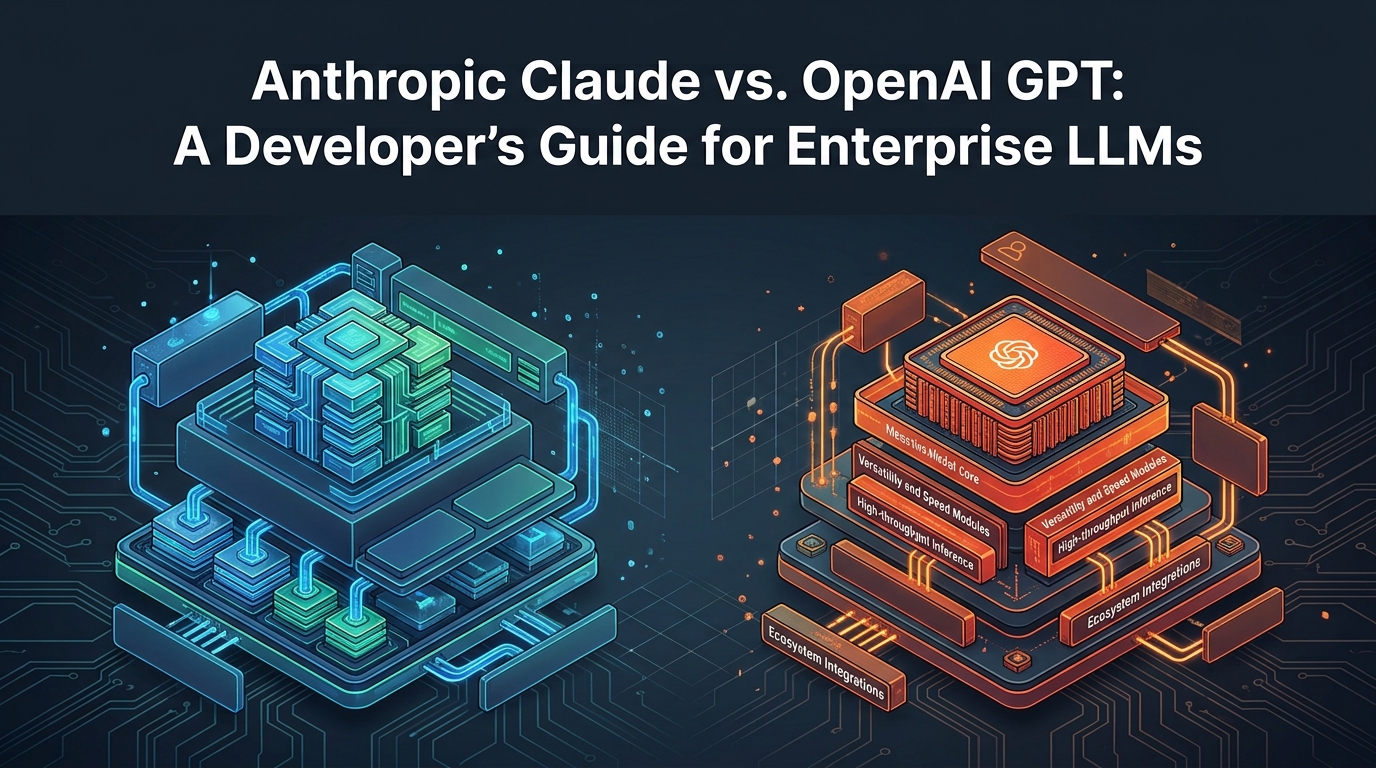
The proliferation of large language models (LLMs) has opened unprecedented opportunities for enterprise innovation, yet the sheer volume of choices can overwhelm even the most seasoned development teams. Navigating this dynamic landscape to select the right foundation model for your specific business needs is a critical challenge. At the forefront of this revolution are two powerful contenders: Anthropic Claude vs. OpenAI GPT. Both offer formidable capabilities, but their underlying philosophies, architectural designs, and deployment ecosystems present distinct advantages for different enterprise applications.
This guide provides a developer-focused decision framework, moving beyond generic benchmarks to help you evaluate Anthropic Claude and OpenAI GPT based on your specific enterprise requirements, project goals, and operational realities.
Mapping Capabilities to Enterprise Workloads: Claude's Edge vs. GPT's Versatility
Choosing an LLM isn't about finding a one-size-fits-all solution; it's about aligning a model's inherent strengths with your precise workload demands. Both Claude and GPT excel in different areas, offering developers unique toolsets.
Long-Context Document Analysis & Compliance-Sensitive Workflows
For enterprises dealing with vast amounts of text data—think legal contracts, financial reports, research papers, or healthcare records—the ability to process and reason over long contexts is paramount.
Anthropic Claude: Claude has historically distinguished itself with its exceptionally large context windows, often surpassing competitors. Models like Claude 3 Opus and Sonnet can handle context windows up to 200K tokens, which translates to hundreds of pages of text in a single prompt. This makes Claude particularly adept at:
Summarization and Extraction: Condensing lengthy legal documents, financial disclosures, or scientific papers while retaining critical details.
Question Answering (Q&A) over large corpuses: Quickly finding specific information or synthesizing answers from extensive internal knowledge bases.
Compliance-Sensitive Workflows: Claude's foundational "Constitutional AI" approach—a set of principles designed to make the model helpful, harmless, and honest—offers an additional layer of trustworthiness and auditability. This can be invaluable in highly regulated industries like healthcare, finance, and legal, where accuracy, safety, and explainability are non-negotiable. Developers can guide Claude's behavior using a constitutional set of rules, reducing the risk of undesirable outputs.
OpenAI GPT: While earlier GPT models had more constrained context windows, recent iterations like GPT-4 Turbo have significantly expanded their capabilities, offering 128K token contexts. This allows GPT to handle substantial documents as well, making it suitable for:
Complex Reasoning: GPT-4 excels at intricate reasoning tasks, which can be applied to analyzing legal arguments or financial scenarios within a given context.
Data Extraction and Transformation: Powerful for structured data extraction from semi-structured documents, often used in RPA (Robotic Process Automation) pipelines.
Developer's Take: If your primary enterprise need is deep analysis, synthesis, and strict adherence to safety principles over extremely large, sensitive documents, Claude's robust context handling and Constitutional AI principles offer a compelling advantage. For general long-document processing with a need for strong reasoning, GPT is also a strong contender, especially where multimodal input might also be beneficial.
Coding Assistants, Agentic Tools, & Developer Workflows
Both LLMs are powerful allies in the developer's toolkit, automating coding tasks, assisting with debugging, and powering autonomous agents.
Anthropic Claude: Claude has seen significant advancements in coding capabilities, particularly with the Claude 3 family.
Code Generation & Refactoring: Increasingly proficient at generating boilerplate code, scripting, and refactoring existing codebases across various languages.
Debugging Assistance: Can help identify errors, suggest fixes, and explain complex code segments.
Tool Use (Function Calling): Claude 3 introduced robust tool use capabilities, allowing developers to define functions and enable the model to decide when and how to call them. This is crucial for building autonomous agents that can interact with external APIs, databases, or internal systems.
# Example of a simple tool for Claude 3 (conceptual)
def get_weather(location: str):
    """Fetches the current weather for a specified location."""
    # ... API call to weather service ...
    return {"location": location, "temperature": "20C", "condition": "sunny"}

tools = [
    {
        "name": "get_weather",
        "description": "Get the current weather for a location.",
        "input_schema": {
            "type": "object",
            "properties": {
                "location": {"type": "string", "description": "The city name"}
            },
            "required": ["location"]
        }
    }
]
# In practice, you'd send this to Claude's tool_choice parameter
OpenAI GPT: GPT has a well-established reputation as a coding assistant, often cited for its strong performance in complex programming tasks.
Code Generation & Explanation: Highly capable of generating complex algorithms, writing unit tests, and providing detailed explanations of code.
Agentic Frameworks: GPT has been widely adopted in agentic frameworks like Auto-GPT and LangChain, thanks to its sophisticated reasoning and general problem-solving abilities.
Function Calling: OpenAI pioneered and refined the concept of function calling, making it incredibly intuitive and reliable for developers to integrate LLMs with external tools and APIs. This is a mature and highly optimized feature.
Developer's Take: For general coding assistance, both are excellent. For sophisticated agentic workflows that require reliable interaction with external tools, GPT's mature function calling framework often provides a slight edge in terms of developer experience and robustness, though Claude 3 is rapidly catching up. The choice may come down to which ecosystem (AWS Bedrock vs. Azure OpenAI) you are already deeply integrated with.
Multimodal & Creative Generation Applications
When your enterprise application demands more than just text—incorporating images, video, or audio—multimodal capabilities become a deciding factor.
OpenAI GPT: This is an area where OpenAI has traditionally held a strong lead.
Vision (GPT-4V): GPT-4V allows the model to accept images as input, enabling applications like image analysis, visual Q&A, content moderation for visual media, and describing complex diagrams or charts.
Image Generation (DALL-E): Integrated with GPT, DALL-E provides powerful image generation capabilities, crucial for creative content generation, marketing campaigns, or even generating synthetic data for other AI models.
Audio (Whisper & TTS): OpenAI also offers robust Speech-to-Text (Whisper) and Text-to-Speech (TTS) models, completing a comprehensive multimodal suite for voice AI applications.
Anthropic Claude: While Claude's primary focus has been on text, the Claude 3 family introduced significant vision capabilities.
Image Understanding: Claude 3 models can interpret images, making them suitable for tasks like analyzing graphs, processing scanned documents, or understanding visual context. While not as extensively documented or broadly applied as GPT-4V, it represents a strong entry into multimodal.
Text-centric Creation: Claude excels at creative text generation, including marketing copy, scripts, creative writing, and long-form content, leveraging its vast context window for consistency.
Developer's Take: If your application requires rich multimodal inputs (e.g., analyzing user-uploaded images, generating diverse creative assets, or comprehensive voice AI), OpenAI's ecosystem currently offers a more mature and integrated set of tools. Claude's vision capabilities are strong for analysis but its creative output remains primarily text-based.
General-Purpose Chatbots & Conversational AI
For building intelligent chatbots, customer service agents, or internal knowledge assistants, both LLMs provide robust foundations.
OpenAI GPT:
Broad Knowledge Base: GPT models are trained on an incredibly vast and diverse dataset, giving them a broad general knowledge base suitable for answering a wide range of queries.
Nuanced Conversations: GPT excels at maintaining coherent and contextually relevant conversations, handling nuances, and understanding user intent across various topics. This makes it excellent for general-purpose chatbots.
Customization: Fine-tuning options and prompt engineering techniques allow for extensive customization to align with specific brand voices or domain knowledge.
Anthropic Claude:
Safety and Harmlessness: Claude's Constitutional AI is a significant differentiator for conversational AI, particularly in sensitive domains. It's designed to be less likely to produce harmful, unethical, or biased responses, which is a major concern for public-facing chatbots.
Long-Term Memory in Conversations: Its large context window can allow for longer, more coherent conversations, retaining more turns of dialogue without losing context, which is beneficial for complex customer support or virtual assistant roles.
Natural Language Understanding: Strong ability to understand complex user queries and provide detailed, thoughtful responses.
Developer's Take: For a general-purpose chatbot requiring broad knowledge and robust conversational flow, GPT is a strong choice. If safety, compliance, and handling sensitive topics with a reduced risk of undesirable outputs are paramount, Claude's Constitutional AI and long context windows offer a distinct advantage for enterprise conversational AI.
Architectural Considerations: Deployment, Integrations, and Hybrid Strategies
Beyond model capabilities, the practical aspects of deploying, integrating, and managing LLMs within your existing enterprise architecture are crucial.
Deployment Ecosystems: AWS Bedrock vs. Azure OpenAI
The choice of LLM often goes hand-in-hand with your cloud strategy, as both Anthropic and OpenAI have deep integrations with major cloud providers.
Anthropic Claude on AWS Bedrock:
AWS Native Integration: If your enterprise is heavily invested in AWS, deploying Claude via Bedrock offers seamless integration with other AWS services (e.g., S3 for data storage, Lambda for serverless functions, SageMaker for MLOps).
Managed Service: Bedrock provides a fully managed service, abstracting away much of the infrastructure complexity. This includes built-in security features, networking controls, and monitoring tools that adhere to AWS best practices.
Foundation Models as a Service: Bedrock provides access to multiple foundation models, including Claude, within a unified API, offering flexibility and reducing vendor lock-in for your model layer.
OpenAI GPT on Azure OpenAI Service:
Azure Native Integration: For enterprises on Microsoft Azure, the Azure OpenAI Service offers unparalleled integration with Azure's comprehensive suite of services (e.g., Azure Cognitive Services, Azure Data Lake Storage, Azure Kubernetes Service).
Enterprise-Grade Security & Compliance: Azure OpenAI provides enterprise-level security, privacy, and compliance features, including virtual network integration, private endpoints, and data residency guarantees. All data processed through Azure OpenAI is isolated and not used for training OpenAI models.
Scalability & Reliability: Leveraging Azure's global infrastructure, the service offers robust scalability, high availability, and service level agreements (SLAs) essential for mission-critical enterprise applications.
Developer's Take: Your existing cloud infrastructure and expertise will heavily influence this decision. Migrating core LLM workloads to a new cloud provider can introduce significant overhead. Consider the depth of integration with your data sources, authentication systems, and existing MLOps pipelines.
Building Robust Tool Use and Agentic Workflows
Autonomous agents, which can reason, plan, and execute tasks by calling external tools or APIs, are a frontier for enterprise LLM applications. Both models support this crucial capability.
OpenAI's Function Calling: OpenAI's API for function calling is highly refined and widely adopted. Developers define tool schemas (JSON) that describe the functions available to the model. The model then intelligently determines when to call these functions, providing the necessary arguments. This allows for powerful integrations with internal systems, databases, and external services.
# OpenAI Function Calling example (conceptual)
{
  "name": "get_current_weather",
  "description": "Get the current weather in a given location",
  "parameters": {
    "type": "object",
    "properties": {
      "location": {
        "type": "string",
        "description": "The city and state, e.g. San Francisco, CA"
      },
      "unit": {"type": "string", "enum": ["celsius", "fahrenheit"]}
    },
    "required": ["location"]
  }
}
# Model returns: {"function_call": {"name": "get_current_weather", "arguments": "{\"location\": \"Boston, MA\"}"}}
Anthropic's Tool Use: Claude 3 introduced robust tool use capabilities, similar in concept to OpenAI's function calling. Developers define tools with JSON schemas, and Claude can decide which tools to use and with what parameters. Anthropic is actively developing and refining this feature, making Claude a strong contender for agentic workflows.
Developer's Take: Both models offer solid foundations for tool use. OpenAI's implementation is currently more mature and has a larger community around it, which can mean more examples, libraries, and best practices. However, Claude's tool use is rapidly evolving and is a powerful feature for building sophisticated agents, particularly when combined with its long-context window for complex planning.
The Case for Hybrid & Model Routing Architectures
In many advanced enterprise LLM applications, a single model may not be optimal for every sub-task. This is where hybrid and model routing architectures shine.
Strategic Combination: Enterprises can leverage the strengths of both Claude and GPT within a single application. For example:
Use Claude for initial document analysis and summarization (leveraging its long context and safety features).
Route the extracted, summarized data to GPT for creative content generation or complex reasoning tasks that might benefit from its multimodal capabilities.
Employ a smaller, faster model (e.g., a fine-tuned open-source model) for simple classification or intent detection tasks.
Model Routing: This involves developing an orchestration layer that intelligently routes user prompts or internal sub-tasks to the most appropriate LLM based on criteria like:
Task Type: Is it a creative writing task, a compliance check, or a code generation request?
Sensitivity: Does the input data require extra safety considerations?
Cost/Performance: Can a cheaper, faster model handle this task effectively?
Confidence Scores: Using confidence metrics from simpler models to determine if a more powerful, expensive model is needed.
Multi-Cloud Strategies & Vendor Lock-in Mitigation: By adopting a hybrid approach, enterprises can reduce reliance on a single vendor or cloud provider. Deploying Claude on AWS Bedrock and GPT on Azure OpenAI, for example, allows you to benefit from the strengths of both ecosystems while mitigating the risks associated with vendor lock-in. This strategy enhances resilience and provides flexibility to switch models or providers as the LLM landscape evolves.
Developer's Take: Designing for model agnosticism from the outset, perhaps through an abstraction layer, can future-proof your applications. While more complex to implement initially, a well-designed routing layer offers unparalleled flexibility, cost optimization, and resilience in the long run.
Operationalizing LLMs: Governance, Data Handling, and Security Controls
Deploying LLMs in an enterprise setting extends beyond raw performance; it demands rigorous governance, meticulous data handling, and robust security.
Data Privacy, Residency, & Enterprise Agreements
How your data is handled, where it resides, and the contractual agreements surrounding its use are non-negotiable for enterprise LLM adoption.
Anthropic: Anthropic emphasizes enterprise data privacy.
No Training on Customer Data (Opt-out): Anthropic generally does not use customer inputs or outputs to train its models unless explicitly opted-in by the customer. This is a critical point for privacy-sensitive industries.
Data Residency: Deployment via AWS Bedrock allows customers to leverage AWS's global network and region-specific deployments to meet data residency requirements.
Enterprise Agreements: Standard enterprise-grade service agreements are available, outlining data handling, confidentiality, and security provisions.
OpenAI: OpenAI, particularly through Azure OpenAI Service, provides robust data privacy and residency guarantees tailored for enterprises.
No Training on Customer Data (Default): With Azure OpenAI Service, customer data is never used to train OpenAI's models. This is a default and non-negotiable policy for the Azure offering.
Data Isolation & Residency: Azure OpenAI ensures that customer data remains within the customer's Azure tenant and regional boundaries, addressing strict data residency requirements like GDPR and HIPAA.
Comprehensive Agreements: Microsoft's enterprise agreements for Azure OpenAI include extensive clauses on data protection, security, and compliance, backed by Microsoft's long-standing commitment to enterprise trust.
Developer's Take: For highly regulated industries, Azure OpenAI provides explicit and robust data privacy, isolation, and residency guarantees as part of the broader Azure ecosystem. Anthropic also offers strong privacy postures, particularly through its managed Bedrock offering. Always review the specific terms of service and enterprise agreements.
Compliance, Auditing, & Responsible AI Principles
Ensuring LLM outputs are compliant with industry regulations and align with responsible AI principles is paramount.
Anthropic's Responsible AI Framework:
Constitutional AI: As mentioned, Claude is built with Constitutional AI, an approach that trains the model to be helpful and harmless by aligning it with a set of principles. This self-correction mechanism reduces the likelihood of generating problematic content and enhances auditability by providing a framework for its internal reasoning.
Safety Guardrails: Anthropic invests heavily in internal red-teaming and safety research to identify and mitigate biases, hallucinations, and other undesirable behaviors.
Transparency: Anthropic aims to provide transparency into its safety methods and model behaviors.
OpenAI's Responsible AI Framework:
Safety & Alignment Research: OpenAI has been a leader in responsible AI research, publishing extensively on model safety, alignment, and mitigating risks.
Content Filtering: Azure OpenAI includes content filtering capabilities that run both input prompts and output completions through moderation models to detect and block harmful content. This configurable layer adds an essential safety net for enterprise deployments.
Human-in-the-Loop: OpenAI often advocates for human oversight and review in sensitive applications to catch errors or biases that automated systems might miss.
Compliance Certifications: Azure OpenAI benefits from Azure's extensive list of compliance certifications, including HIPAA, GDPR, ISO 27001, and more, which are critical for regulated sectors.
Developer's Take: Both companies prioritize responsible AI, but their approaches differ. Claude's Constitutional AI offers a unique, intrinsic safety mechanism. Azure OpenAI provides a strong combination of OpenAI's research with Azure's enterprise-grade compliance and configurable content filtering. For highly regulated industries, the specific compliance certifications of the underlying cloud platform (Azure) can be a decisive factor.
Monitoring, Observability, & Lifecycle Management
Operationalizing LLMs requires continuous monitoring, clear observability into their performance, and a robust lifecycle management strategy.
Monitoring LLM Performance:
Key Metrics: Track metrics like token usage, latency, error rates, and quality of responses (e.g., relevance, coherence, hallucination rate).
Human Feedback: Implement mechanisms for human feedback loops to continuously improve model performance and fine-tuning.
Logging: Comprehensive logging of prompts, completions, and intermediate steps is crucial for debugging and auditing.
Observability:
Cloud-Native Tools: Leverage the monitoring and logging tools provided by AWS (CloudWatch, S3 logs) for Claude on Bedrock and Azure (Azure Monitor, Application Insights) for GPT on Azure OpenAI.
Custom Dashboards: Build custom dashboards to visualize key performance indicators (KPIs) and alert on anomalies.
Tracing: Implement tracing for complex agentic workflows to understand the flow of information and tool calls.
Lifecycle Management:
Version Control: Treat prompts, fine-tuned models, and application code with version control.
Experimentation Platforms: Use platforms (e.g., MLflow, Weights & Biases) to track experiments and compare different model versions or prompt engineering strategies.
A/B Testing: Implement A/B testing frameworks to evaluate new models or prompt changes in production before a full rollout.
Security Controls: Enforce API key management, role-based access control (RBAC), and network isolation. Ensure data in transit and at rest is encrypted.
Developer's Take: Both Bedrock and Azure OpenAI integrate well with their respective cloud provider's observability stacks. The choice often comes down to your team's familiarity and existing investment in one cloud's operational tools over the other. Regardless of the choice, a proactive approach to monitoring and lifecycle management is essential for reliable enterprise LLM applications.
Performance, Cost, and Scalability Trade-offs
Real-world performance, cost-effectiveness, and the ability to scale are practical considerations that significantly impact the total cost of ownership (TCO) for enterprise LLMs.
Cost-Effectiveness Across Different Context Windows
LLM pricing is typically token-based, with different rates for input (prompt) and output (completion) tokens. Larger context windows generally mean higher costs per token.
Anthropic Claude:
Pricing Structure: Anthropic models (Opus, Sonnet, Haiku) have varying price points, with Opus being the most capable and expensive, and Haiku being the fastest and most cost-effective.
Context Window Impact: Claude's large context windows (up to 200K tokens) are powerful but can lead to higher token usage and thus higher costs if not managed carefully. The pricing for these larger contexts reflects the increased computational resources required.
Cost Optimization: For tasks that don't require the full 200K context, using a smaller model like Claude 3 Haiku or Sonnet can significantly reduce costs.
OpenAI GPT:
Pricing Structure: OpenAI also uses a tiered pricing model, with GPT-4 Turbo being more expensive than GPT-3.5 Turbo.
Context Window Impact: GPT-4 Turbo's 128K context window is substantial, and its pricing model is similar: more tokens mean higher costs.
Cost Optimization: For simpler tasks, GPT-3.5 Turbo remains a highly cost-effective option. OpenAI's approach to fine-tuning for GPT-3.5 can also offer cost savings for specific, repetitive tasks by reducing prompt lengths.
Developer's Take: Analyze your typical workload's input and output token counts. For tasks requiring extremely long contexts or complex reasoning, Claude Opus or GPT-4 Turbo are indispensable, but developers must optimize prompt engineering to minimize unnecessary token usage. For simpler, higher-volume tasks, a smaller, faster model from either provider can offer significant cost savings. Consider a hybrid strategy for cost optimization.
Latency, Throughput, and Rate Limits
The speed at which an LLM responds (latency) and the volume of requests it can handle per unit time (throughput) are crucial for user experience and application scalability.
Latency:
Interactive Applications: For real-time applications like chatbots or virtual assistants, low latency is critical to provide a smooth, responsive user experience.
Model Size & Complexity: Larger, more capable models (e.g., Claude Opus, GPT-4 Turbo) generally have higher latency compared to their smaller, faster counterparts (e.g., Claude Haiku, GPT-3.5 Turbo).
Network Proximity: Deploying your application in the same geographical region as the LLM endpoint significantly reduces network latency.
Throughput:
Batch Processing: For tasks like document processing or content generation that can be done offline or in batches, high throughput is more important than ultra-low latency.
Concurrency: Both AWS Bedrock and Azure OpenAI offer scaling capabilities to handle high concurrent requests, though specific rate limits and quotas apply and can be increased upon request.
Rate Limits:
API Quotas: Both providers impose rate limits (requests per minute, tokens per minute) to ensure fair usage and service stability. These limits vary by model and can typically be increased for enterprise customers.
Impact on Design: Developers must design their applications to handle rate limits gracefully, using strategies like exponential backoff and request queuing to prevent service disruptions.
Developer's Take: Benchmarking is essential. Prototype with both models and measure actual latency and throughput for your specific use cases. Consider different models for different parts of your application: a fast model for real-time user interaction, and a more powerful (potentially slower) model for background processing.
API Stability & Regional Availability
Enterprise-grade deployments demand high API stability, reliable service level agreements (SLAs), and global regional availability.
API Stability:
Robustness: Both Anthropic (via AWS Bedrock) and OpenAI (via Azure OpenAI) aim for high API stability, with versioned APIs and clear deprecation policies.
SLAs: AWS and Microsoft provide enterprise-grade SLAs for their managed services, offering guarantees on uptime and performance, which is critical for mission-critical applications.
Regional Availability:
Global Footprint: Both AWS and Azure have extensive global data center networks. Deploying models in regions geographically close to your users minimizes latency and helps meet data residency requirements.
Specific Model Availability: While the underlying cloud infrastructure is global, specific LLM models might not be immediately available in all regions. Always check the current regional availability for the exact model you plan to use.
Developer's Take: For enterprise applications, rely on the robust infrastructure and SLAs provided by AWS Bedrock and Azure OpenAI. Carefully plan your deployment regions to optimize for latency and meet regulatory requirements. Stay informed about new model releases and regional availability.
Developing Your LLM Selection Framework
Choosing between Anthropic Claude and OpenAI GPT is a strategic decision that shapes the future of your enterprise applications. Instead of chasing the latest benchmark, build a structured framework.
Start with the Use Case, Not the Brand
The most common pitfall is to select an LLM based on hype or brand loyalty. Instead, meticulously define your use case:
Identify the Core Problem: What specific business problem are you trying to solve with an LLM? (e.g., automate customer support, analyze legal documents, generate marketing copy, assist developers).
Define Inputs and Outputs: What kind of data will the LLM receive? What format should its output take? Are multimodal inputs/outputs required?
Specify Performance Requirements: What are the acceptable latency, throughput, and accuracy requirements?
Outline Constraints: What are the budgetary limitations? What are the regulatory and compliance requirements (data residency, privacy, safety)?
Metrics of Success (KPIs): Crucially, define clear, measurable KPIs before selection. How will you measure the success of the LLM integration? (e.g., X% reduction in customer service resolution time, Y% improvement in document analysis speed, Z% increase in content generation efficiency).
Evaluate Ecosystem Synergy & Integration Overhead
Consider how the chosen LLM will integrate with your existing technology stack:
Cloud Provider Alignment: Are you primarily an AWS shop or an Azure shop? Leveraging existing cloud investments reduces integration complexity and overhead.
Developer Experience: How easy is it for your team to work with the API, SDKs, and tooling provided by each platform?
Data & MLOps Integration: How well does the LLM platform integrate with your data storage solutions, MLOps pipelines, and monitoring tools?
Tooling & Agentic Needs: If building agents, evaluate the maturity and ease of use of their respective function calling/tool use capabilities.
Prioritize Governance and Operational Maturity
Ignoring governance and operational aspects can lead to significant challenges down the line:
Data Security & Privacy: Which model and platform provide the strongest guarantees around data isolation, non-training on customer data, and data residency?
Compliance Frameworks: Does the platform offer the necessary certifications and features (e.g., content filtering, audit logs) to meet your industry's regulatory requirements?
Responsible AI: Which model's safety philosophy and built-in guardrails (e.g., Constitutional AI, moderation APIs) best align with your enterprise's ethical guidelines and risk tolerance?
Monitoring & Observability: How robust are the platform's tools for tracking performance, cost, and identifying issues in production?
Vendor Relationship & Support: Evaluate the quality of enterprise support, documentation, and the long-term roadmap of each provider.
Given the rapid evolution of LLMs, the "best" model is a moving target. Start with a phased approach: prototype with both models where feasible, run small-scale pilots, and then optimize based on empirical results against your defined KPIs. Build adaptable architectures that allow you to swap models or employ routing strategies as your needs evolve and new models emerge.
Given the rapid evolution of LLMs, what specific enterprise workload or integration challenge have you found to be the most decisive factor when choosing between Anthropic Claude and OpenAI GPT in your development projects?
💬 Join the conversation — share your take in the comments and tell us what you’d add.