AI Consulting: Engineering Successful Engagements from Vision to Deployment
AI Consulting strategies for engagement success—from vision to deployment—so you can scope, deliver, and scale with confidence. Learn more.
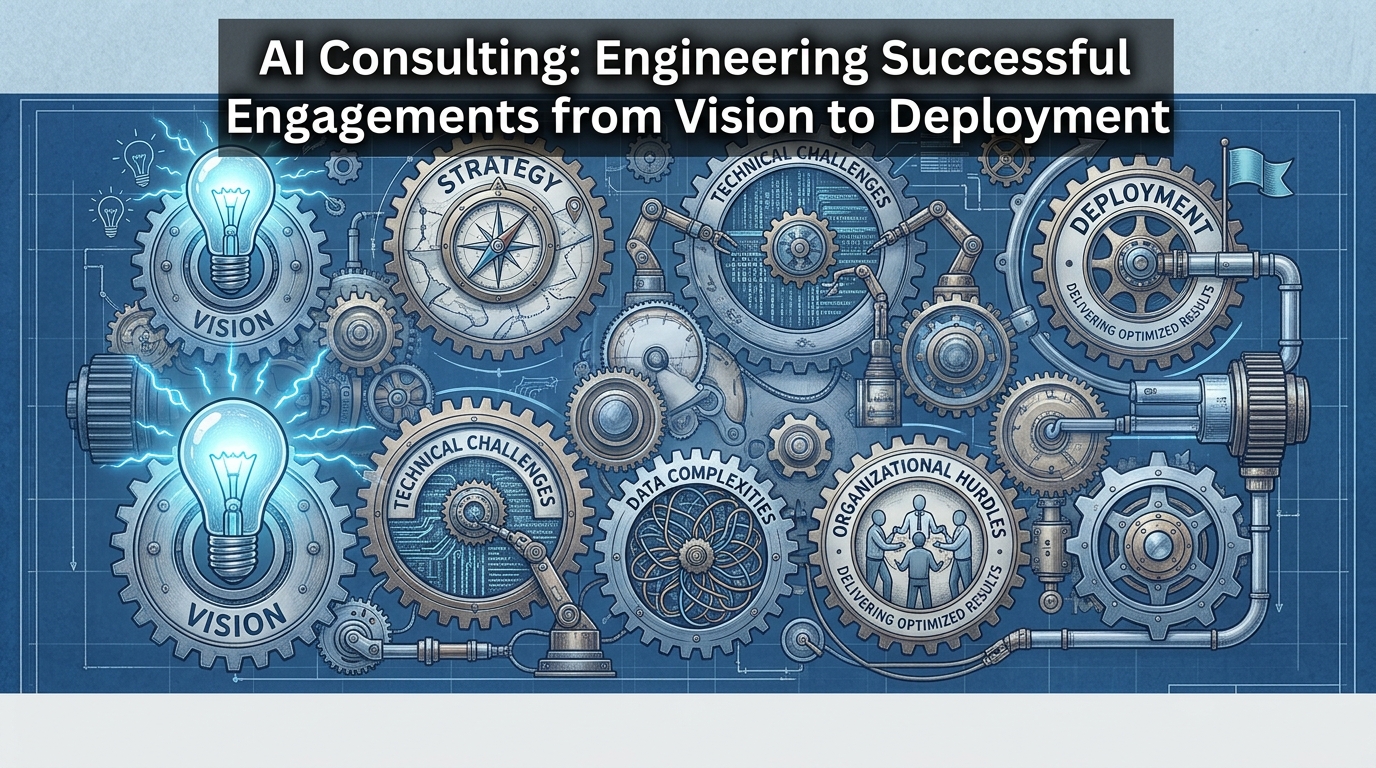
The promise of Artificial Intelligence often glitters with visions of transformative efficiency and unprecedented insight. Yet, the journey from these inspiring visions to tangible, business-driving reality is frequently complex, fraught with technical challenges, data complexities, and organizational hurdles. This is where expert AI consulting becomes not just beneficial, but essential – a strategic partnership designed to engineer successful engagements that navigate these complexities from initial concept to robust, sustainable deployment.
This guide will equip you with a comprehensive understanding of what defines a truly successful AI consulting engagement, how to select the right partner, the critical phases of a project lifecycle, and the crucial elements for ensuring long-term value and internal ownership.
What Defines a Successful AI Consulting Engagement?
A successful AI consulting engagement transcends mere technological implementation; it's a strategic partnership focused squarely on solving core business problems and delivering measurable value through intelligent automation and insight.
Demystifying AI Consulting: Beyond the Buzzwords
At its heart, AI consulting is about problem-solving with AI. It's not simply about deploying algorithms or purchasing software; it's about understanding an organization's strategic objectives and identifying where AI can genuinely move the needle. Unlike general IT consulting, which often focuses on established systems and processes, AI consulting grapples with unique challenges:
Data Scarcity or Quality: AI models are only as good as the data they're trained on. Consultants must assess, prepare, and govern data rigorously.
Model Explainability and Bias: Understanding why a model makes a certain prediction and ensuring fairness is paramount, especially in regulated industries.
Rapidly Evolving Technology: The AI landscape changes daily, requiring consultants to be at the forefront of new techniques and tools.
Organizational Adoption: Gaining user trust and integrating AI into existing workflows often requires significant change management.
Therefore, AI consulting requires a blend of deep technical expertise in machine learning, data science, and MLOps, coupled with robust business acumen and strong change management capabilities.
The Business-First Imperative: Why Technology Alone Isn't Enough
The gravest error in many AI initiatives is a "tech for tech's sake" approach. Companies, mesmerized by the latest AI advancements, often jump into projects without a clear problem statement or a defined path to ROI. A successful AI consulting engagement begins not with a technology pitch, but with a deep dive into core business challenges:
"What operational bottleneck are we trying to remove?"
"What customer experience are we trying to enhance?"
"What new revenue stream can AI unlock?"
"What costs can AI significantly reduce?"
Without this business-first imperative, projects risk becoming expensive proofs-of-concept that fail to scale or integrate, gathering dust instead of delivering value. Consultants must relentlessly connect AI solutions back to clear, measurable business outcomes and demonstrate a path to quantifiable ROI, rather than just showcasing impressive technical feats.
Choosing Your AI Consulting Partner: Beyond the Pitch Deck
Selecting the right AI consulting firm is a critical decision that can make or break your AI journey. It requires due diligence beyond flashy presentations.
Evaluating Experience and Proven Production Track Records
Look for concrete evidence of success, not just promising rhetoric. Key criteria include:
Industry Vertical Expertise: Has the firm successfully implemented AI solutions in your industry? They should understand your sector's specific data, regulatory environment, and competitive landscape.
Specific AI Domain Knowledge: Do they specialize in the type of AI you need (e.g., natural language processing, computer vision, predictive analytics, generative AI)?
Track Record of Production Deployments: This is crucial. Many firms can deliver impressive pilots or proofs-of-concept (PoCs). Far fewer have a consistent record of taking those pilots to full-scale, robust production environments that deliver sustained value. Ask for case studies that detail the entire journey from vision to production. Differentiate between firms that just offer "pilots" versus those capable of full-lifecycle engineering, including MLOps and ongoing maintenance.
Understanding Their Delivery Framework: From Discovery to Deployment
A robust delivery framework indicates a mature and reliable partner. Ask specific questions about their approach to:
Discovery & Problem Definition: How do they ensure they deeply understand your business challenges before proposing solutions? What artifacts (e.g., business requirements document, use case canvas) do they produce?
Data Readiness & Governance: What is their process for assessing your data landscape, preparing data for AI, and establishing data governance protocols to ensure quality and compliance?
Solution Design & Architecture: How do they design scalable, secure, and maintainable AI architectures that integrate with your existing systems?
Change Management & User Adoption: What strategies do they employ to manage organizational change, train users, and foster internal buy-in?
Security & Compliance: How do they embed security-by-design principles and address relevant compliance requirements (e.g., GDPR, HIPAA, CCPA) throughout the project?
A transparent, phase-driven approach with clear deliverables and decision gates at each stage is a strong indicator of a well-structured engagement.
Assessing Post-Engagement Support and Knowledge Transfer
The goal of an AI consulting engagement should be to empower your organization, not create dependency. Evaluate their strategies for:
Internal Ownership: How do they plan to transition ownership of the AI solution and its ongoing operations to your internal teams?
Sustainable Knowledge Transfer: What specific programs, documentation, and mentorship do they offer to upskill your employees and ensure they can maintain, iterate, and even build upon the deployed AI solution? This might include structured training sessions, pairing client employees with consultants, and providing comprehensive technical documentation and runbooks.
A partner committed to your long-term autonomy will prioritize knowledge transfer from day one.
The Lifecycle of an AI Consulting Project: From Vision to Value
A structured, phased approach is key to de-risking AI initiatives and ensuring value delivery. While specifics may vary, a typical AI consulting project follows these critical stages:
Phase 1: Business-First Discovery & Strategic Alignment
This foundational phase is arguably the most important. It's about ensuring the right problem is being solved.
Activities:
Problem Definition: Articulating the core business challenge in clear, measurable terms. What pain points are you addressing?
Use Case Prioritization: Identifying potential AI use cases and prioritizing them based on business impact, technical feasibility, and data availability.
Initial ROI Projection: Developing a preliminary business case, outlining anticipated benefits (e.g., cost savings, revenue uplift, efficiency gains) and success metrics.
Stakeholder Workshops: Engaging key business leaders, end-users, and technical teams to gather requirements and build consensus.
Key Artifacts: Problem Statement Document, Use Case Prioritization Matrix, Initial Business Case with ROI estimates, Stakeholder Map.
Decision Gate: Go/No-Go on selected use cases, agreement on project scope and success metrics.
Phase 2: Data Readiness, Architecture & Solution Design
With a clear business problem identified, the focus shifts to the technical foundation.
Activities:
Thorough Data Assessment: Auditing existing data sources for relevance, quality, volume, velocity, and variety. Identifying data gaps.
Data Preparation Strategies: Developing plans for data collection, cleansing, transformation (ETL/ELT), and feature engineering.
Foundational Data Governance: Establishing policies and processes for data quality, security, privacy, and access control.
Solution Architecture Design: Proposing the overall technical architecture, including data pipelines, model training/inference infrastructure, integration points, and security considerations. This might involve cloud platforms (AWS, Azure, GCP) or on-premise solutions.
Technology Stack Selection: Choosing appropriate AI/ML frameworks, tools, and services.
Key Artifacts: Data Readiness Report, Data Governance Plan, Solution Architecture Diagram, Technology Stack Recommendation.
Decision Gate: Approval of data strategy, architectural blueprint, and technology stack.
Phase 3: Phased Pilot & Iterative Development
This phase brings the solution to life in a controlled environment.
Activities:
Model Development & Training: Building and training initial AI models using prepared data.
Minimum Viable Product (MVP) Development: Implementing a core set of features that demonstrate the solution's value.
Technical Feasibility Validation: Proving that the AI model can achieve desired performance metrics (e.g., accuracy, precision, recall) on real-world data.
Demonstrating Business Impact: Showing the initial value proposition in a tangible way to stakeholders.
Gathering User Feedback: Deploying the pilot to a small group of users to collect feedback and identify areas for improvement.
Iterative Refinement: Using feedback and performance data to refine models and features in an agile manner.
Key Artifacts: Trained AI Model, Pilot Application/Interface, Performance Metrics Report, User Feedback Summary, Iteration Backlog.
Decision Gate: Validation of technical feasibility, positive business impact in pilot, readiness for broader rollout.
Phase 4: Production Deployment & Scaled Operations
This is where the AI solution moves from experimentation to full operational status, delivering sustained value.
Activities:
Robust Architecture Implementation: Finalizing and hardening the production architecture, including scalability, reliability, and fault tolerance.
MLOps Integration: Setting up continuous integration/continuous deployment (CI/CD) pipelines for models, automated testing, and model versioning.
Deployment Strategy: Implementing the chosen deployment method (e.g., cloud, edge, on-premise).
Monitoring & Alerting: Establishing comprehensive monitoring for model performance drift, data quality, system health, and business KPIs.
Security & Compliance Hardening: Finalizing security controls, access management, and ensuring compliance with all relevant regulations.
User Training & Rollout: Training broader user groups and rolling out the solution across the organization.
Key Artifacts: Production Deployment Plan, MLOps Pipelines, Monitoring Dashboards, User Training Materials, Post-Deployment Review.
Decision Gate: Successful production deployment, stable operations, and initial realization of defined business value.
Ensuring Production Readiness: Beyond the Proof of Concept
Many AI projects stumble at the leap from a successful pilot to a production-grade system. True success means building a solution that is robust, secure, compliant, and adopted by users.
Building MLOps and Data Governance Foundations
A production-grade AI system is a living entity that requires continuous care. This is where MLOps (Machine Learning Operations) becomes indispensable. Essential components include:
Reliable Data Pipelines: Automated, resilient pipelines for continuous data ingestion, transformation, and delivery to models. Tools like Apache Airflow or Prefect can orchestrate these.
Model Monitoring: Continuously tracking model performance, data drift, concept drift, and system health. Solutions like Arize AI, Evidently AI, or custom dashboards can provide vital insights.
Version Control for Models and Data: Just like code, models, data versions, and training configurations must be tracked and managed (e.g., using Git LFS, DVC, or MLflow).
Continuous Integration/Deployment (CI/CD) for AI: Automating the testing, building, and deployment of new model versions or updates to the AI application, ensuring rapid and reliable iteration. This involves integrating with tools like Jenkins, GitLab CI, or GitHub Actions.
Automated Retraining and Calibration: Setting up systems to automatically retrain models with new data or recalibrate them to maintain optimal performance over time.
Alongside MLOps, robust data governance ensures data quality, accessibility, and ethical use throughout the model's lifecycle.
Integrating Security, Compliance, and Ethical AI
These aspects are not afterthoughts; they must be integrated from the earliest design phases.
Security-by-Design: Building security into the AI system from the ground up, including secure coding practices, access control, data encryption (at rest and in transit), and vulnerability management.
Compliance Requirements: Adhering to relevant regulatory standards (e.g., GDPR for data privacy, HIPAA for healthcare data, industry-specific regulations). This includes data anonymization, audit trails, and data retention policies.
Ethical AI Considerations: Proactively addressing potential biases in data or models, ensuring fairness, transparency, and explainability. This might involve techniques for bias detection and mitigation, or using explainable AI (XAI) tools to understand model decisions.
Driving Change Management and User Adoption
Even the most technically brilliant AI solution will fail if users don't adopt it.
Effective User Training: Providing comprehensive, hands-on training tailored to different user groups, highlighting how the AI solution will benefit them directly.
Stakeholder Communication: Maintaining transparent and consistent communication with all stakeholders, from executives to front-line staff, about project progress, benefits, and impacts.
Organizational Change Management: Developing strategies to address resistance to change, fostering a culture of innovation, and aligning incentives for adoption.
Internal Ownership: Clearly defining roles and responsibilities within your organization for the ongoing support, maintenance, and future enhancement of the AI system. This creates a sense of accountability and ensures long-term viability.
Measuring Success: Quantifying AI Consulting ROI
The ultimate measure of a successful AI consulting engagement is the quantifiable return on investment it delivers. This isn't just a post-project exercise; it starts on day one.
Defining Measurable Metrics from Day One
During the initial discovery phase, clear, measurable Key Performance Indicators (KPIs) and success criteria must be established. These should directly link the AI's technical performance to business outcomes.
Technical Metrics: Model accuracy, precision, recall, F1-score, latency, throughput.
Business Metrics:
Efficiency: Time saved per process, reduced manual effort, faster decision-making cycle.
Cost Reduction: Decreased operational costs, reduced waste, lower error rates.
Revenue Generation: Increased sales, new product/service offerings, improved customer retention.
Customer Experience: Faster response times, personalized interactions, higher satisfaction scores.
Attributing Value: Time Saved, Revenue Generated, Margin Improved
Connecting AI outcomes to tangible business metrics requires careful planning:
Baseline Measurement: Establish current performance metrics before AI implementation.
Incremental Impact: Design the AI solution to allow for measuring its specific contribution to changes in KPIs. This might involve A/B testing or controlled experiments.
Cost Avoidance: Quantify costs that are prevented (e.g., fewer equipment failures due to predictive maintenance, reduced customer churn due to personalized offers).
Real-World ROI: A Sample Calculation
Let's consider an AI solution for predictive equipment maintenance:
Business Problem: Unplanned equipment downtime costs the company significant revenue and maintenance expenses.
AI Solution: An AI model predicts equipment failure with 85% accuracy 48 hours in advance, allowing for proactive maintenance.
Baseline:
Average unplanned downtime events per month: 10
Average cost per unplanned downtime event (lost production + emergency repair): $5,000
Total monthly cost from unplanned downtime: 10 events * $5,000/event = $50,000
AI Impact (Conservative Estimate):
AI reduces unplanned downtime events by 50% (5 events avoided per month).
Cost savings per month: 5 events * $5,000/event = $25,000
AI Project Costs:
Consulting fees, software licenses, infrastructure: $150,000 (one-time) + $2,000/month (ongoing)
ROI Calculation:
Annual cost savings: $25,000/month * 12 months = $300,000
Annual ongoing costs: $2,000/month * 12 months = $24,000
Net annual benefit (after ongoing costs): $300,000 - $24,000 = $276,000
Payback Period: $150,000 (initial costs) / ($25,000 - $2,000) (net monthly savings) ≈ 6.5 months
Annual ROI after payback: ($276,000 / $150,000) * 100% = 184% (after the first year, considering initial investment is recouped)
This example illustrates how clear metrics and a structured approach allow for direct attribution of value and a compelling case for your AI investment. Ongoing monitoring against these metrics is crucial to ensure sustained performance.
Mitigating Failure: Common Pitfalls and Practical Solutions
The path to AI success is often littered with failed projects. Recognizing common pitfalls and implementing preventative measures is essential.
The Allure of Technology Over Business Problem
Pitfall: Focusing on implementing "cool" AI technology (e.g., the latest large language model) without clearly defining the specific business problem it needs to solve. This leads to solutions looking for problems.
Solution: Insist on a rigorous "Phase 1: Discovery & Strategic Alignment." Every AI initiative must start with a well-defined business problem, a clear use case, and a quantifiable ROI hypothesis. Continuously ask, "What business value are we creating here?"
Underestimating Data Readiness and Quality
Pitfall: Assuming existing enterprise data is "AI-ready." Issues like poor data quality (inaccuracies, inconsistencies), insufficient data volume, limited data access, or a lack of robust data governance are common project killers.
Solution: Conduct a comprehensive data audit early in the project. Allocate significant time and resources to data cleansing, preparation, and feature engineering. Establish strong data governance frameworks and pipelines to ensure continuous data quality. This isn't a one-time fix but an ongoing commitment.
Ignoring Internal Adoption and Change Management
Pitfall: Developing a technically sound AI solution that users resist, don't understand, or simply refuse to integrate into their workflows. Lack of stakeholder buy-in or insufficient training leads to underutilization.
Solution: Engage stakeholders early and continuously. Involve end-users in the design and testing phases. Provide extensive training and clear communication about how the AI solution will benefit them, address their concerns, and enhance their roles. Design user-friendly interfaces and integrate the AI seamlessly into existing tools. Appoint internal champions to advocate for the new system.
The 'Set It and Forget It' Fallacy
Pitfall: Treating AI deployment as a final destination rather than the beginning of a new operational phase. Neglecting ongoing model maintenance, performance monitoring, and continuous improvement. AI models can "drift" over time as real-world data patterns change.
Solution: Embrace MLOps from the outset. Implement robust monitoring, alerting, and automated retraining mechanisms. Plan for ongoing model governance, version control, and regular audits. Establish clear internal ownership for the AI system's lifecycle and allocate resources for its sustained operation and evolution.
Building Internal AI Fluency and Sustainable Ownership
The ultimate goal of any successful AI consulting engagement is to leave your organization more capable and self-sufficient in its AI journey. This requires intentional strategies for knowledge transfer and operational readiness.
Designing Your Internal AI Operating Model
As AI solutions become integral to your business, you'll need an internal structure to support them. Considerations for your AI operating model include:
Cross-Functional Teams: Establish teams comprising MLOps engineers (for deployment and infrastructure), data scientists (for model development and iteration), data engineers (for data pipelines), and crucially, business product owners (to guide AI strategy and ensure business alignment).
Centralized vs. Decentralized: Decide if AI capabilities will be centralized within a "Center of Excellence" or distributed across business units. A hybrid model often works best, with a central core for governance and shared services, and embedded teams for specific applications.
Governance & Ethics Boards: Implement clear structures for reviewing AI projects, ensuring ethical guidelines are met, and managing risk.
Effective Knowledge Transfer and Upskilling Programs
A consulting engagement should be a learning experience for your team.
Consultant-Led Upskilling: Consultants should not just deliver a solution but actively mentor and train your internal staff. This can involve pairing your employees with consultants, running workshops, and providing hands-on coaching.
Comprehensive Documentation: Ensure that all aspects of the AI solution—from data pipelines and model architecture to deployment scripts and monitoring dashboards—are thoroughly documented. This includes runbooks for troubleshooting and guides for future iteration.
Structured Training Programs: Develop and deliver customized training programs for different internal roles, covering topics like AI fundamentals, data science tools, MLOps best practices, and ethical AI principles.
Code Review and Collaboration: Encourage joint code reviews and collaborative development efforts to foster a deeper understanding of the codebase and methodologies.
Ensuring Post-Engagement Maintainability
Before consultants depart, a clear handover plan must be executed.
Detailed Documentation: Beyond technical specs, this includes business context, decision logs, and a clear roadmap for future enhancements.
Runbooks and Incident Response Plans: Comprehensive guides for diagnosing and resolving common issues, ensuring your team can react swiftly to any operational hiccups.
Robust Monitoring Tools: Hand over access and training for all monitoring dashboards and alerting systems, enabling your team to proactively manage solution health.
Clear Ownership Structures: Define who within your organization is responsible for the ongoing maintenance, performance, and evolution of each component of the AI system.
Embedding AI-Driven Thinking: Work to integrate AI-driven decision-making and processes into your organizational culture. This involves encouraging data literacy, critical thinking about AI capabilities, and a continuous learning mindset.
Engineering a successful AI consulting engagement is a journey that demands strategic planning, deep technical expertise, and a relentless focus on business value. By prioritizing a business-first approach, choosing the right partner, adhering to a structured lifecycle, and committing to internal ownership, organizations can unlock the transformative power of AI and build sustainable competitive advantage.
What's one lesson you learned from an AI consulting engagement – positive or challenging – that you wish you knew before starting?
💬 Join the conversation — share your take in the comments and tell us what you’d add.