Advancements in Edge AI: Transforming Real-Time Processing for Mobile Applications
Discover how Edge AI revolutionizes mobile apps with real-time processing benefits. Stay ahead with innovative technology today!
Advancements in Edge AI: Transforming Real-Time Processing for Mobile Applications
Imagine a world where your mobile device can analyze data and make decisions in real-time without relying on distant cloud servers. Edge AI is making this a reality, reshaping the way our mobile applications perform. This blog explores how Edge AI enhances processing capabilities, ensuring that mobile apps deliver improved speed, security, and user experiences.
Understanding Edge AI and Its Mechanics
What is Edge AI?
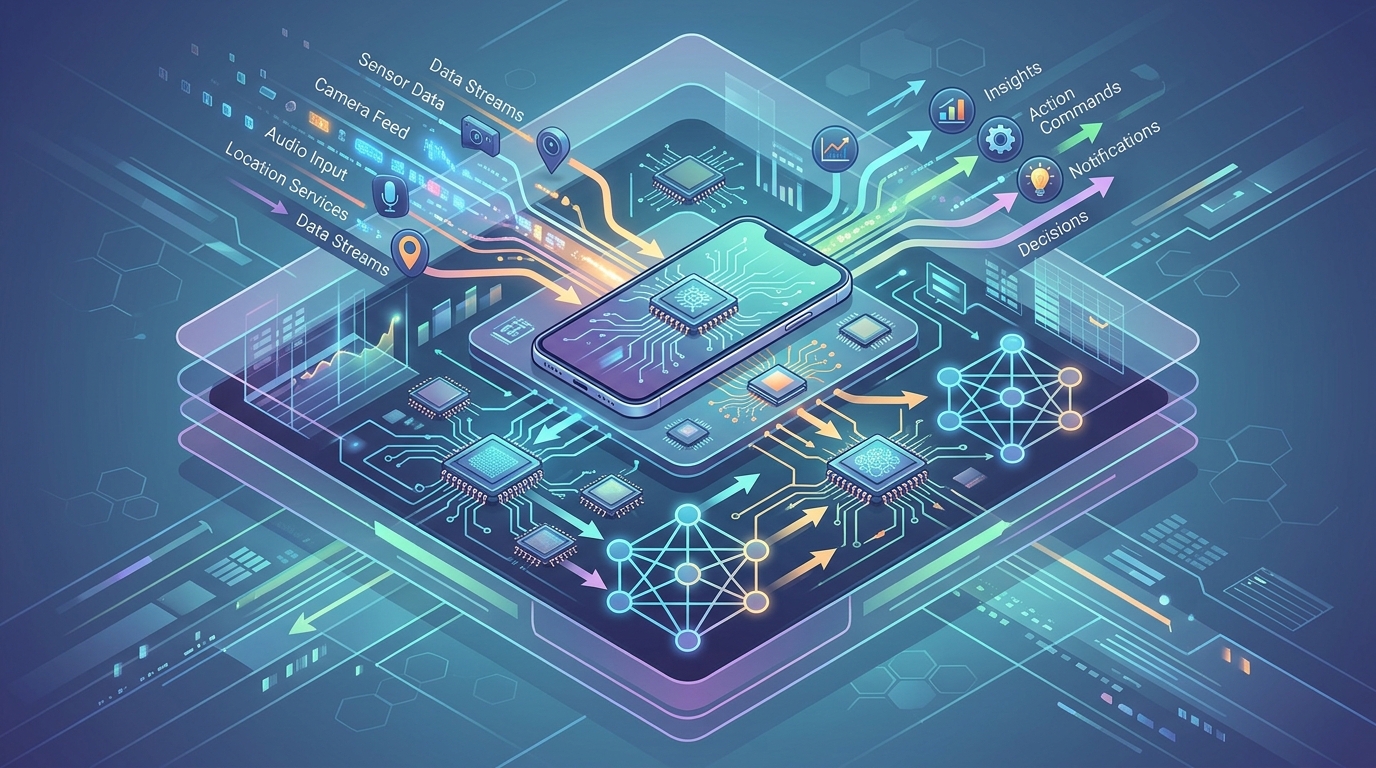
Edge AI refers to the deployment of artificial intelligence algorithms directly on the edge devices, such as smartphones and tablets, rather than relying on centralized cloud systems. This localized processing allows for faster decision-making, significantly reducing the latency often experienced when data has to travel to and from the cloud.
In contrast to traditional AI, which processes data in remote data centers, Edge AI ensures that data stays close to its source. By minimizing the distance data must travel, it empowers applications to operate more fluidly and responsively.
How Does Edge AI Work?
The mechanics of Edge AI are rooted in robust algorithms enhanced by powerful hardware capabilities. Devices equipped with AI chips—like GPUs or specialized processors—handle tasks like image recognition or natural language processing locally. By performing computations on-device, Edge AI reduces latency and bandwidth use.
This local processing is crucial in scenarios requiring real-time data processing—such as augmented reality games or health monitoring applications—where even slight delays can impact functionality. For instance, real-time facial recognition or gesture control in mobile applications can only reach their full potential when powered by Edge AI.
Benefits of Edge AI in Mobile Applications
Enhanced Performance and Speed
One of the most significant advantages of Edge AI is the dramatic improvement in response times. Applications that leverage Edge AI can provide instantaneous feedback, enhancing user experience. For example, in gaming, Edge AI can facilitate real-time interactions, making complex environments feel more immersive.
Consider a scenario where a mobile app uses Edge AI for image processing. By analyzing images directly on the device, it can deliver quick enhancements or filters, allowing users to see results almost instantaneously instead of waiting for uploads and downloads.
Data Privacy and Security
Edge AI fundamentally enhances data privacy by processing sensitive information locally. Rather than transmitting potentially sensitive data over the internet, Edge AI ensures that data stays on the user’s device. This is particularly beneficial in sectors like healthcare, where patient information must be safeguarded.
Real-world applications that exemplify this include health-tracking apps that monitor vital signs and provide insights directly on the device. Since none of this sensitive data leaves the phone, it dramatically enhances user trust in the application.
Integration of Edge AI with 5G Networks
Improving Connectivity
The rollout of 5G technology offers tremendous opportunities for Edge AI, as it provides the ultra-low latency and high-speed connectivity necessary to support more advanced applications. With 5G, devices can transmit data back to the edge even faster, unlocking more complex AI functions while still maintaining speed.
This synergy between Edge AI and 5G networks is a game-changer. For instance, self-driving cars can leverage 5G connectivity to communicate with other vehicles and systems in real-time, enhancing safety measures and efficiency.
Innovative Use Cases
A prime example of successful integration is the deployment of smart camera systems in urban infrastructure. These cameras, utilizing Edge AI algorithms, can analyze traffic patterns or detect incidents in real time, all while transmitting critical information over 5G networks to city planners and emergency services.
Application-Specific Integrated Circuits (ASICs) in Edge AI
Understanding ASICs
Application-Specific Integrated Circuits (ASICs) are custom chips designed for a specific task, making them ideal for Edge AI applications. Unlike general-purpose processors, ASICs are tailored for specific computations involved in AI processes, resulting in heightened efficiency.
Benefits of ASIC Integration
One of the primary benefits of ASICs is their energy efficiency. With an ever-increasing demand for battery life in mobile devices, ASICs consume less power while performing complex tasks. For example, mobile applications like smart photo editing software can harness ASICs to apply advanced filters without draining the device's battery rapidly.
Moreover, ASICs increase the speed of processing, which is vital for applications that require real-time feedback. This combination of efficiency and power creates a robust foundation for creating high-performance mobile applications.
The Rise of TinyML for Energy-Efficient AI Solutions
What is TinyML?
TinyML is an emerging technology that brings machine learning to microcontrollers, enabling Edge AI on extremely low-power devices. This innovation expands the horizons of what Edge AI can achieve by operating on devices with very minimal resources.
Real-World Impacts
TinyML applications are already transforming mobile technology. For example, smart home devices use TinyML to recognize voice commands without needing an internet connection, effectively executing tasks locally. This not only streamlines operations but minimizes data transmission, thus conserving energy and enhancing privacy.
Federated Learning and Privacy-Preserving Edge AI
What is Federated Learning?
Federated learning is a decentralized approach to machine learning where algorithms are trained across multiple devices without exchanging data. Each device learns from its local data, and only the minimal model updates are sent back to a central server, thus preserving privacy.
Applications in Healthcare and Beyond
The implications of federated learning are significant, especially in sensitive areas like healthcare. For instance, healthcare applications can utilize federated learning to improve diagnostic algorithms without ever exposing sensitive patient data. This ensures compliance with regulations like HIPAA while still allowing for advancements in AI.
In gaming, federated learning can enhance player experience by personalizing interactions based on data from users' devices without compromising privacy.
Hybrid AI Models: Bridging Edge and Cloud Solutions
Benefits of Hybrid Models
Hybrid AI models combine the strengths of Edge AI and cloud computing. With a hybrid approach, applications can process simple tasks locally while offloading more complex computations to the cloud. This flexibility allows for resource efficiency and optimal performance.
Example Applications
An excellent example of a hybrid model in action is music streaming services that analyze user preferences on-device while utilizing cloud resources for larger-scale data analytics. This method creates a seamless user experience, ensuring that users can discover new music quickly without being hindered by latency.
Conclusion
The advancements in Edge AI are revolutionizing mobile applications, making real-time processing not just a dream but a necessity. As these technologies evolve, they promise a future where mobile applications are faster, more secure, and more efficient than ever before.
What unique experiences have you had with Edge AI applications in your mobile devices?
💬 Join the conversation — share your take in the comments and tell us what you’d add.